1503 résultats
Personalized Neuromodulation: A Computational Workflow to Guide Noninvasive Clinical Treatment of Neurological and Psychiatric Disorders

Transcranial Electrical Stimulation (tES) is a noninvasive neuromodulation technique wherein low intensity electrical current is applied to the head via scalp-mounted electrodes. Transcranial Direct Current Stimulation (tDCS, a form of tES) is increasingly being used in the treatment of several neurological and psychiatric disorders such as stroke recovery, depression, and schizophrenia. However, tDCS-induced electrical current patterns in the brain show marked inter-individual variation due to underlying differences in brain morphology and choice of treatment protocol. It is therefore difficult to predict the clinical outcome of tDCS treatment in a particular subject.

Customer Papers
Personalized Neuromodulation: A Computational Workflow to Guide Noninvasive Clinical Treatment of Neurological and Psychiatric Disorders
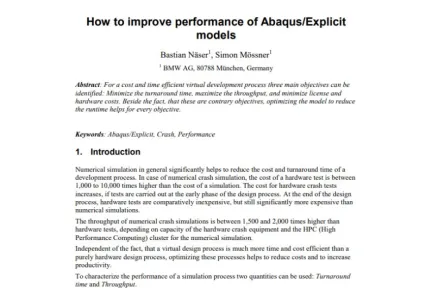
How to improve performance of Abaqus/Explicit models

For a cost and time efficient virtual development process three main objectives can be identified: Minimize the turnaround time, maximize the throughput, and minimize license and hardware costs. Beside the fact, that these are contrary objectives, optimizing the model to reduce the runtime helps for every objective.

Customer Papers

How to improve performance of Abaqus/Explicit models
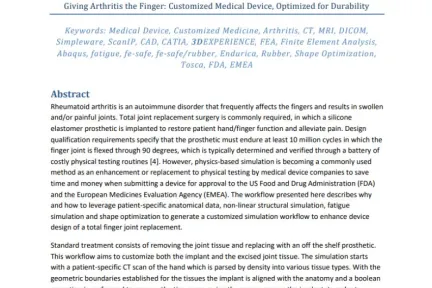
Giving Arthritis the Finger: Customized Medical Device, Optimized for Durability

Rheumatoid arthritis is an autoimmune disorder that frequently affects the fingers and results in swollen and/or painful joints. Total joint replacement surgery is commonly required, in which a silicone elastomer prosthetic is implanted to restore patient hand/finger function and alleviate pain. Design qualification requirements specify that the prosthetic must endure at least 10 million cycles in which the finger joint is flexed through 90 degrees, which is typically determined and verified through a battery of costly physical testing routines. However, physics-based simulation is becoming a commonly used method as an enhancement or replacement to physical testing by medical device companies to save time and money when submitting a device for approval to the US Food and Drug Administration (FDA) and the European Medicines Evaluation Agency (EMEA).

Customer Papers

Giving Arthritis the Finger: Customized Medical Device, Optimized for Durability
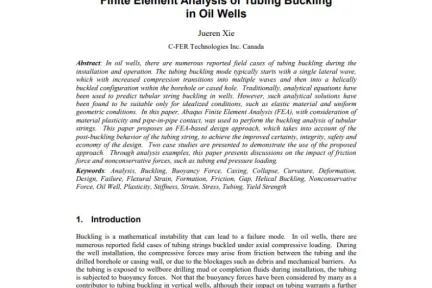
Finite Element Analysis of Tubing Buckling in Oil Wells

In oil wells, there are numerous reported field cases of tubing buckling during the installation and operation. The tubing buckling mode typically starts with a single lateral wave, which with increased compression transitions into multiple waves and then into a helically buckled configuration within the borehole or cased hole. In this paper, Abaqus Finite Element Analysis (FEA), with consideration of material plasticity and pipe-in-pipe contact, was used to perform the buckling analysis of tubular strings. This paper proposes an FEA-based design approach, which takes into account of the post-buckling behavior of the tubing string, to achieve the improved certainty, integrity, safety and economy of the design.

Customer Papers

Finite Element Analysis of Tubing Buckling in Oil Wells
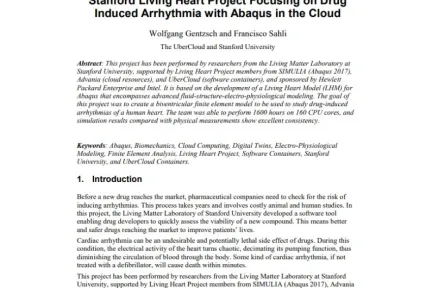
Stanford Living Heart Project Focusing on Drug Induced Arrhythmia with Abaqus in the Cloud

This project has been performed by researchers from the Living Matter Laboratory at Stanford University, supported by Living Heart Project members from SIMULIA (Abaqus 2017), Advania (cloud resources), and UberCloud (software containers), and sponsored by Hewlett Packard Enterprise and Intel. It is based on the development of a Living Heart Model (LHM) for Abaqus that encompasses advanced fluid-structure-electro-physiological modeling. The goal of this project was to create a biventricular finite element model to be used to study drug-induced arrhythmias of a human heart. The team was able to perform 1600 hours on 160 CPU cores, and simulation results compared with physical measurements show excellent consistency.

Customer Papers

Stanford Living Heart Project Focusing on Drug Induced Arrhythmia with Abaqus in the Cloud
Precise Calculation of Mesh Stiffness Fluctuation for Predicting Gear Noise

Nabtesco manufactures diverse configurations of reduction gears for varied applications in a wide range of industries worldwide. With changing markets demanding quieter operation, the perennial issue of noise generated by spur gears has become an even greater concern. Our traditional development strategy was designing gear shape modifications empirically and producing prototypes for testing. However, producing multiple gears and conducting noise evaluations is very cost and time intensive. We could not determine the exact effect various shape modifications would have on noise and why. While there are some longestablished methods for analyzing gearbox noise, these methods are not appropriate for predicting gear shapes as size differences among gear shape modifications are much smaller than parameters established for gearbox noise evaluation.

Customer Papers

Precise Calculation of Mesh Stiffness Fluctuation for Predicting Gear Noise
Effect of Tolerance Analysis in Simulations Using Finite Element Methods

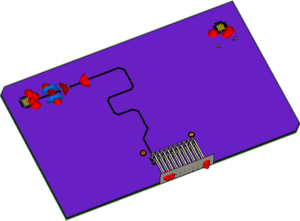
This paper explores the effects of tolerance analysis in finite element simulations. Simulations in bending, tension, and torsion were run for a beam. For each situation, 100 different simulations were run using slight variations in the dimensions and material properties of the beam. In doing so, the tolerances of these properties were captured; all were within two percent of the mean value. The computer-generated data for maximum stress and maximum deflection was compared to the theoretical values. The goal was to determine if Abaqus/CAE can capture variations in the maximum deflection and maximum stress. Probability density functions were generated to see if the data followed a normal distribution.

Customer Papers

Effect of Tolerance Analysis in Simulations Using Finite Element Methods
Virtual Human Model CASIMIR - A Chance and a Challenge for the Aetiology Understanding of Pressure Injury Development

The human body model CASIMIR was developed at the TU of Darmstadt [Buck 1997]. The goal was the risk evaluation of a possible lumbar spine degeneration due to vibrations exposed in working environments. Currently it is used by OEM and Tier-1 suppliers for the virtual analysis of static and dynamic seating comfort in passenger cars. Finally, a case study of an intensive care bed is presented showing the application of the simulation method with the human body model CASIMIR. In the study, relevant mechanical quantities for the risk evaluation of pressure injuries are analyzed for different bed designs. Further, a comparison to a real measurement procedure via motion capture is presented.

Customer Papers

Virtual Human Model CASIMIR - A Chance and a Challenge for the Aetiology Understanding of Pressure Injury Development
Simulation of Controlled Deflation, Folding and Inflation of Large-Scale Confined Inflatable Structures

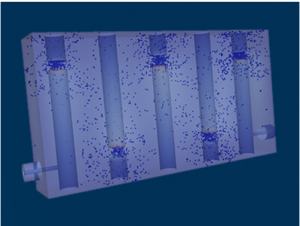
Transportation tunnels have been identified as particularly vulnerable to different threats such as propagation of toxic gases, or smoke originated by human activities, or flooding originated by extreme climatic events such as hurricanes and severe weather. The implementation of large-scale inflatable structures to plug specific locations of the tunnel system to minimize the consequences of the propagation of disastrous events is now possible. The finite element simulations presented in this work are focused on reproducing deflation, folding, and placement procedures for deployment and inflation of a largescale inflatable from the ceiling of a tunnel segment.

Customer Papers
Simulation of Controlled Deflation, Folding and Inflation of Large-Scale Confined Inflatable Structures
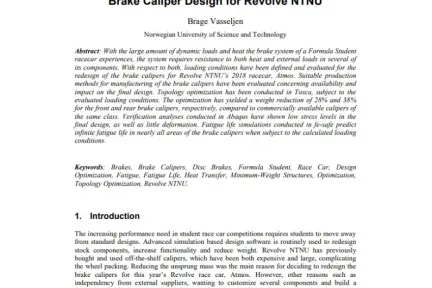
Brake Caliper Design for Revolve NTNU

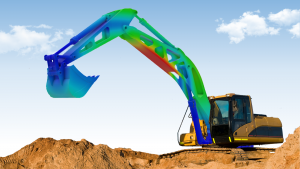
With the large amount of dynamic loads and heat the brake system of a Formula Student racecar experiences, the system requires resistance to both heat and external loads in several of its components. With respect to both, loading conditions have been defined and evaluated for the redesign of the brake calipers for Revolve NTNU’s 2018 racecar, Atmos. Suitable production methods for manufacturing of the brake calipers have been evaluated concerning availability and impact on the final design. Topology optimization has been conducted in Tosca, subject to the evaluated loading conditions. The optimization has yielded a weight reduction of 28% and 38% for the front and rear brake calipers, respectively, compared to commercially available calipers of the same class.

Customer Papers
Brake Caliper Design for Revolve NTNU
257 résultats

Témoignages clients

150 résultats
4 résultats

Auto-apprentissage SIMULIA

Nous proposons plusieurs centaines de modules d'auto-apprentissage pour que vous puissiez continuer à apprendre à votre rythme.

Blogs

Lisez le blog SIMULIA pour connaître les dernières actualités et innovations de nos experts.

703 résultats

Découvrir comment SIMULIA peut vous aider

Contactez un expert SIMULIA pour découvrir comment nos solutions permettent une collaboration transparente et une innovation durable dans des entreprises de toutes tailles.

Commencer

Des formations et des cours sont disponibles pour les étudiants, le monde académique, les professionnels et les sociétés. Trouvez la formation SIMULIA qui vous convient. 

Obtenir de l'aide

Obtenez des informations sur la certification des logiciels et du matériel, les téléchargements de logiciels, la documentation utilisateur, les coordonnées du support et l'offre de services.