Hay 1497 resultados
Off-highway Diesel Engines - Reducing Cost, Improving Quality and Shortening Development Cycles at Caterpillar using Advanced Virtual Validation

This presentation will demonstrate how Abaqus can be used to drive design decisions at an early stage in the engine development process. Caterpillar is committed to using virtual validation methods within its engine design and development process. This has several benefits, namely, reducing the cost of numerous design iterations, ensuring that designs are durable and fit for purpose and also compressing the time between concept and production. Caterpillar has employed virtual methods for over 35 years, using a mix of commercial FE software supported by internal codes. Abaqus has been used within Caterpillar from 1995 and since then has become the core FE code for engine analysis.

Customer Papers
Off-highway Diesel Engines - Reducing Cost, Improving Quality and Shortening Development Cycles at Caterpillar using Advanced Virtual Validation
Finite element simulation for the impact of Root Morphology on pulling-out process

The Finite Element Method (FEM) has been used in recent years to simulate various root anchorage effects. This study aims at using the FEM to demonstrate the impact of individual root models in anchorage process with consideration to different rooting patterns and to estimate the stress distribution in soil during the pulling out process. The FEM was used to carry out the 3D simulations of root pulling-out in unsaturated sandy silt soil. The anchorage model consists of a root system embedded in a soil block. Six root patterns were used and individual roots were removed to determine their contribution to anchorage

Customer Papers

Finite element simulation for the impact of Root Morphology on pulling-out process
Pipeline Dynamics with Flowing Contents in Abaqus/Standard

Increasing demand for the supply of oil and gas creates great challenges in the design of subsea pipelines. Pipelines that traverse a rough seabed terrain or lay over pipe supports may have large spans of up to several hundred metres where there is no contact between the pipeline and seabed. The behaviour of these is often investigated within Abaqus using dynamic analyses of models primarily constructed of pipe elements. Pipelines that transport multi phase flow potentially involve slugging issues. Slugging issues occur due to the variation of the content density of the pipe which can introduce changes in the loading and inertia of the pipeline giving rise to pipeline fatigue failure.

Customer Papers

Pipeline Dynamics with Flowing Contents in Abaqus/Standard
Numerical Simulation of Fluid-Structure Interaction in the Design Process for a New Axial Hydraulic Pump

With the help of numerical simulation a new high-pressure hydraulic axial pump has been developed at Gdansk University. The pump is used in different applications demanding high power, e.g. construction machinery or military applications. Its unique feature is the total independence of a pressure switching mechanism, which saves weight and provides the possibility to control the pump by computer. Prototypes have been built and tested, for example in lifting devices on ships in an extreme temperature environment. However, when the pressure changes from high to low via a commutative bushing harmful pressure peaks were observed.

Customer Papers

Numerical Simulation of Fluid-Structure Interaction in the Design Process for a New Axial Hydraulic Pump
TMF Lite Process Development

A simplified manifold transient thermal analysis method has been developed and used in engine design and validations. Traditionally full-blown manifold transient thermal analysis has been performed using CFD and it will take weeks for completion. In this simplified method, a user subroutine film.f is used to define the htc and gas temperature at manifold surfaces so that the transient thermal analysis can be performed in Abaqus quickly. The method is designed to reduce the simulation time significantly by sacrificing some accuracy. The simulation time has been reduced from weeks to days. It proved to be a good alternative to full scale CFD analysis when many design versions need to be compared at the early design stage.

Customer Papers

TMF Lite Process Development
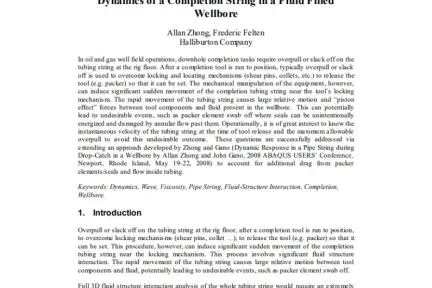
Dynamics of a Completion String in a Fluid Filled Wellbore

In oil and gas well field operations, downhole completion tasks require overpull or slack off on the tubing string at the rig floor. After a completion tool is run to position, typically overpull or slack off is used to overcome locking and locating mechanisms (shear pins, collets, etc.) to release the tool (e.g. packer) so that it can be set. The mechanical manipulation of the equipment, however, can induce significant sudden movement of the completion tubing string near the tool’s locking mechanis m. The rapid movement of the tubing string causes large relative motion and “piston effect” forces between tool components and fluid present in the wellbore.

Customer Papers

Dynamics of a Completion String in a Fluid Filled Wellbore
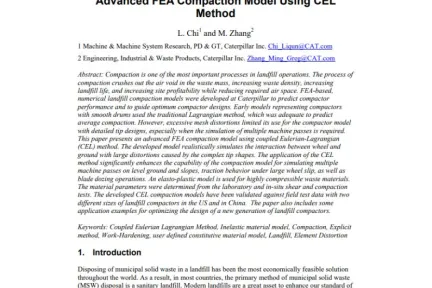
Advanced FEA Compaction Model Using CEL Method

Compaction is one of the most important processes in landfill operations. The process of compaction crushes out the air void in the waste mass, increasing waste density, increasing landfill life, and increasing site profitability while reducing required air space. FEA-based, numerical landfill compaction models were developed at Caterpillar to predict compactor performance and to guide optimum compactor designs. Early models representing compactors with smooth drums used the traditional Lagrangian method, which was adequate to predict average compaction. However, excessive mesh distortions limited its use for the compactor model with detailed tip designs, especially when the simulation of multiple machine passes is required.

Customer Papers

Advanced FEA Compaction Model Using CEL Method
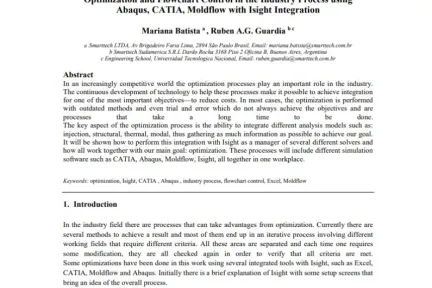
Optimization and Flowchart Control in the Industry Process using Abaqus, CATIA, Moldflow with Isight Integration

In an increasingly competitive world the optimization processes play an important role in the industry. The continuous development of technology to help these processes make it possible to achieve integration for one of the most important objectives—to reduce costs. In most cases, the optimization is performed with outdated methods and even trial and error which do not always achieve the objectives and are processes that take a long time to be done. The key aspect of the optimization process is the ability to integrate different analysis models such as: injection, structural, thermal, modal, thus gathering as much information as possible to achieve our goal.

Customer Papers

Optimization and Flowchart Control in the Industry Process using Abaqus, CATIA, Moldflow with Isight Integration
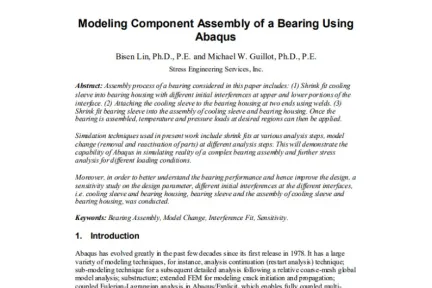
Modeling Component Assembly of a Bearing Using Abaqus

Assembly process of a bearing considered in this paper includes: Shrink fit cooling sleeve into bearing housing with different initial interferences at upper and lower portions of the interface. Attaching the cooling sleeve to the bearing housing at two ends using welds. Shrink fit bearing sleeve into the assembly of cooling sleeve and bearing housing. Once the bearing is assembled, temperature and pressure loads at desired regions can then be applied. Simulation techniques used in present work include shrink fits at various analysis steps, model change (removal and reactivation of parts) at different analysis steps. This will demonstrate the capability of Abaqus in simulating reality of a complex bearing assembly and further stress analysis for different loading conditions.

Customer Papers

Modeling Component Assembly of a Bearing Using Abaqus
Analysis of High Cycle Fatigue Cracks in the Welds of Large Diesel Engines

High cycle fatigue cracks may develop in large two stroke diesel engines used in ships and stationary power plants as the engines run at a constant cyclic loading for most of their lifetime. The dimension of the failed structure does in general exclude replacement and a repair solution is needed. The best repair solution can be found from a given quantity of solutions by relative comparison of calculated stress amplitudes and mean stress levels. The singular nature of the weld geometry does however complicate the absolute evaluation of the final welded design with the linear analysis giving unphysical high stress level at the welds. This paper demonstrates and discusses how a real case of fatigue crack growth in a large diesel engine can be analyzed by the use of the XFEM in Abaqus.

Customer Papers

Analysis of High Cycle Fatigue Cracks in the Welds of Large Diesel Engines
CAE-based Optimization Methodology for Stamping Process of Deep Drawn Automotive Component

Stamping process of deep drawn components involves consideration of various parameters such as material properties, blank holding pressures, punch velocity and their effect on forming quality parameters like wrinkling, tearing, spring-back etc. Simulation of stamping is a highly nonlinear phenomenon involving elastic-plastic material modeling and contact predictions. An Abaqus based stamping process template has been developed with an objective to achieve desired quality of deep-drawn components. This study demonstrates how to arrive at optimum values of forming process parameters viz. blank size and blank holding force. Stamping simulation of front side automotive panel made of high strength steel has been performed in Abaqus.

Customer Papers

CAE-based Optimization Methodology for Stamping Process of Deep Drawn Automotive Component
3-D Finite Element Analysis of Instrumented Indentation of Transversely Isotropic Materials

In this study finite element computations are conducted using Abaqus to simulate indentation of transversely isotropic materials. Indentation simulation is carried out both perpendicular and parallel to the plane of isotropy using a 70.3 degree cone half-angle indenter. Using dimensional analysis dimensionless functions are constructed to establish a frame of relations between the materials properties and the indentation parameters. The dimensionless functions are verified for their validity and robustness. Finally an analysis is carried out to determine the sensitivity of the relations to slight errors in input values.

Customer Papers

3-D Finite Element Analysis of Instrumented Indentation of Transversely Isotropic Materials
Hay 247 resultados

Testimonios de clientes

Hay 132 resultados
Hay 3 resultados

Autoaprendizaje de SIMULIA

Ofrecemos cientos de módulos de autoaprendizaje para que pueda seguir aprendiendo a su ritmo

Blogs

Lea el blog de SIMULIA sobre las últimas noticias e innovaciones de nuestros expertos.

Hay 696 resultados

Descubra lo que SIMULIA puede hacer por usted

Hable con un experto de SIMULIA para descubrir cómo nuestras soluciones permiten colaborar sin problemas e innovar de manera sostenible en organizaciones de todos los tamaños.

Póngase en marcha

Los cursos y las clases están disponibles para estudiantes, instituciones académicas, profesionales y empresas. Encuentre la formación de SIMULIA adecuada para usted. 

Obtener ayuda

Encuentre información sobre certificación de software y hardware, descargas de software, documentación del usuario, contacto con soporte y oferta de servicios