Hay 1497 resultados
Simulating blood flow in Living Heart Model

Being able to visualize blood flow in leaving heart helps to understand heart diseases and define strategy for surgical intervention. The ideal simulation should be performed on a specific patient heart model (individual geometry) to correctly asses the specific cardiac problem and predict possible treatment. In this paper two approaches is presented for simulating blood flow using numerical CFD approach: simulation based on the SIMULIA Living Heart FE Model and simulation based on dynamic 3D heart model obtained from a 3D MRI/MRT scanner. The CFD simulation is performed in both cases using FlowVision CFD code. Both approaches provide a better understanding of the blood flow during a cardiac cycle.

Customer Papers
Simulating blood flow in Living Heart Model
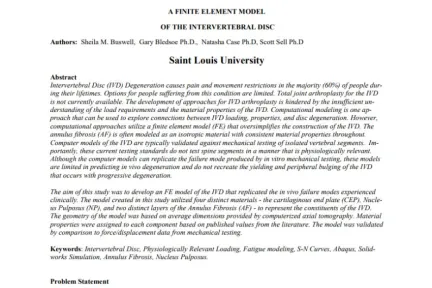
A FINITE ELEMENT MODEL OF THE INTERVERTEBRAL DISC

The aim of this study was to develop an FE model of the IVD that replicated the in vivo failure modes experienced clinically. The model created in this study utilized four distinct materials - the cartilaginous end plate (CEP), Nucleus Pulposus (NP), and two distinct layers of the Annulus Fibrosis (AF) - to represent the constituents of the IVD. The geometry of the model was based on average dimensions provided by computerized axial tomography. Material properties were assigned to each component based on published values from the literature. The model was validated by comparison to force/displacement data from mechanical testing.

Customer Papers

A FINITE ELEMENT MODEL OF THE INTERVERTEBRAL DISC
Stiffness Mapping in Biological Materials based on MRI Imaging and Topology Optimization

Magnetic resonance imaging (MRI) is a preeminent technology to visualize the internal tissue structure, in addition to other physical phenomena like flow and diffusion. One specialized MRI technique, termed displacements under applied loading by MRI (dualMRI), was developed to measure displacements and strain in musculoskeletal tissues, hydrogels, and engineered constructs. However, deformation information does not directly describe spatial distributions of tissue stiffness, which is critical to the understanding of disease progression. In this study, the inverse simulation was validated on displacements results derived from forward simulations where materials properties and boundary conditions were known.

Customer Papers

Stiffness Mapping in Biological Materials based on MRI Imaging and Topology Optimization
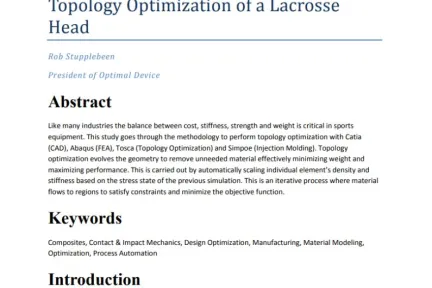
Topology Optimization of a Lacrosse Head

Like many industries the balance between cost, stiffness, strength and weight is critical in sports equipment. This study goes through the methodology to perform topology optimization with Catia (CAD), Abaqus (FEA), Tosca (Topology Optimization) and Simpoe (Injection Molding). Topology optimization evolves the geometry to remove unneeded material effectively minimizing weight and maximizing performance. This is carried out by automatically scaling individual element’s density and stiffness based on the stress state of the previous simulation. This is an iterative process where material flows to regions to satisfy constraints and minimize the objective function.

Customer Papers

Topology Optimization of a Lacrosse Head
A hyperelastic visco-elasto-plastic damage model for rubber materials

In designing a kinetic mechanism for modern complex structural members that include a rubber device, it is of technical importance to improve the accuracy of predicting the inelastic cyclic behavior of rubber materials. A simple term like “dynamic spring constant” is no longer adequate to describe advanced industrial applications. This paper describes our experimental investigations and numerical simulations of the dynamic characteristics of rubber materials. The experimental dynamic responses, with strain amplitude, temperature dependence, or frequency dependence, were provided by simple shear test specimens as well as by automotive rubber bushings

Customer Papers

A hyperelastic visco-elasto-plastic damage model for rubber materials
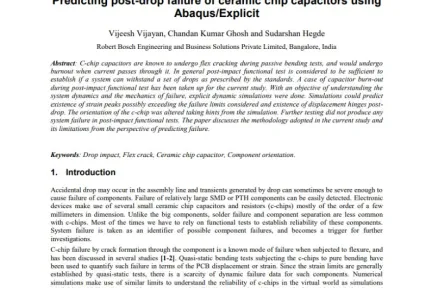
Predicting post-drop failure of ceramic chip capacitors using Abaqus/Explicit

C-chip capacitors are known to undergo flex cracking during passive bending tests, and would undergo burnout when current passes through it. In general post-impact functional test is considered to be sufficient to establish if a system can withstand a set of drops as prescribed by the standards. A case of capacitor burn-out during post-impact functional test has been taken up for the current study. With an objective of understanding the system dynamics and the mechanics of failure, explicit dynamic simulations were done. Simulations could predict existence of strain peaks possibly exceeding the failure limits considered and existence of displacement hinges postdrop. The orientation of the c-chip was altered taking hints from the simulation. Further testing did not produce any system failure in post-impact functional tests. The paper discusses the methodology adopted in the current study and its limitations from the perspective of predicting failure.

Customer Papers
Predicting post-drop failure of ceramic chip capacitors using Abaqus/Explicit
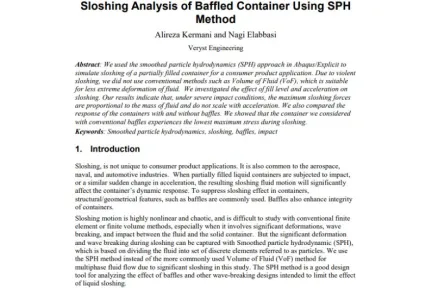
Sloshing Analysis of Baffled Container Using SPH Method

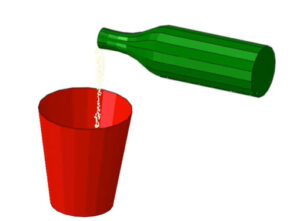
We used the smoothed particle hydrodynamics (SPH) approach in Abaqus/Explicit to simulate sloshing of a partially filled container for a consumer product application. Due to violent sloshing, we did not use conventional methods such as Volume of Fluid (VoF), which is suitable for less extreme deformation of fluid. We investigated the effect of fill level and acceleration on sloshing. Our results indicate that, under severe impact conditions, the maximum sloshing forces are proportional to the mass of fluid and do not scale with acceleration. We also compared the response of the containers with and without baffles. We showed that the container we considered with conventional baffles experiences the lowest maximum stress during sloshing.

Customer Papers

Sloshing Analysis of Baffled Container Using SPH Method
Virtual Modeling’s Role in Improving Impact Performance of Plastic Containers

The packaging industry is on the brink of process change—including manufacturing, materials and their applications. New concepts are being born via computer screens and virtually nurtured to create commercially-viable packages. This is taking place before ever touching the mold, creating an actual package or conducting a physical test. It’s important to understand various aspects of processing, material properties, package design, product characteristics, as well as specifications and performance parameters that need to be met.

Customer Papers

Virtual Modeling’s Role in Improving Impact Performance of Plastic Containers
Improving rubber tread designs against heat buildup under cyclic loading using strain energy

Heat generation in rubber is a complex phenomenon that occurs when a rubber component is being cyclically loaded. The development of this heat build-up comes from the viscoelastic nature of rubber compounds that occurs during the loading and unloading processes, and it is a difficult mechanism to quantify numerically. A lot of research on this particular and characteristic behavior of rubber has been done essentially since the invention of rubber. Over the course of the last decade or so, there have been numerous breakthroughs in the area of heat generation, and finite element codes are beginning to provide solutions to study this behavior. However, it is still a very complex parameter to measure and validate for practical purposes. As a result, an alternate way to devise a method to improve the designs of treads in our tracks against the development of heat build-up is to study the strain energy. The purpose of this research is to understand how we can use the strain energy generated under one full load cycle and utilize this to design a new and better generation of treads that can meet the constant increasing demands for performance in the world of rubber tracks.

Customer Papers

Improving rubber tread designs against heat buildup under cyclic loading using strain energy
A non linear model for studying the interface’s behavior bloc/mortar in a heritage building in Morocco and numerical modeling by Abaqus

This research work follows our first work presented in Simulia 2015 [1] about the modeling the mortarblock assembly for analyzing the potential occurrence of mechanical problems at interfaces as the consequence of an eventual incompatibility. The study considers a heritage building located in Morocco. In this recent study the authors test the effect of non linear behavior of materials and interface. An elastoplastic model including contact with friction and thermal conductivity is used. One concrete numerical example using Abaqus code will be treated and showed on this paper.

Customer Papers

A non linear model for studying the interface’s behavior bloc/mortar in a heritage building in Morocco and numerical modeling by Abaqus
Strength Analysis of Thermoplastic Containers Using Numerical Simulation

This study presents a numerical simulation strategy developed for strength analysis of thermoplastic containers. The method is based on the finite element analysis of both, the blowmolding process and the in-service loadings. The blow-molding analysis is performed to get the molded shape thickness distribution. The parison thickness and the coefficient of friction between the parison and the mold cavity are treated as parameters. They are varied until a good estimate of the thickness distribution is achieved. The thickness distribution obtained from the blowmolding analysis is then used in the subsequent loading analyses on the finished product.

Customer Papers

Strength Analysis of Thermoplastic Containers Using Numerical Simulation
Hay 247 resultados

Testimonios de clientes

Hay 132 resultados
Hay 3 resultados

Autoaprendizaje de SIMULIA

Ofrecemos cientos de módulos de autoaprendizaje para que pueda seguir aprendiendo a su ritmo

Blogs

Lea el blog de SIMULIA sobre las últimas noticias e innovaciones de nuestros expertos.

Hay 696 resultados
How do batteries work?

“Do people understand how batteries work? I don’t think so.” That’s the...

Article

How do batteries work?

Descubra lo que SIMULIA puede hacer por usted

Hable con un experto de SIMULIA para descubrir cómo nuestras soluciones permiten colaborar sin problemas e innovar de manera sostenible en organizaciones de todos los tamaños.

Póngase en marcha

Los cursos y las clases están disponibles para estudiantes, instituciones académicas, profesionales y empresas. Encuentre la formación de SIMULIA adecuada para usted. 

Obtener ayuda

Encuentre información sobre certificación de software y hardware, descargas de software, documentación del usuario, contacto con soporte y oferta de servicios