有 1506 个结果
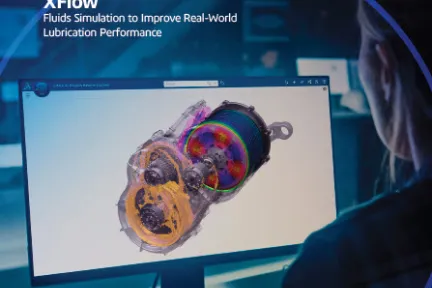
XFLOW Fluids Simulation to Improve Real-World Lubrication Performance

XFlow is a particle-based Lattice Boltzmann technology solver for high fidelity Computational Fluid Dynamics (CFD) applications as a part of SIMULIA’s Fluids Simulation portfolio. XFlow offers multiphase and moving parts modeling capabilities specially focused on lubrication workflows such as gearboxes and electric motor drives. Regardless of the system complexity, gear types or lubrication method, XFlow provides detailed insight into the system performance. Lubrication simulation can reduce the number of physical tests, reducing development times and costs. It also provides quantitative predictions for results like wetted area and churning losses that can be very difficult or impossible to measure experimentally.

Brochures
XFLOW Fluids Simulation to Improve Real-World Lubrication Performance
Identification of Ductile Damage Parameters

This paper describes the calibration process for uncoupled material model of ductile damage by Johnson-Cook and Rice-Tracey that is implemented in FE package Abaqus. As the work was supported by the grant “Identification of ductile damage parameters for nuclear facilities”, calibration was done for typical steel used in nuclear power plant industry. The project includes both design and realization of experiments, and application of experimental outputs in calibration process of material constants of mentioned ductile damage models. Calibration process of material model uses fifteen types of experimental specimens corresponding with literature. The result of the calibration process was verified through the comparison of FE simulation of each specimen with experimental response. As the material model describing ductile damage within the wide range of stress states was searched in this project, the model was tested on a several another specimens which exhibit higher stress concentration.

Customer Papers

Identification of Ductile Damage Parameters
Multi-GPU Computing with Abaqus: Benchmarking and scaling for multiphysics applications in mechatronics

Mechatronic systems encountered in the power and automation industries exhibit very complex behavior for a variety of applications. These problems require solutions derived from diverse physical phenomena, and hence are considered to be multiphysics problems. One such problem includes computing the coupled electromechanical response of electroactive polymer actuators. Due to the complex nature of the problem, obtaining the transient response of electroactive polymer actuator-enabled mechanical systems is a computationally expensive task. In this study, we investigate how multi-GPU acceleration using Abaqus/Standard 6.12 may improve the overall simulation speed.

Customer Papers

Multi-GPU Computing with Abaqus: Benchmarking and scaling for multiphysics applications in mechatronics
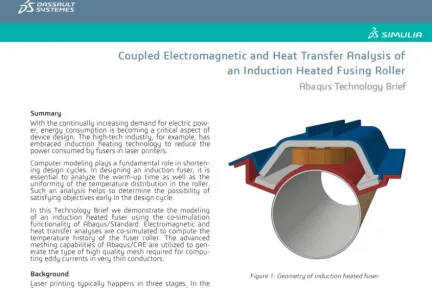
Coupled Electromagnetic and Heat Transfer Analysis of an Induction Heated Fusing Roller

In this Technology Brief we demonstrate the modeling of an introduction heated fuser using the co-simulation functionality of Abaqus/Standard. Electromagnetic and heat transfer analyses are co-simulated to compute the temperature history of the fuser roller. The advanced meshing capabilities of Abaqus/CAE are utilized to generate the type of high quality mesh required for computing eddy currents in very thin conductors.

Tech Notes

Coupled Electromagnetic and Heat Transfer Analysis of an Induction Heated Fusing Roller
Improved Quality Prediction of Injection Molded Fiber Reinforced Components by Considering Fiber Orientations

For fiber reinforced parts the consideration of anisotropic material behavior is required to receive reliable results. In the scope of this fact a procedure is described how to consider these effects in terms of process-structure interaction and how to achieve possible benefits such as weight reduction and shorter development cycles shown for examples of the industry . The developed procedures show how to consider the anisotropic mechanical behavior of injection molded short-fiber-reinforced plastics parts in FE analysis. It is shown how the existing information, which is provided by injection molding simulation software, can be processed and transferred into mechanical simulation models. The procedure is outlined with practical applications.

Customer Papers

Improved Quality Prediction of Injection Molded Fiber Reinforced Components by Considering Fiber Orientations
Structural Topology Optimization of Car Body Using ATOM

The weight reduction of components and systems is of utmost importance in the automotive industry. Reducing weight translates into higher performance and lower fuel consumption. In this paper, we suggest an optimization process for linear and nonlinear load cases of car body. In order to achieve this goal without sacrificing the current performance of selected model, we use Abaqus Topology Optimization Module (ATOM).

Customer Papers

Structural Topology Optimization of Car Body Using ATOM
Hot Rolling and Accelerated Cooling Simulations using ABAQUS – a Fertile Basis for Fast Online Algorithms in Heavy Steel Plate Production

Increasing customer requirements concerning product quality (e.g. dimensional tolerances, mechanical properties) in heavy steel plate production, require permanent enhancement of online control systems. Focusing on the main production steps “hot rolling” and “accelerated cooling“, the prediction of the local thermomechanical behavior applying physically based modeling techniques is of vital importance.

Customer Papers

Hot Rolling and Accelerated Cooling Simulations using ABAQUS – a Fertile Basis for Fast Online Algorithms in Heavy Steel Plate Production
Numerical Method for Laser Welding Simulation

Numerical methods using Abaqus to simulate welding processes have been available for several years. These methods typically are based on arc welding procedures where one is depositing a bead or beads and the interest is in the thermal/stress history in the local heat affected zone. The significant thermal cycle found during welding does introduce residual stress in the structure. This residual stress must either be managed with a post weld heat treatment or the welding process and variables must be adjusted to minimize residual stress.

Customer Papers

Numerical Method for Laser Welding Simulation
DOE Analysis for Internal Cooling Configuration of Gas Turbine Blade

Today manufacturing companies are more and more often characterized by a growing complexity of products and processes. Projects need the participation of teams that have to collaborate in a multidisciplinary and integrated way. The gas turbine blade design process is typically multidisciplinary where the variables of one discipline can strongly influence the results of other disciplines. For this reason it is important to have a single simulation process that can correlate the different I/O and allow an investigation of the entire Design Space, in order to verify even those solutions that are hardly predictable.

Customer Papers

DOE Analysis for Internal Cooling Configuration of Gas Turbine Blade
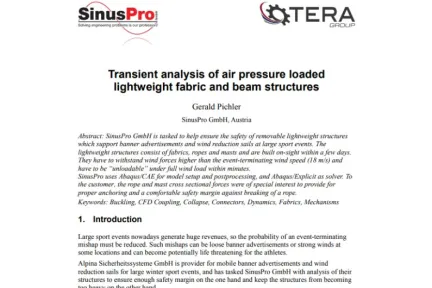
Transient analysis of air pressure loaded lightweight fabric and beam structures

SinusPro GmbH is tasked to help ensure the safety of removable lightweight structures which support banner advertisements and wind reduction sails at large sport events. The lightweight structures consist of fabrics, ropes and masts and are built on-sight within a few days. They have to withstand wind forces higher than the event-terminating wind speed (18 m/s) and have to be “unloadable” under full wind load within minutes. SinusPro uses Abaqus/CAE for model setup and postprocessing, and Abaqus/Explicit as solver. To the customer, the rope and mast cross sectional forces were of special interest to provide for proper anchoring and a comfortable safety margin against breaking of a rope.

Customer Papers

Transient analysis of air pressure loaded lightweight fabric and beam structures
Importance of Capturing Non-linear Viscoelastic Material Behavior in Tire Rolling Simulations

Tire engineers are always interested in predicting rolling resistance using a finite element analysis tool. Rolling resistance mainly depends on the viscoelastic energy dissipation of the rubber material used in the tires. Computation of viscoelastic energy dissipation with linear viscoelasticity approach for finite strains is inaccurate and remains a technical challenge so far. With the recent implementation of the Parallel Rheological Framework model (PRF) in Abaqus1,2 , a non-linear viscoelastic approach, the viscoelastic energy dissipation is computed more accurately than it was possible before. This paper provides a theoretical background of the linear and non-linear viscoelastic models available in Abaqus.

White Papers

Importance of Capturing Non-linear Viscoelastic Material Behavior in Tire Rolling Simulations
有 246 个结果

客户成功故事

有 150 个结果
有 6 个结果

SIMULIA 自学

我们提供数百个自学模块,以便您能够在方便的时间不断学习

博客

欢迎阅读 SIMULIA 博客,了解最新报道以及我们专家的最新创新。

有 694 个结果

了解 SIMULIA 可以为您做些什么

与 SIMULIA 专家交谈,了解我们的解决方案如何在各种规模的企业中实现无缝协作和可持续创新。

启动开发

课程面向学生、学术界、专业人士和企业开放。查找适合您的 SIMULIA 培训。

获得帮助

查找有关软硬件认证、软件下载、用户文档、支持联系人和服务项目的信息