WASP-NET’s CAD Features
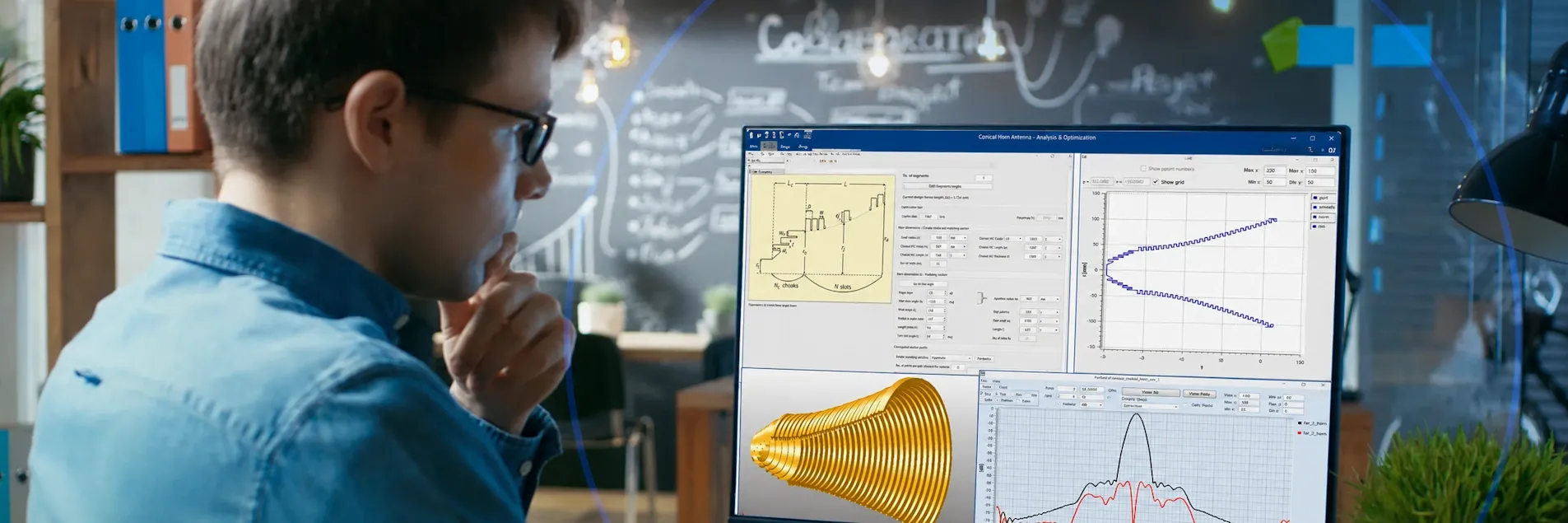
WASP-NET’s particular CAD strength is its efficient EM CAD solution for demanding waveguide and antenna design problems with tough specifications.
Accelerating RF, Microwave, mm-Wave Component, Antenna and Array Design
WASP-NET provides advanced fast full-wave EM CAD and optimization capabilities for RF, microwave, mm-wave component, antenna and array design workflows. From waveguiding components to reflector antennas, phased arrays, and integrated feed networks, WASP-NET combines high-speed electromagnetic (EM) simulation and fast optimization with full-wave precision to help engineers rapidly develop accurate, fabrication-ready RF, microwave, mm-wave, antenna and array components and systems.
The following selected examples provide a short overview.
Fast Full-Wave EM Level Optimization
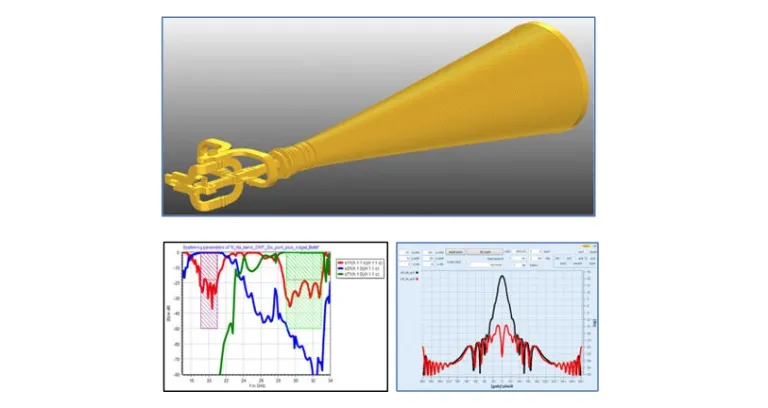
Due to its high efficiency, WASP-NET is particularly well appropriate for the fast direct optimization of waveguide, antenna and antenna array components to meet desired demanding specifications. Optimizations are carried out directly on accurate full-wave electro-magnetic (EM) level, and the high speed allows with high numbers of optimization iterations to exploit physical limits within reasonably short design times.
Three powerful optimizers, the self-learning evolution optimizer EVOPT, which is able to find the global minimum and to efficiently handle huge numbers (e.g. thousands) of optimization parameters, the robust direct search algorithm EXTREME, and POWELL, a gradient-based optimizer, in combination with the high computational speed of WASP-NET, enable users to master also highly demanding and complex optimization problems, that would take an unreasonably long time to solve using more conventional methods.
CAD of Waveguiding Components
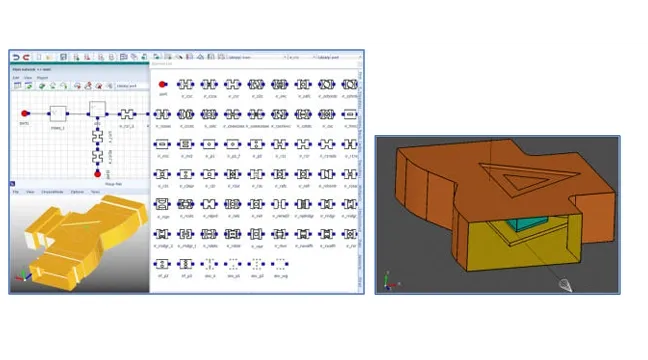
WASP-NET’s efficient full-wave design and optimization capabilities cover – in addition to antenna and antenna array structures - the entire class of waveguiding components, from standard waveguide structures with canonical and arbitrary cross-sections to mm-wave waveguiding structures, such as substrate integrated (SIW), micro-strip and gap waveguides. WASP-NET’s calculation speed for components that include structural waveguide element parts with standard or non-standard cross-sections, is particularly high, as these structural parts are calculated using the highly efficient quasi-analytical mode-matching (MM) method. Waveguide components can conveniently be composed in the user interface by selecting and combining via mouse click corresponding basic elements, such as steps, irises, junctions, transitions etc., from the element library. The library comprises ca. 400 often used fundamental elements. More general and special user-specific elements and structures, not available in the element library, can easily be set-up in form of multi-port black-box elements with parametrized geometry dimensions, and then be combined full-wave with library elements or with additional black-box elements.
CAD of Antennas including Feed-Networks
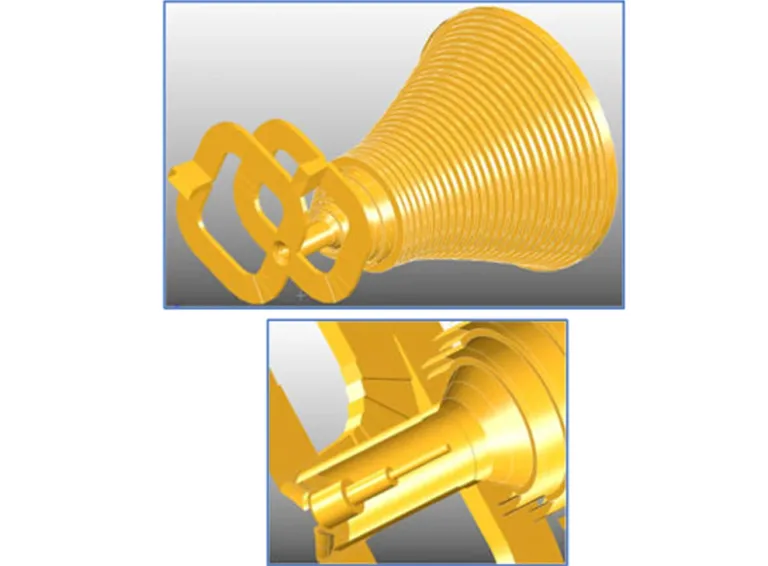
WASP-NET’s efficient full-wave design and optimization capabilities cover – in addition to waveguiding and array structures - the entire class of antennas, from wire antennas, corrugated horn antennas, to single and dual shaped reflector antennas, both body-of-revolution (BOR) and offset structures. Additionally, WASP-NET includes a powerful characteristic mode analysis (CMA) tool, which allows investigating fundamental radiation characteristics of antenna structures. Complete feed-networks, such as OMTs, polarizers, tapers, can directly and accurately be included in the antenna design, and the complete antenna system efficiently be optimized as a whole to meet final overall specifications. This special advanced design capability eliminates the traditional need for calculating antennas and feed-networks as separate parts (and often by separate tools), and avoids time-consuming data transfers. This saves development time and offers users the advantage of achieving optimal antenna performance by optimizing the entire assembly as a complete system. 9 For radiating structural parts, the accurate method-of-moments (MoM) with higher-order basis functions is applied, large structures and symmetries are taken into account by efficient tailored algorithms. On state-of-the-art standard PCs, the analysis and optimization speed for antenna structures (including feed networks) is typically in the range from a few seconds to several tens of seconds per frequency point. Many common antenna components can conveniently be designed by using WASP-NET’s user friendly wizards, or be selected directly as a template from WASP-NET’s comprehensive designer data base. Since the antennas are modeled via general multi-port black-box elements, such as define_bor (for BOR antennas), define_ant (for general antennas), and def_layered (for multilayer microstrip antennas), WASP-NET offers full antenna design flexibility.
CAD of Arrays including Feed-Networks
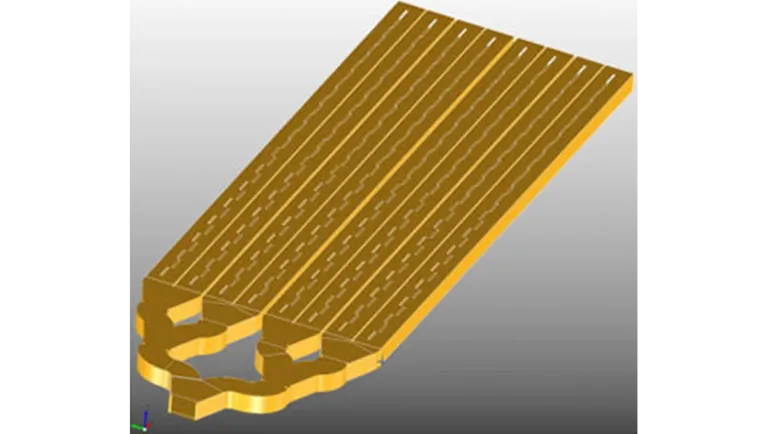
WASP-NET’s efficient full-wave design and optimization capabilities cover the entire class of common arrays: Waveguide slot-arrays (resonant, travelling, ridge, circular polarized, dual polarized, edge, SIW, gap), horn arrays, microstrip arrays (patch, multilayer, Vivaldi), wire antenna arrays, phased arrays, frequency selective structures (FSS), absorber arrays, and reflect-arrays. Due to WASP-NET’s full-wave generalized S-matrix combination of sub-circuits and elements, complete feed-networks can directly and accurately be included in the array design, and the complete antenna system efficiently be optimized as a whole to meet final overall specifications. Finite array sizes can accurately and efficiently be taken into account. Slot-arrays can conveniently be designed by using WASP-NET’s user-friendly slot-array wizard. Many array types can be selected directly as a template and be modified and optimized to special needs from WASP-NET’s comprehensive designer data base. For phased array design and optimization, WASP-NET offers a user-friendly array tool. Since the arrays are modeled via general multi-port black-box elements, which work with (by text or graphic editor) editable geometry input files, WASP-NET offers full flexibility for the design of practically all kind of arrays. For radiating structural parts, the accurate method-of-moments (MoM) with higher-order basis functions is applied, large structures and finite sizes are taken into account by efficient periodic boundary solutions and tailored algorithms, such as domain decomposition methods. On standard state-of-the-art PCs, the analysis and optimization speed for array structures (including feed networks) is typically in the range from a few tens of seconds to several hundreds of seconds per frequency point.
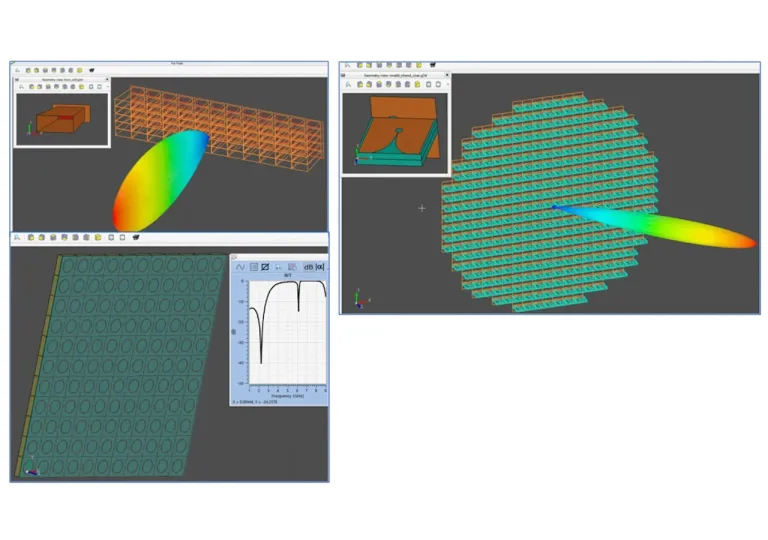
Array Tool: CAD of Phased Array
WASP-NET includes a powerful array tool for efficient design and optimization of phased arrays supporting both periodic and finite array structures for advanced phased array solutions.
Key Benefits
- User-friendly phased array design workflow
- Fast Floket based solver for large arrays
- Accurate finite array analysis and optimization using DDM FETI solvers
- Flexible unit-cell and topology editing
- High-speed EM optimization of geometry parameters, excitation amplitudes and phases
- Supports large scan angle performance optimization
Typical Applications
- Wire antenna (e.g. helix) arrays
- Patch arrays
- Horn arrays
- Vivaldi arrays
- Frequency selective surface (FSS) structures
- Absorber arrays
- Finite and periodic phased array systems
Also Discover
Hybrid Multi-Solver Domain Decomposition Electromagnetic CAD Technology

Simulation and Analysis of Electromagnetic Fields
Learn What SIMULIA Can Do for You
Speak with a SIMULIA expert to learn how our solutions enable seamless collaboration and sustainable innovation at organizations of every size.
Get Started
Courses and classes are available for students, academia, professionals and companies. Find the right SIMULIA training for you.
Get Help
Find information on software & hardware certification, software downloads, user documentation, support contact and services offering