1495개의 결과가 있습니다.
Projected contact area method and its application to rolling tire simulation

It is well known that the friction coefficient of rubber-like materials is a function of normal contact pressure, sliding velocity and temperature. In this reason, the exact calculation of normal contact pressure is very important when the rubber frictional forces are computed under a pressure dependent frictional model. Nevertheless, in many finite element codes including ABAQUS have been observed not to exactly calculate the nodal contact area and pressure at contact surface edges and corners. To overcome this problem, PCAM is proposed and implemented via ABAQUS user subroutine VFRIC

Customer Papers
Projected contact area method and its application to rolling tire simulation
X-FEM for Abaqus Toolkit for Automated Crack Onset and Growth Simulations

A software tool for automated crack onset and growth simulations based on the eXtended Finite Element Method (X-FEM) has been developed. For the first time, this tool is able to simulate arbitrary crack growth and composite delamination without remeshing. The automated tool is integrated with Abaqus/Standard and Abaqus/CAE via the customization interfaces. It seamlessly works with the Commercial, Off-The-Shelf (COTS) Abaqus suite. The levelset method coupled with X-FEM is used to enrich the displacement field with jump and asymptotic near-tip solutions and track the crack geometry as it grows. A penalty-based formulation is developed within the UEL framework to simulate crack closure and frictional contact.

Customer Papers

X-FEM for Abaqus Toolkit for Automated Crack Onset and Growth Simulations
Modeling the Creep Behavior of Torsional Springs

A finite element model is developed to investigate the instantaneous as well as long-term (time-dependant) structural response of a pre-loaded torsional spring. Torsional springs belong to a class of spiral springs that are commonly made out of Elgiloy - an alloy of Cobalt, Chromium, Nickel and Iron. Elgiloy has very high yield strength, and is commonly used as a spring material in clocks. The research involves development of a detailed component-level model, using Abaqus/Standard, to investigate the instantaneous static moment-rotation response, and the longterm stress relaxation response of the spring system, along with, understanding the sensitivity of this response on the various design parameters.

Customer Papers

Modeling the Creep Behavior of Torsional Springs
Load Transfer Analysis of SDS Wood Screw Connection in Multi-Ply Girder Trusses

ABAQUS/Explicit, combining with general contact, connector elements, distributedmemory processing (DMP), and digital signal processing (DSP) techniques, has a unique strength in solving some of the large quasi-static problems which involve large number of sliding contact pairs, highly nonlinear structural behavior. In this paper, a case is presented to show the successful application of ABAQUS/Explicit to solve the real-world problem in multi-ply girder truss load distribution testing. The model predicted ply-to-ply load transfer rates agree well with the test results. The calibrated model can be used for taking the place of some expensive lab tests, and it can be also used for evaluation of many design variations more efficiently.

Customer Papers

Load Transfer Analysis of SDS Wood Screw Connection in Multi-Ply Girder Trusses
Comprehensive Multiaxial Fatigue Analysis with ABAQUS

Many engine components in large medium-speed diesel engines are subject to cyclic loading. In many cases constant amplitude loading in the high-cycle range is assumed, hence it is customary to design for an infinite lifetime. Many engine components have a complex geometry, and that is why, particularly in locations of stress concentrations, a multiaxial stress state will prevail. It will be of utmost importance, already in the design stage, to make a rigorous fatigue damage evaluation on the results from the finite element analysis. For this purpose an in-house post-processing program has been written in the C++ programming language.

Customer Papers

Comprehensive Multiaxial Fatigue Analysis with ABAQUS
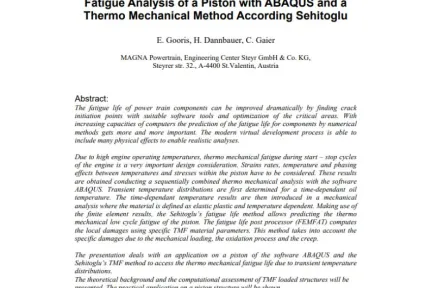
Fatigue Analysis of a Piston with ABAQUS and a Thermo Mechanical Method According Sehitoglu

The fatigue life of power train components can be improved dramatically by finding crack initiation points with suitable software tools and optimization of the critical areas. With increasing capacities of computers the prediction of the fatigue life for components by numerical methods gets more and more important. The modern virtual development process is able to include many physical effects to enable realistic analyses. The presentation deals with an application on a piston of the software ABAQUS and the Sehitoglu’s TMF method to access the thermo mechanical fatigue life due to transient temperature distributions.

Customer Papers

Fatigue Analysis of a Piston with ABAQUS and a Thermo Mechanical Method According Sehitoglu
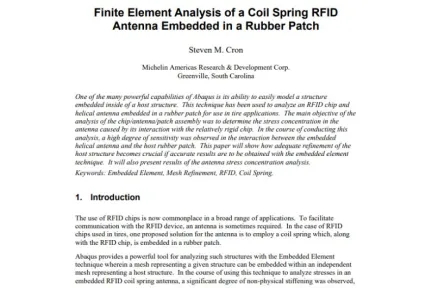
Finite Element Analysis of a Coil Spring RFID Antenna Embedded in a Rubber Patch

One of the many powerful capabilities of Abaqus is its ability to easily model a structure embedded inside of a host structure. This technique has been used to analyze an RFID chip and helical antenna embedded in a rubber patch for use in tire applications. The main objective of the analysis of the chip/antenna/patch assembly was to determine the stress concentration in the antenna caused by its interaction with the relatively rigid chip. In the course of conducting this analysis, a high degree of sensitivity was observed in the interaction between the embedded helical antenna and the host rubber patch. This paper will show how adequate refinement of the host structure becomes crucial if accurate results are to be obtained with the embedded element technique.

Customer Papers

Finite Element Analysis of a Coil Spring RFID Antenna Embedded in a Rubber Patch
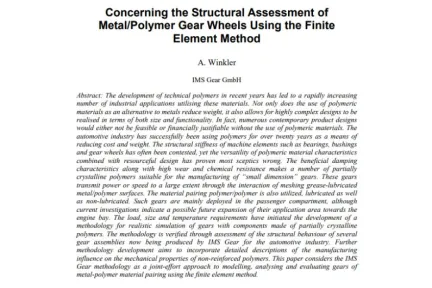
Concerning the Structural Assessment of MetalPolymer Gear Wheels Using the Finite Element Method

The development of technical polymers in recent years has led to a rapidly increasing number of industrial applications utilising these materials. Not only does the use of polymeric materials as an alternative to metals reduce weight, it also allows for highly complex designs to be realised in terms of both size and functionality. In fact, numerous contemporary product designs would either not be feasible or financially justifiable without the use of polymeric materials. The automotive industry has successfully been using polymers for over twenty years as a means of reducing cost and weight.

Customer Papers

Concerning the Structural Assessment of MetalPolymer Gear Wheels Using the Finite Element Method
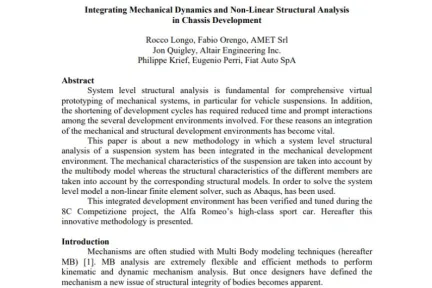
Integrating Mechanical Dynamics and Non-Linear Structural Analysis in Chassis Development

This paper is about a new methodology in which a system level structural analysis of a suspension system has been integrated in the mechanical development environment. The mechanical characteristics of the suspension are taken into account by the multibody model whereas the structural characteristics of the different members are taken into account by the corresponding structural models. In order to solve the system level model a non-linear finite element solver, such as Abaqus, has been used. This integrated development environment has been verified and tuned during the 8C Competizione project, the Alfa Romeo’s high-class sport car. Hereafter this innovative methodology is presented.

Customer Papers

Integrating Mechanical Dynamics and Non-Linear Structural Analysis in Chassis Development
On the Application of ABAQUS in The Validation Process of Crashworthiness of Railway Vehicles

New standards like prEN15227 and the TSI Highspeed prescribe the validation process for the crashworthiness of railway vehicles. Stadler Rail has introduced ABAQUS as explicit solver to simulate the design collision scenarios required: train against identical train at a closing speed of 36 km/h, train against 80-ton-freight wagon at a closing speed of 36 km/h, and train against a large deformable obstacle (representing a truck) at a closing speed of 110 km/h. The large deformable obstacle is defined in the standard by prescribing a load-deflection curve for the collision of a rigid sphere of a three-meter diameter against the obstacle. Suitable material laws in ABAQUS have enabled to achieve the required stiffness behavior for the deformable obstacle.

Customer Papers

On the Application of ABAQUS in The Validation Process of Crashworthiness of Railway Vehicles
Optimization Module for Abaqus/CAE based on Genetic Algorithm

Genetic algorithms have become one of successful tools in design and topology optimization. The optimization module based on genetic algorithms was developed and employed in Abaqus/CAE by GUI and kernel scripting. The new module extends advanced functionality of Abaqus/CAE allowing to perform optimization directly in Abaqus Unified FEA product suite from SIMULIA. Significant improvement in evolving into optimal solution can be achieved when genetic algorithms are combined with neural networks which one can train by running Abaqus jobs, and substantially improve the efficiency of computations. In the paper the shape optimization problem of a tooth implant will be presented and discussed in detail.

Customer Papers

Optimization Module for Abaqus/CAE based on Genetic Algorithm
Elastic-Plastic-Failure Finite Element Analyses of Railroad Tank Car Heads in Impact

This paper presents a computational framework that employs elastic-plastic-failure finite element analysis (FEA) tools to predict dynamic forces, deformations and puncture resistance of railroad tank car heads in impact events. First, computational sensitivity to analysis code, analysis type, element type, element size, through-the-thickness characteristics and element integration scheme is studied for elastic-plastic analyses. Second, the progressive damage and failure modeling for ductile metals is employed to estimate the puncture resistance of a tank car head.

Customer Papers

Elastic-Plastic-Failure Finite Element Analyses of Railroad Tank Car Heads in Impact
260개의 결과가 있습니다.

고객 사례

150개의 결과가 있습니다.
3개의 결과가 있습니다.

SIMULIA 자기 주도 학습

학습자가 편리하게 학습을 꾸준히 이어갈 수 있도록 수백 개의 자기 주도 학습 모듈을 제공합니다.

블로그

SIMULIA 블로그에서 당사 전문가들이 전하는 최신 뉴스와 혁신에 대해 알아보세요.

775개의 결과가 있습니다.

SIMULIA의 지원 서비스 알아보기

SIMULIA 전문가와 상담하여 당사의 솔루션이 모든 규모의 조직에서 원활한 협업과 지속 가능한 혁신을 실현하는 방법에 대해 알아보세요.

시작하기

학생, 교육, 전문가 및 회사를 위한 교육 과정과 강의가 제공됩니다. 당신에게 맞는 SIMULIA 교육을 찾아보세요. 

도움받기

소프트웨어 및 하드웨어 인증, 소프트웨어 다운로드, 사용자 설명서, 지원 연락처 및 서비스 제공에 대한 정보를 확인하세요.