1495개의 결과가 있습니다.
Link of injection molding simulation with FEM structure mechanical analysis

One major benefit of using a 3D injection molding simulation is the capability to simulate the fiber orientation and the anisotropic warpage, with the option, to transfer the material properties to structural mechanical analysis. With this option, it is possible to reduce the over dimensioning of fiber reinforced parts and thus resulting in substantial savings of mass, material and costs .This work will demonstrate the benefit of FEM combined with injection molding simulation but also the risks that can occur.

Customer Papers
Link of injection molding simulation with FEM structure mechanical analysis
Elastomer Analysis, a case study in element selection and mesh discretization

While nonlinear FEA of rubber or elastomer components is quite common today, there is still some uncertainty in modelling choices and representations. Material modelling choices, curve fitting from material test data, etc., have been discussed in many papers, but some fundamental issues of element selection and mesh discretization for nearly incompressible and fully incompressible materials are less discussed

Customer Papers

Elastomer Analysis, a case study in element selection and mesh discretization
A Gasket Element Representation of An Intumescent Mat Material

An intumescent mat is a very popular material for mounting a ceramic catalyst inside the steel can of an automotive catalytic converter. The major roles of this mat material in a converter are providing a tight seal between catalyst and can, and holding the catalyst without breakage during assemblage and operation stages. Choosing the right mat material is critical for the performance and durability of the catalytic converter. Numerical simulation of the mat material and catalytic converter system provides a good tool for evaluating the mat material performance, and the accurate material modeling is essential.

Customer Papers

A Gasket Element Representation of An Intumescent Mat Material
Application of Optimization Program IOSO NM and ABAQUS at Civil Structures of NPP

At the stage of NPP civil structure design for determination of stress-strain state (SSS) at static and dynamic loading ABAQUS is widely used. Hereto the floor response spectra are determined for calculation of loadings on the equipment at special dynamic impacts (seismic, air shock wave, aircraft crash). In case if the obtained characteristics of SSS or spectral accelerations exceed maximum permissible values, designers take actions on strengthening the corresponding structural components.

Customer Papers

Application of Optimization Program IOSO NM and ABAQUS at Civil Structures of NPP
Crashworthy design of a heavy 6-axle diesel locomotive

The main focus in this paper is on the simulation with ABAQUS/Explicit of the required crash scenarios with different obstacles. Especially the assembly of the full scale crash model will be discussed in greater detail. It consists of the carbody with all equipment, bogies with wheelsets and the coupling elements. Thereby extensive use was made from different connector elements available in ABAQUS. Also the external crash buffer elements with their energy absorbing characteristics were modelled by means of special connector behavior features. The contact between wheel and rail is also included. Before the actual crash the spring deflection of the primary and secondary suspension due to gravity is considered.

Customer Papers

Crashworthy design of a heavy 6-axle diesel locomotive
Numerical Simulation in the Design Process of Foam Seats for the Automotive Industry

This study is focused on the assessment of the application of numerical simulations done with ABAQUS in the development of car seat cushions made of polyurethane foam. First, mechanical simulations of simple tests were carried out using a hyperelastic constitutive model of ABAQUS in order to adjust its parameters with real test data. Then, a static indentation test, which reproduces the mechanical response of a seat under the load of a dummy occupant, was simulated. The indentation curve was validated with real test results in a first approach. Validation of the contact pressure field is still to be done.

Customer Papers

Numerical Simulation in the Design Process of Foam Seats for the Automotive Industry
Modeling Fluid Structure Interaction for Aerospace Applications

New approach for solving Fluid Structure Interaction in aerospace application is presented in this paper. The proposed approach is based on the two-way coupling between CFD code FlowVision and FEA code ABAQUS. The codes are coupled directly without using any 3rd party software or intermediate structure. A direct link offers a full control over the load transfer and interpolation error free data exchange between the codes. The direct link is implemented using special meshing techniques (submerged meshes in FlowVision). FE mesh is subtracted from the Cartesian CFD mesh; all links between CFD mesh cell and outside faces of the finite elements are preserved.

Customer Papers

Modeling Fluid Structure Interaction for Aerospace Applications
Failure analysis of adhesively bonded joints in crash simulations

Experimental evidence of certain adhesive materials reveals a hardening regime with a pronounced strength difference between tension, torsion or combined loading. The results for the stress-strain curves are strongly rate dependent. Additionally a softening regime is observed, also dependent on the stress state of tension, torsion or combined loading. For simulation of these phenomena a Perzyna type flow parameter is introduced, It is formulated on the basis of an overstress function dependent on the first and second basic invariants of the related effective stress tensor.

Customer Papers

Failure analysis of adhesively bonded joints in crash simulations
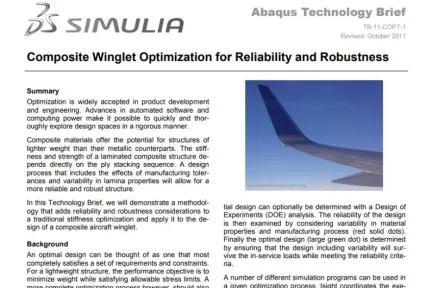
Composite Winglet Optimization for Reliability and Robustness

Optimization is widely accepted in product development and engineering. Advances in automated software and computing power make it possible to quickly and thoroughly explore design spaces in a rigorous manner. In this Technology Brief, we will demonstrate a methodology that adds reliability and robustness considerations to a traditional stiffness optimization and apply it to the design of a composite aircraft winglet.

Customer Papers

Composite Winglet Optimization for Reliability and Robustness
Advanced Material Modeling in a Virtual Biomechanical Knee

For clinicians and medical device manufacturers, in-vitro and in-vivo testing of the knee are important methods for evaluating treatment techniques. However, numerical models that can provide much of the same information will become of more service and are a new focus of the modeling community. A continued effort has centered on specimen-specific anatomical and functional models, in terms of both geometry and mechanical properties of the tissue constituents. Here, a specimen-specific model of the knee is presented that includes the femur, tibia, and four main ligaments. Solid models based on CT and MR scans of a human knee joint were meshed in Patran and assembled for solving in Abaqus 6.7-1.

Customer Papers

Advanced Material Modeling in a Virtual Biomechanical Knee
A Second-Invariant Extension of the Marlow Model: Representing Tension and Compression Data Exactly

The deviatoric response of the Marlow model in Abaqusis defined by test data from a single mode of deformation. For example, the model can be defined with uniaxial tension data or uniaxial compression data but not with both (except in very limited cases involving 1-D elements). The fact that the Marlow model depends only on the first strain invariant causes the limitation. This paper shows that the Marlow model in Abaqus is a special case of a hyperelastic potential function which involves the first and second strain invariants. The extended Marlow model is defined by uniaxial tension and equibiaxial tension data.

Customer Papers

A Second-Invariant Extension of the Marlow Model: Representing Tension and Compression Data Exactly
A Study of Transient Dynamics with Frictional Contact: Oblique Elastic Impact of Spheres

Oblique elastic impact of spheres and the related case for cylinders have been studied cases for many years in simulations of systems with loose supports, such as heat exchanger tubesupport interaction, as well as granular flows and robotic task modeling. The problem is a relative simple one in the class of transient frictional contact problems in that the stresses away from the contact zone are typically neglected. The available continuum model solutions from literature show some very interesting features. For near normal angles of incidence, these solutions combine a Hertzian contact stress solution in the normal direction with a partial-slip shear stress distribution in the tangential direction, in which a central portion of the contact zone is sticking while the coincident points of the outer annulus slide relative to one another.

Customer Papers

A Study of Transient Dynamics with Frictional Contact: Oblique Elastic Impact of Spheres
260개의 결과가 있습니다.

고객 사례

150개의 결과가 있습니다.
3개의 결과가 있습니다.

SIMULIA 자기 주도 학습

학습자가 편리하게 학습을 꾸준히 이어갈 수 있도록 수백 개의 자기 주도 학습 모듈을 제공합니다.

블로그

SIMULIA 블로그에서 당사 전문가들이 전하는 최신 뉴스와 혁신에 대해 알아보세요.

775개의 결과가 있습니다.

SIMULIA의 지원 서비스 알아보기

SIMULIA 전문가와 상담하여 당사의 솔루션이 모든 규모의 조직에서 원활한 협업과 지속 가능한 혁신을 실현하는 방법에 대해 알아보세요.

시작하기

학생, 교육, 전문가 및 회사를 위한 교육 과정과 강의가 제공됩니다. 당신에게 맞는 SIMULIA 교육을 찾아보세요. 

도움받기

소프트웨어 및 하드웨어 인증, 소프트웨어 다운로드, 사용자 설명서, 지원 연락처 및 서비스 제공에 대한 정보를 확인하세요.