1495개의 결과가 있습니다.
Validation Study for Flow over a Sphere using CEL Method in Abaqus

The study of fluid dynamics has evolved so much from mathematical modeling to numerical calculations. Recent advancement in numerical calculations introduced by Abaqus for fluid analysis is Coupled Eulerian-Lagrangian (CEL) method. The new method provides quicker solution for a Fluid-Solid Interaction (FSI) analysis. However, when a new method introduced, it is important for the users to know the accuracy, efficiency or even the limitation of the method. The objective of this study is to validate the famous flow over a sphere using CEL method in comparison to the experimental data.

Customer Papers
Validation Study for Flow over a Sphere using CEL Method in Abaqus
Effects of Subscale Size and Shape on Global Energy Dissipation in a Multiscale Model of a Fiberreinforced Composite Exhibiting Post-peak Strain Softening using Abaqus and FEAMAC

A mesh objective crack band model is implemented in the generalized method of cells (GMC) micromechanics model to predict failure of a composite repeating unit cell (RUC). The micromechanics calculations are achieved using the MAC/GMC core engine within the ImMAC suite of micromechanics codes, developed at the NASA Glenn Research Center. The microscale RUC is linked to a macroscale Abaqus/Standard finite element model using the FEAMAC multiscale framework (included in the ImMAC suite). The effects of the relationship between the characteristic length of the finite element and the size of the microscale RUC on the total energy dissipation of the multiscale model are investigated.

Customer Papers

Effects of Subscale Size and Shape on Global Energy Dissipation in a Multiscale Model of a Fiberreinforced Composite Exhibiting Post-peak Strain Softening using Abaqus and FEAMAC
Nonlinear Response of a Skin Panel Under Combined Thermal and Structural Loading

Future hypersonic vehicle will operate in an extreme environment, which includes extreme aerodynamic heating, fluctuating pressure and acoustic loading. Hypersonic vehicle must be reusable, lightweight and affordable in such environment. For hypersonic flight, the structure experiences complex aero-acoustic loads. The design of structure depends on the ability to predict response and life of structure in extreme environment. This paper presents a detailed investigation of the interactions and interplay among these parameters as evidenced by the nonlinear response of the panel.

Customer Papers

Nonlinear Response of a Skin Panel Under Combined Thermal and Structural Loading
Analysis of Crack Propagation in Polyurethane Panels Subject to Cyclic Compressive Buckling

When a panel of an elastomeric material, such as polyurethane, is subject to large cyclic in-plane displacements which result in cyclic compressive buckling, cracks will be observed to form at the center and edges of the panel. These cracks tend to propagate across the panel in the region of maximum deflection. If the magnitude of the applied cyclic deflection is held constant, the crack growth rate is observed to be nearly a constant over much of the width of the panel. This paper will present a method for evaluating the strain energy release rate in compressively flexed elastomeric panels and present results showing the influence of basic geometric parameters on the strain energy release rate.

Customer Papers

Analysis of Crack Propagation in Polyurethane Panels Subject to Cyclic Compressive Buckling
Mesh Human Phantoms with MCNP

Improvements in technology and computing have provided highly detailed representations of the human body for biomedical simulations. One specific application is the use of these computational phantoms for particle transport in MCNP, a general purpose particle transport code developed by Los Alamos National Laboratory (LANL). Traditional mathematical based phantoms, such as the ICRP 23 Reference Man, MIRD-5 Adult Male and the Snyder phantom, use equations to specify the surfaces and volumes of organs within the body. Image based models, such as the Visible Photographic Man (VIP-Man), Zubal model, and Extended cardiac-torso (XCAT), use segmented CT and MRI data to construct a three dimensional model of the body.

Customer Papers

Mesh Human Phantoms with MCNP
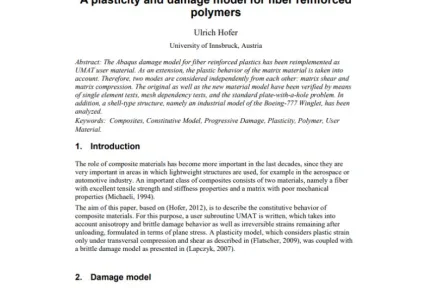
A plasticity and damage model for fiber reinforced polymers

The Abaqus damage model for fiber reinforced plastics has been reimplemented as UMAT user material. As an extension, the plastic behavior of the matrix material is taken into account. Therefore, two modes are considered independently from each other: matrix shear and matrix compression. The original as well as the new material model have been verified by means of single element tests, mesh dependency tests, and the standard plate-with-a-hole problem. In addition, a shell-type structure, namely an industrial model of the Boeing-777 Winglet, has been analyzed.

Customer Papers

A plasticity and damage model for fiber reinforced polymers
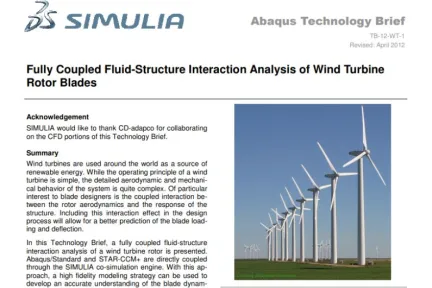
Fully Coupled Fluid-Structure Interaction Analysis of Wind Turbine Rotor Blades

In this Technology Brief, a fully coupled fluid-structure interaction analysis of a wind turbine rotor is presented. Abaqus/Standard and STAR-CCM+ are directly coupled through the SIMULIA co-simulation engine. With this approach, a high fidelity modeling strategy can be used to develop an accurate understanding of the blade dynamics.

Solution Briefs

Fully Coupled Fluid-Structure Interaction Analysis of Wind Turbine Rotor Blades
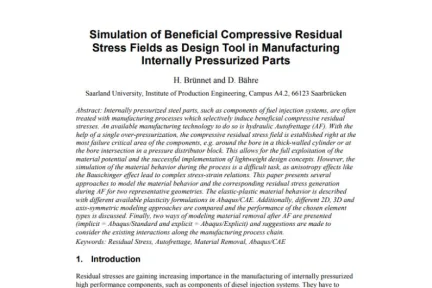
Simulation of Beneficial Compressive Residual Stress Fields as Design Tool in Manufacturing Internally Pressurized Parts

: Internally pressurized steel parts, such as components of fuel injection systems, are often treated with manufacturing processes which selectively induce beneficial compressive residual stresses. An available manufacturing technology to do so is hydraulic Autofrettage (AF). With the help of a single over-pressurization, the compressive residual stress field is established right at the most failure critical area of the components, e.g. around the bore in a thick-walled cylinder or at the bore intersection in a pressure distributor block. This allows for the full exploitation of the material potential and the successful implementation of lightweight design concepts. This paper presents several approaches to model the material behavior and the corresponding residual stress generation during AF for two representative geometries.

Customer Papers

Simulation of Beneficial Compressive Residual Stress Fields as Design Tool in Manufacturing Internally Pressurized Parts
Pirelli Formula 1 tyre modeling application with Abaqus

As the sole tyre supplier for Formula1 Championship, Pirelli Tyre provides the teams with a virtual tyre model to help simulate racing conditions. The highly sophisticated body shape of a F1 car is driven by aerodynamic efficiency and tyre deformation plays an important role in this context. Tyre shape prediction at speeds up 300kph has been achieved by using a combination of Abaqus/Standard and Abaqus/Explicit. The numerical results have been verified using indoor test bench results. Tyre shape is also the key factor for wind tunnel analysis. The same modeling technique has been applied to wind tunnel FE tyre model.

Customer Papers

Pirelli Formula 1 tyre modeling application with Abaqus
Integrated Tool for Strain Extraction in Virtual Testing

This paper presents an automated approach to extract strains of aircraft structural models from widely used CAD and FE environments. The developed approach has been implemented as an integrated tool in widely used CATIA V5 and Abaqus environments. The integrated tool eliminates tedious procedures involved in manual extraction of strains using FEA models at appropriate strain gage locations. This integrated tool is a quick, inexpensive and effective technique for predicting structural strains. This work uses Abaqus-Python, CATIA-VB and Visual Basic environment to develop integrated tool for identifying location, direction and strains in the strain gages present in an aircraft structure.

Customer Papers

Integrated Tool for Strain Extraction in Virtual Testing
Validation of VUEOS in Abaqus/Explicit and Application to Noble-Abel and Mie-Grüneisen Equations of State

In the release of Abaqus 6.13-1, SIMULIA is adding a new user subroutine capability in Explicit termed VUEOS. This capability allows the user to define a hydrodynamic material model in which the material's volumetric response is determined by a user-defined equation of state (EOS). The introduction of this capability gives the user the ability define an EOS based on a constitutive relationship involving pressure, energy, and density, where the pressure may have parameter fits or empirical data. In order to validate this new user subroutine framework, the U.S. Army – ARDEC developed three user EOS’s for comparison with analytical and published data.

Customer Papers

Validation of VUEOS in Abaqus/Explicit and Application to Noble-Abel and Mie-Grüneisen Equations of State
260개의 결과가 있습니다.

고객 사례

150개의 결과가 있습니다.
3개의 결과가 있습니다.

SIMULIA 자기 주도 학습

학습자가 편리하게 학습을 꾸준히 이어갈 수 있도록 수백 개의 자기 주도 학습 모듈을 제공합니다.

블로그

SIMULIA 블로그에서 당사 전문가들이 전하는 최신 뉴스와 혁신에 대해 알아보세요.

775개의 결과가 있습니다.

SIMULIA의 지원 서비스 알아보기

SIMULIA 전문가와 상담하여 당사의 솔루션이 모든 규모의 조직에서 원활한 협업과 지속 가능한 혁신을 실현하는 방법에 대해 알아보세요.

시작하기

학생, 교육, 전문가 및 회사를 위한 교육 과정과 강의가 제공됩니다. 당신에게 맞는 SIMULIA 교육을 찾아보세요. 

도움받기

소프트웨어 및 하드웨어 인증, 소프트웨어 다운로드, 사용자 설명서, 지원 연락처 및 서비스 제공에 대한 정보를 확인하세요.