1495개의 결과가 있습니다.
Large scale models for A350

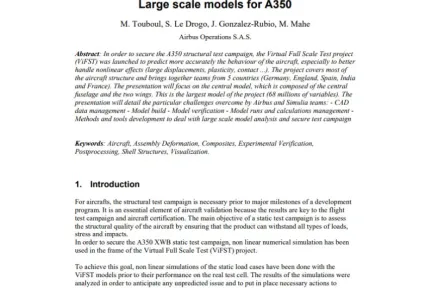
In order to secure the A350 structural test campaign, the Virtual Full Scale Test project (ViFST) was launched to predict more accurately the behaviour of the aircraft, especially to better handle nonlinear effects (large displacements, plasticity, contact ...). The project covers most of the aircraft structure and brings together teams from 5 countries (Germany, England, Spain, India and France). The presentation will focus on the central model, which is composed of the central fuselage and the two wings. This is the largest model of the project (68 millions of variables). The presentation will detail the particular challenges overcome by Airbus and Simulia teams.

Customer Papers
Large scale models for A350
Experience and lessons learnt from the SMART 2013 benchmark

The French CEA, together with EDF and the IAEA, recently organised an international benchmark to evaluate the ability to model the mechanical behaviour of a typical nuclear reinforced concrete structure subjected to seismic demands. The paper presents the conclusions of the pre-test exercise, as well as some observations from additional simulations conducted after the experimental results were made available.

Customer Papers

Experience and lessons learnt from the SMART 2013 benchmark
Simplified approaches for modelling a sealed and partly fluid filled container

Containers (bottles) made of polymers are exposed to manifold loads during their life cycle. They are open or sealed as well as empty or filled. Depending on the mentioned conditions a container behaves different under loading. This effect can be observed in everyday life. Imagine opening a shaken plastic bottle filled with a carbonated beverage. Abaqus provides simulation methods for completely filled containers with either a pneumatic or a hydraulic fluid. Real containers barely are totally filled with a hydraulic fluid. In general there is always a so called head space filled with gas (pneumatic fluid). This paper presents two methods for modelling the two-phase system (liquid and gas) inside a partly filled container using a fluid cavity instead of meshing the volume inside the container.

Customer Papers

Simplified approaches for modelling a sealed and partly fluid filled container
Validation of flow simulation on ABAQUS/CELTM

The main topic of the paper is to show the validation of the Coupled EulerianLagrangian (CEL) analysis technique applied to Newtonian fluid dynamics simulations described by an equation of state (EOS) suggested by Mie-Grüneisen. The model is driven only by body forces through cavity filling. This implementation allows to obtain free surfaces profile, splash droplet formation, velocity field, instantaneous pressure at the contact points between solid and fluid, as well as in solid parts, stresses and strains, all at the same time. The free surface validation obtained in the fluid is made through comparisons with radiographs obtained experimentally.

Customer Papers

Validation of flow simulation on ABAQUS/CELTM
An Approach Towards an Optimal Design of Composite Structures Using Abaqus as FE-solver

The present paper shows the development of an efficient, fast and reliable optimizer for composite and metallic parts of lightweight structures. The algorithm aims at identifying the optimal configuration of different structural parts concerning thickness, fibre orientation, number of plies, etc. This leads to mass savings and also a decrease of the development time in the structural dimensioning phase. Due to the limited applicability of classical optimization algorithms like gradient based or evolutionary methods in case of large Finite Element models with a high number of design variables, a novel approach is presented where the optimization problem is tackled by a heuristic adaption procedure on element level.

Customer Papers

An Approach Towards an Optimal Design of Composite Structures Using Abaqus as FE-solver
Higher Efficiency by Optimization

Higher Efficiency by Optimization - Integrating Simulation-based Structural Optimization into the Product Development Process

White Papers

Higher Efficiency by Optimization
Use of Abaqus Explicit for Composite Sandwich Damage Prediction during Bird Impact

A method development program of testing and simulations was carried out to develop bird impact NLFEA capabilities of composite sandwich damage prediction and bird dispersion after penetration of the primary layer using Abaqus Explicit. Curved composite honeycomb panels (referred to as J-Nose) representing typical composite wing Fixed Leading Edge (FLE) structure were subjected to bird strike to generate data for method validation. The test campaign was tailored to produce various levels of damage and modes of failure; from minor localized core/skin damage to panel perforation. In all tests high speed video were installed to capture the behavior of the structure during the impact.

Customer Papers

Use of Abaqus Explicit for Composite Sandwich Damage Prediction during Bird Impact
An Easy Procedure for Anisotropic Non-Linear Behavior of Short-Fiber-Reinforced Plastics

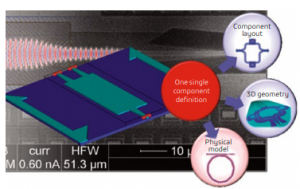
The developed procedures show how to consider the anisotropic mechanical behavior of injection molded short-fiber-reinforced plastics parts in FE analysis. It is shown how the existing information, which is provided by injection molding simulation software, can be processed and transferred into mechanical simulation models. The procedure is outlined with practical applications.

Customer Papers
An Easy Procedure for Anisotropic Non-Linear Behavior of Short-Fiber-Reinforced Plastics
Failure Analysis of CFRP Tubes with Integrated Rubber Layers Subjected to Transverse LowVelocity Impact Loading

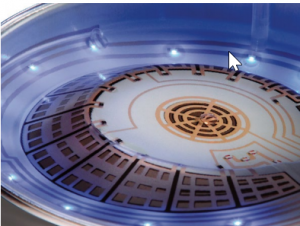
Among the numerous advantages of CFRP laminated structures there are some drawbacks, such as the high sensitivity in terms of impact loading. Particularly low-velocity impacts result in non-visible and barely-visible impact damage respectively. The threedimensional state of stress in the impact zone leads to matrix cracking and delamination inside the composite laminate and possibly to fibre failure for higher impact energies. It can be very difficult to detect such damage by visual inspection, and additionally, in most cases a significant reduction of strength and stiffness can be expected. To improve the damage tolerance a rubber layer, named KRAIBON , is integrated in the composite layup of cylindrical carbon/epoxy tubular specimens.

Customer Papers
Failure Analysis of CFRP Tubes with Integrated Rubber Layers Subjected to Transverse LowVelocity Impact Loading
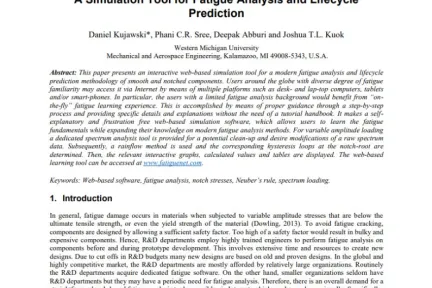
A Simulation Tool for Fatigue Analysis and Lifecycle Prediction

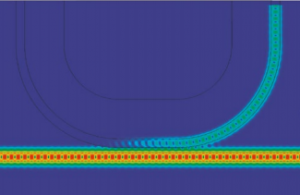
This paper presents an interactive web-based simulation tool for a modern fatigue analysis and lifecycle prediction methodology of smooth and notched components. Users around the globe with diverse degree of fatigue familiarity may access it via Internet by means of multiple platforms such as desk- and lap-top computers, tablets and/or smart-phones. In particular, the users with a limited fatigue analysis background would benefit from “onthe-fly” fatigue learning experience. This is accomplished by means of proper guidance through a step-by-step process and providing specific details and explanations without the need of a tutorial handbook.

Customer Papers
A Simulation Tool for Fatigue Analysis and Lifecycle Prediction
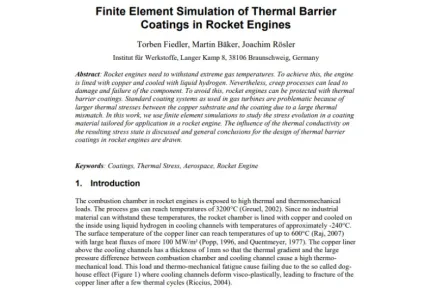
Finite Element Simulation of Thermal Barrier Coatings in Rocket Engines

Rocket engines need to withstand extreme gas temperatures. To achieve this, the engine is lined with copper and cooled with liquid hydrogen. Nevertheless, creep processes can lead to damage and failure of the component. To avoid this, rocket engines can be protected with thermal barrier coatings. Standard coating systems as used in gas turbines are problematic because of larger thermal stresses between the copper substrate and the coating due to a large thermal mismatch. In this work, we use finite element simulations to study the stress evolution in a coating material tailored for application in a rocket engine. The influence of the thermal conductivity on the resulting stress state is discussed and general conclusions for the design of thermal barrier coatings in rocket engines are drawn.

Customer Papers

Finite Element Simulation of Thermal Barrier Coatings in Rocket Engines
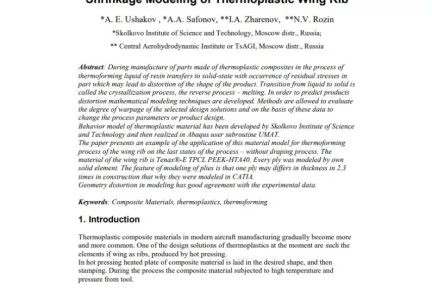
Shrinkage Modeling of Thermoplastic Wing Rib

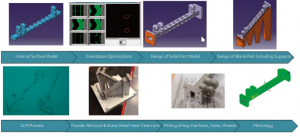
During manufacture of parts made of thermoplastic composites in the process of thermoforming liquid of resin transfers to solid-state with occurrence of residual stresses in part which may lead to distortion of the shape of the product. Transition from liquid to solid is called the crystallization process, the reverse process – melting. In order to predict products distortion mathematical modeling techniques are developed. Methods are allowed to evaluate the degree of warpage of the selected design solutions and on the basis of these data to change the process parameters or product design.

Customer Papers

Shrinkage Modeling of Thermoplastic Wing Rib
260개의 결과가 있습니다.

고객 사례

150개의 결과가 있습니다.
3개의 결과가 있습니다.

SIMULIA 자기 주도 학습

학습자가 편리하게 학습을 꾸준히 이어갈 수 있도록 수백 개의 자기 주도 학습 모듈을 제공합니다.

블로그

SIMULIA 블로그에서 당사 전문가들이 전하는 최신 뉴스와 혁신에 대해 알아보세요.

775개의 결과가 있습니다.

SIMULIA의 지원 서비스 알아보기

SIMULIA 전문가와 상담하여 당사의 솔루션이 모든 규모의 조직에서 원활한 협업과 지속 가능한 혁신을 실현하는 방법에 대해 알아보세요.

시작하기

학생, 교육, 전문가 및 회사를 위한 교육 과정과 강의가 제공됩니다. 당신에게 맞는 SIMULIA 교육을 찾아보세요. 

도움받기

소프트웨어 및 하드웨어 인증, 소프트웨어 다운로드, 사용자 설명서, 지원 연락처 및 서비스 제공에 대한 정보를 확인하세요.