1495개의 결과가 있습니다.
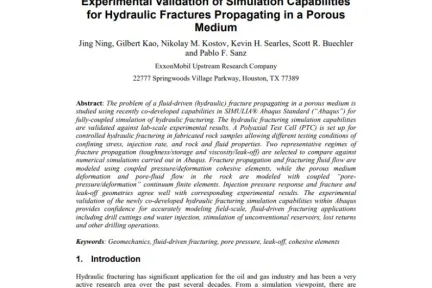
Experimental Validation of Simulation Capabilities for Hydraulic Fractures Propagating in a Porous Medium

The problem of a fluid-driven (hydraulic) fracture propagating in a porous medium is studied using recently co-developed capabilities in SIMULIA Abaqus Standard (“Abaqus”) for fully-coupled simulation of hydraulic fracturing. The hydraulic fracturing simulation capabilities are validated against lab-scale experimental results. A Polyaxial Test Cell (PTC) is set up for controlled hydraulic fracturing in fabricated rock samples allowing different testing conditions of confining stress, injection rate, and rock and fluid properties. Two representative regimes of fracture propagation (toughness/storage and viscosity/leak-off) are selected to compare against numerical simulations carried out in Abaqus.

Customer Papers
Experimental Validation of Simulation Capabilities for Hydraulic Fractures Propagating in a Porous Medium
A Numerical Investigation on the Bedding Resistance of Laterally Displaced Pipelines

The soil resistances in axial and lateral direction strongly affect the behavior of earthburied district heating pipes under variable operating temperatures. The state of knowledge regarding these resistance forces is summarized, and it is shown that almost no information exists regarding the cyclic effects on lateral soil resistances. However, for the safe design of a district heating network, the forces that soil can exert on the structure due to relative soil-pipe displacements are of particular interest. So, a numerical model has been developed, using the concept of hypoplasticity as an advanced constitutive model for noncohesive, granular materials.

Customer Papers
A Numerical Investigation on the Bedding Resistance of Laterally Displaced Pipelines
Use of FEA and Radial Basis Functions for Reliability-based Design and Assessment of Tubular Connection Sealability

One of the significant challenges in oil wells is to maintain adequate structural and sealing capacities of casing and tubing connections. In particular, unconventional wells, such as thermal and HPHT wells, require elevated standards to evaluate structural integrity and sealability of tubular connections. This paper presents a Reliability Based Design & Assessment (RBDA) methodology that characterizes system safety using a quantitative estimate of reliability. This paper also presents an FEA example of a generic premium connections to demonstrate the use of the proposed methodology.

Customer Papers
Use of FEA and Radial Basis Functions for Reliability-based Design and Assessment of Tubular Connection Sealability
The Virtual Composites Factory

The Virtual Factory (VF) can put composites manufacturing simulations in the hands of those who need them to invent new and innovative ways to capture the extraordinary benefits of these high performance products at an acceptable manufactured cost. “Crowd-sourcing” is the new way to drive innovation where contributions from organizations, large and small, are joined in the development of new products. The VF provides the user with simple browser access to powerful tools that simulate the actual steps and outcome conditions of a complex manufacturing process without the need to download and maintain software in the conventional manner. Learning to use uncertainty quantification (UQ) with manufacturing simulation tools will also be accomplished on the VF in order to allow for continuous learning and growth of the human talent required in composites manufacturing.

Customer Papers

The Virtual Composites Factory
High Velocity Perforation as a Benchmark Problem for Material Model Validation

High velocity perforation problem is taken as a benchmark to validate material plasticity and fracture models. 2024-T3(51) aluminum alloy is chosen as a reference material. Numerical simulations of a plate perforation using Johnson-Cook plasticity model with two sets of parameters, Johnson-Cook fracture criterion with one set of fitting parameters and pressure and Lode dependent ductile fracture criterion with three sets of material constants are performed into Abaqus/Explicit. Calibration of all the material constants is accomplished using results of quasistatic and high strain rate experiments.

Customer Papers

High Velocity Perforation as a Benchmark Problem for Material Model Validation
Modeling of Hyperelastic Water-Skipping Spheres using Abaqus/Explicit

This research seeks to model and elucidate the physics of water impact of elastomeric spheres, including the mechanisms by which severe deformations enable spheres to skip off the free water surface. The interplay between solid mechanics and fluid mechanics, or fluid-structure interaction, is extremely rich and complicated for this physical phenomenon. This research and knowledge could lead to exciting applications such as the novelty products from Waboba Inc. Numerical simulations are performed in Abaqus/Explicit of a highly-compliant elastomeric sphere impacting a free surface of water using a Coupled Euler-Lagrangian (CEL) approach.

Customer Papers

Modeling of Hyperelastic Water-Skipping Spheres using Abaqus/Explicit
Simulating Damage due to a Lightning Strike Event: Effects of Temperature Dependent Properties on Interlaminar Damage

A multidirectional, carbon fiber/epoxy, composite panel is subjected to a simulated lightning strike, within a finite element method framework, and the effect of material properties on the failure (delamination) response is investigated through a detailed numerical study. The numerical model of the composite panel consists of individual homogenized plies with userdefined, cohesive interface elements between them. Lightning strikes are simulated as an assumed combination of excessive heat and high pressure loadings. It is observed that the initiation and propagation of lightning-induced delamination is a significant function of the temperature dependency of interfacial fracture toughness.

Customer Papers

Simulating Damage due to a Lightning Strike Event: Effects of Temperature Dependent Properties on Interlaminar Damage
Advanced Fracture Modeling for Cuttings Re-injection

An environmentally friendly and cost-effective method for waste-disposal operations commonly used worldwide in the oil and gas industry is known as Cuttings Re-Injection (CRI). It consists of injecting drill cuttings into a suitable geological formation through one or more hydraulically-induced fractures. In this paper, some case studies assessing the risks associated with CRI are introduced using recently co-developed capabilities in Abaqus Standard for simulating fully-coupled hydraulic fracturing. Finite element models (FEM) are constructed using material properties and in situ stress state based on well log information. Furthermore, models are calibrated using data from actual field injection tests.

Customer Papers

Advanced Fracture Modeling for Cuttings Re-injection
Dynamic Hydraulic Fracture Modeling for Wellbore Integrity Prediction in a Porous Medium

We present a workflow for modeling dynamic growth of hydraulically induced fractures in a porous medium in the near-wellbore region. The focus is on the early time fracture growth behavior and the stress state near the wellbore as a result of it. The model is based on the Cohesive Zone Model (CZM) elements with pore pressure degrees of freedom, which were codeveloped with ExxonMobil Upstream Research Company and recently implemented into the Abaqus finite element package. In addition to including the physics of dynamic fracture growth and pore pressure diffusion, the model allows for fluid leak-off from the wellbore and fracture faces into the porous medium, as well as an arbitrary injection schedule.

Customer Papers

Dynamic Hydraulic Fracture Modeling for Wellbore Integrity Prediction in a Porous Medium
Optimization of Curved Fir-Tree Root of Steam Turbine Using Computer Aided Optimization and Finite Element Analysis

This paper is concerned with optimization of the design of a turbine blade curved fir-tree root and rim by integrating a knowledge of computer aided optimization (CAO) and finite element analysis (FEA). The optimization software Isight and FEA software Abaqus are applied in an effort to optimize the shape of the curved fir-tree root of a given turbine blade. Several critical geometrical features such as the radius of root centerline, (x, y) coordinate of center point of the centerline, and distances from blade center to leading and trailing edge of the platform, are taken as design variables and the maximum equivalent stress of root and rim as objective function.

Customer Papers

Optimization of Curved Fir-Tree Root of Steam Turbine Using Computer Aided Optimization and Finite Element Analysis
Process integration between CAD and CAE applications for Isight-based DOE analysis

Product development engineers often use simulation to evaluate the performance of a single design - a part or a system - characterized by a specific CAD representation, specific input data, and materials properties. This paper is focused on CAD and CAE workflow integration for the design of a Gas Turbine vane. The model of the complete process, implemented in the SEE-Fiper environment and involving all the calculation tools, is described.

Customer Papers

Process integration between CAD and CAE applications for Isight-based DOE analysis
Increasing the efficiency of offshore rigid pipeline lateral buckling assessments using a dedicated GUI and Isight

The design phase for offshore rigid pipelines can be lengthy and demanding. A significant number of engineering hours can be burned before the various analyses attain target results. The assessment of the lateral buckling phenomenon is one aspect of the pipeline design that requires numerous finite element simulations. The purpose of such simulations is to determine if the pipeline has a genuine tendency for lateral buckling and, if so, whether control of the buckling behavior is required to ensure that the pipeline stresses and strains are within allowable limits.

Customer Papers

Increasing the efficiency of offshore rigid pipeline lateral buckling assessments using a dedicated GUI and Isight
260개의 결과가 있습니다.

고객 사례

150개의 결과가 있습니다.
3개의 결과가 있습니다.

SIMULIA 자기 주도 학습

학습자가 편리하게 학습을 꾸준히 이어갈 수 있도록 수백 개의 자기 주도 학습 모듈을 제공합니다.

블로그

SIMULIA 블로그에서 당사 전문가들이 전하는 최신 뉴스와 혁신에 대해 알아보세요.

775개의 결과가 있습니다.

SIMULIA의 지원 서비스 알아보기

SIMULIA 전문가와 상담하여 당사의 솔루션이 모든 규모의 조직에서 원활한 협업과 지속 가능한 혁신을 실현하는 방법에 대해 알아보세요.

시작하기

학생, 교육, 전문가 및 회사를 위한 교육 과정과 강의가 제공됩니다. 당신에게 맞는 SIMULIA 교육을 찾아보세요. 

도움받기

소프트웨어 및 하드웨어 인증, 소프트웨어 다운로드, 사용자 설명서, 지원 연락처 및 서비스 제공에 대한 정보를 확인하세요.