1495개의 결과가 있습니다.
Analysis of Driven Pile Setup with AbaqusStandard

Pullout resistance of driven foundation piles often increases with time in a process known as pile “setup.” The consolidation of the surrounding soil after the pile is driven plays a dominant role in the setup process. Finite element modeling of pile setup can help in obtaining reliable estimates of the increase in pile resistance, which would allow for reductions in pile lengths, pile sections, or sizes of the pile driving equipment. The coupled pore fluid and stress analysis capabilities of Abaqus/Standard can be used for modeling the pile setup phenomenon and can help in estimating the increase in pile pullout resistance with time.

Solution Briefs
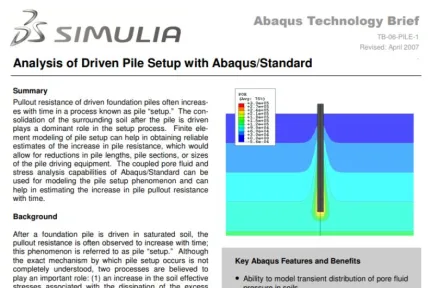
Analysis of Driven Pile Setup with AbaqusStandard
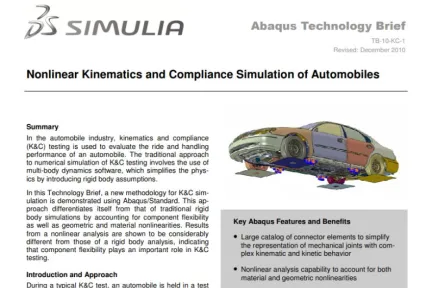
Nonlinear Kinematics and Compliance Simulation of Automobiles

In this Technology Brief, a new methodology for K&C simulation is demonstrated using Abaqus/Standard. This approach differentiates itself from that of traditional rigid body simulations by accounting for component flexibility as well as geometric and material nonlinearities. Results from a nonlinear analysis are shown to be considerably different from those of a rigid body analysis, indicating that component flexibility plays an important role in K&C testing.

Solution Briefs

Nonlinear Kinematics and Compliance Simulation of Automobiles
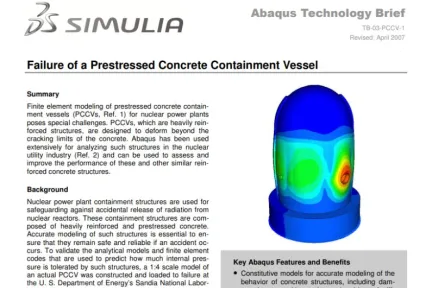
Failure of a Prestressed Concrete Containment Vessel

Finite element modeling of prestressed concrete containment vessels (PCCVs) for nuclear power plants poses special challenges. PCCVs, which are heavily reinforced structures, are designed to deform beyond the cracking limits of the concrete. Abaqus has been used extensively for analyzing such structures in the nuclear utility industry and can be used to assess and improve the performance of these and other similar reinforced concrete structures.

Solution Briefs

Failure of a Prestressed Concrete Containment Vessel
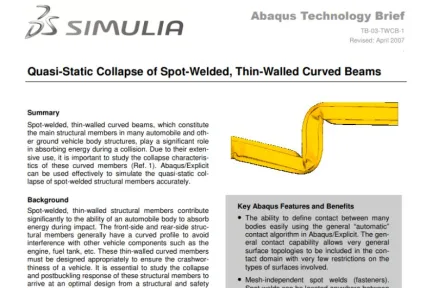
Quasi-Static Collapse of Spot-Welded, Thin-Walled Curved Beams

Spot-welded, thin-walled curved beams, which constitute the main structural members in many automobile and other ground vehicle body structures, play a significant role in absorbing energy during a collision. Due to their extensive use, it is important to study the collapse characteristics of these curved members. Abaqus/Explicit can be used effectively to simulate the quasi-static collapse of spot-welded structural members accurately.

Solution Briefs

Quasi-Static Collapse of Spot-Welded, Thin-Walled Curved Beams
XFEM Analyses of Critical Cracks in a Pressure Tap for a 40mm Gun Breech

Critical flaw size was estimated using the Extended Finite Element Method (XFEM) capabilities in the general purpose finite element program ABAQUS. Results suggest that the pressure loads were not high enough to initiate a crack or propagate cracks within the critical defect size limits of the breech for pressure loads currently used in test and evaluation. The results are consistent with the 150+ successful shots that have been completed and the 1000+ shots completed on a similar breech with similar pressure taps.

Customer Papers

XFEM Analyses of Critical Cracks in a Pressure Tap for a 40mm Gun Breech
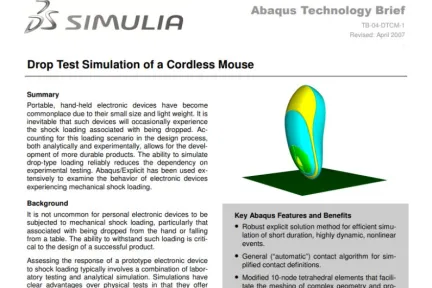
Drop Test Simulation of a Cordless Mouse

Portable, hand-held electronic devices have become commonplace due to their small size and light weight. It is inevitable that such devices will occasionally experience the shock loading associated with being dropped. Accounting for this loading scenario in the design process, both analytically and experimentally, allows for the development of more durable products. The ability to simulate drop-type loading reliably reduces the dependency on experimental testing. Abaqus/Explicit has been used extensively to examine the behavior of electronic devices experiencing mechanical shock loading.

Solution Briefs

Drop Test Simulation of a Cordless Mouse
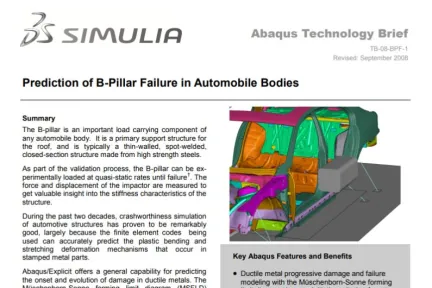
Prediction of B-Pillar Failure in Automobile Bodies

Abaqus/Explicit offers a general capability for predicting the onset and evolution of damage in ductile metals. The Müschenborn-Sonne forming limit diagram (MSFLD) damage initiation criterion allows for the prediction of necking instability in sheet metal. When combined with appropriate damage evolution criteria, sheet metal rupture initiated by necking can be captured in an Abaqus/ Explicit simulation. In this Technology Brief, the MSFLD criterion is employed to investigate the failure of a B-pillar structure. Abaqus/Explicit results are shown to match well with experimental data provided by BMW.

Solution Briefs

Prediction of B-Pillar Failure in Automobile Bodies
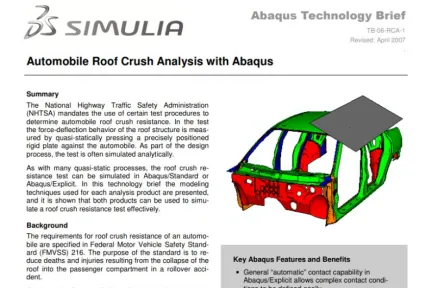
Automobile Roof Crush Analysis with Abaqus

As with many quasi-static processes, the roof crush resistance test can be simulated in Abaqus/Standard or Abaqus/Explicit. In this technology brief the modeling techniques used for each analysis product are presented, and it is shown that both products can be used to simulate a roof crush resistance test effectively.

Solution Briefs

Automobile Roof Crush Analysis with Abaqus
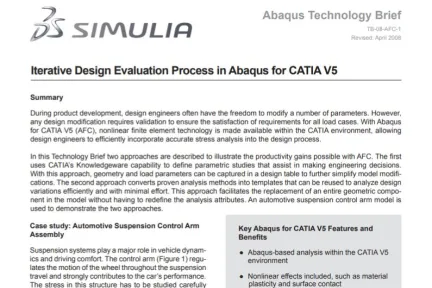
Iterative Design Evaluation Process in Abaqus for CATIA V5

In this Technology Brief two approaches are described to illustrate the productivity gains possible with AFC. The first uses CATIA’s Knowledgeware capability to define parametric studies that assist in making engineering decisions. With this approach, geometry and load parameters can be captured in a design table to further simplify model modifications. The second approach converts proven analysis methods into templates that can be reused to analyze design variations efficiently and with minimal effort.

Solution Briefs

Iterative Design Evaluation Process in Abaqus for CATIA V5
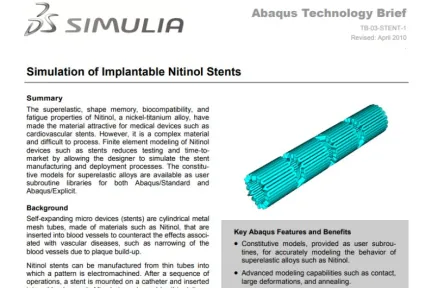
Simulation of Implantable Nitinol Stents

Self-expanding micro devices (stents) are cylindrical metal mesh tubes, made of materials such as Nitinol, that are inserted into blood vessels to counteract the effects associated with vascular diseases, such as narrowing of the blood vessels due to plaque build-up. Nitinol stents can be manufactured from thin tubes into which a pattern is electromachined. After a sequence of operations, a stent is mounted on a catheter and inserted into a blood vessel. After being released by this delivery system, the stent self-expands and exerts a radial force on the wall of the blood vessel.

Solution Briefs

Simulation of Implantable Nitinol Stents
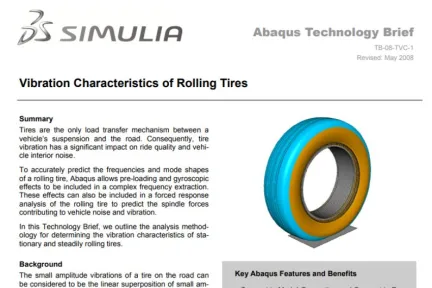
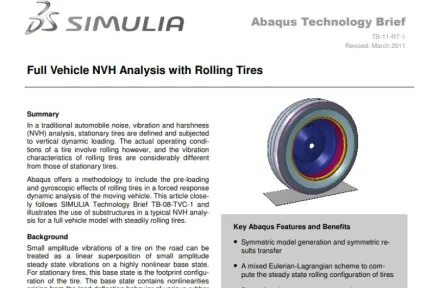
Full Vehicle NVH Analysis with Rolling Tires

Abaqus offers a methodology to include the pre-loading and gyroscopic effects of rolling tires in a forced response dynamic analysis of the moving vehicle. This article closely follows SIMULIA Technology Brief TB-08-TVC-1 and illustrates the use of substructures in a typical NVH analysis for a full vehicle model with steadily rolling tires.

Solution Briefs

Full Vehicle NVH Analysis with Rolling Tires
260개의 결과가 있습니다.

고객 사례

150개의 결과가 있습니다.
3개의 결과가 있습니다.

SIMULIA 자기 주도 학습

학습자가 편리하게 학습을 꾸준히 이어갈 수 있도록 수백 개의 자기 주도 학습 모듈을 제공합니다.

블로그

SIMULIA 블로그에서 당사 전문가들이 전하는 최신 뉴스와 혁신에 대해 알아보세요.

775개의 결과가 있습니다.

SIMULIA의 지원 서비스 알아보기

SIMULIA 전문가와 상담하여 당사의 솔루션이 모든 규모의 조직에서 원활한 협업과 지속 가능한 혁신을 실현하는 방법에 대해 알아보세요.

시작하기

학생, 교육, 전문가 및 회사를 위한 교육 과정과 강의가 제공됩니다. 당신에게 맞는 SIMULIA 교육을 찾아보세요. 

도움받기

소프트웨어 및 하드웨어 인증, 소프트웨어 다운로드, 사용자 설명서, 지원 연락처 및 서비스 제공에 대한 정보를 확인하세요.