



Addressing Complexity with MBSE in Shipbuilding: A Maritime Drone Use Case | Dassault Systèmes
Discover how Model-Based Systems Engineering (MBSE) is transforming shipbuilding, particularly in the development of autonomous vessels.
Engineer, validate and industrialize unmanned systems under one connected digital foundation.
Drone manufacturers (specifically unmanned systems (UxS) across air, land and sea) must move fast, but they also need to make the right decisions early. Every change in payload, propulsion, structure, electronics and communication equipment can affect mass, range, endurance, thermal behavior, cost and manufacturability. Getting these decisions wrong could extend time to market and affect product delivery to defense stakeholders.
For emerging industries, these technical decisions must often be made with limited resources and compressed development timelines. At the same time, the company must prepare to meet the expectations of customers, prime contractors and government organizations.
An initial prototype must therefore achieve more than just being a functional prototype. It must evolve into a controlled, traceable and optimized system that can integrate into a wider environment and be produced consistently at increasing volumes.
Dassault Systèmes connects requirements, engineering, simulation, validation, manufacturing and operations across this complete journey.
UxS companies do not all face the same priorities. Some are establishing their initial engineering concept, others are responding to formal defense requirements, while more mature programs must rapidly increase production.
The 3DEXPERIENCE® platform provides a scalable engineering and industrial foundation that supports each stage of unmanned systems development without forcing the organization to rebuild its processes and data environment as the program grows. It also follows the needs and evolution of specific programs, staying agile even during system deployments, financing rounds, factory commissioning and new customer agreements.
Create a controlled engineering foundation to integrate disciplines, manage design changes and prepare the program for future growth, while staying open to third party software.
Optimize and validate the system (within the context of a system of systems), keep requirements and support traceability to prepare for its integration into broader defense architectures.
Connect engineering and production to manage variant generation, follow operational feedback, and standardize processes to scale with consistent quality into a mass production cadence.
Discover how UxS manufacturers can move from an initial engineering concept to a traceable, integrated and production-ready capability.
Once an emerging UxS company has secured funding, identified a specific mission need or gap and started developing its first prototype, the immediate challenge is to integrate structures, propulsion, sensors, electronics, software and supplier components while the design continues to evolve. This is what's known as a multiphysics engineering model.
The objective here is to create a reliable engineering baseline which will become the same digital backbone later on. Requirements, product definitions, software, electronics and supplier information can be managed within a shared environment rather than distributed across disconnected files and individual tools.
As payloads, components and mission needs quickly evolve, structured change and configuration management can help teams understand the impact of each modification and maintain a controlled definition of every prototype or variant. Establishing digital continuity at this stage also ensures that the information created during early development can later support validation, qualification and manufacturing
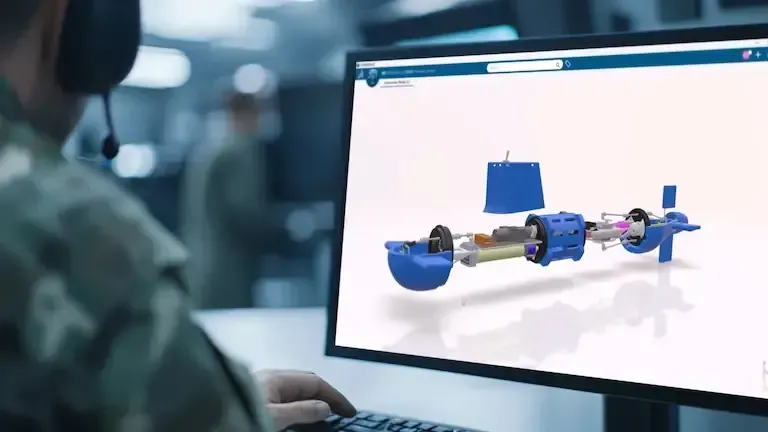
A functional prototype is not yet sufficient for a major customer, integrator or defense organization. The manufacturer must demonstrate that the system meets defense-defined requirements, performs as expected within a legacy system of systems and is interoperable within a broader architecture.
Model based systems engineering (MBSE) helps define the UxS architecture, interfaces, behaviors and interactions with command systems, sensors, other platforms and existing assets. This provides a clearer shared definition between the manufacturer, suppliers, integrators and customer.
At the same time, engineers must also optimize the complete system. Increasing endurance may affect battery mass and payload. Reducing structural weight can influence robustness. Antenna placement can affect communication performance, while power and thermal choices may impact electronics and embedded systems.
Multiphysics simulation and multidisciplinary design optimization (MDO) help teams evaluate interconnected design trade-offs earlier and focus physical testing on the most promising configurations. Virtual validation does not replace physical testing, but it helps teams focus prototypes and tests on the most promising configurations. Connecting virtual twin data with real operational data helps teams make the best decisions in record time.
Requirements, architecture decisions, simulations, changes and test/mission records should remain connected. This makes it easier to demonstrate how requirements are addressed and updates the relevant evidence when the design evolves. For a new program, it also shows a user or prime contractor that the program can be managed with the discipline expected of a larger industrial organization.

Unmanned systems (UxS) manufacturing brings new challenges. Once orders arrive, the focus shifts from demonstrating that one system works to ensuring that every system can be produced consistently.
UxS platforms may need to support different payloads, communication suites, propulsion options and customer-specific configurations. Managing these variants from a common product baseline allows teams to reuse validated elements rather than treating each configuration as a separate program.
Digital continuity, implemented at the earliest stages, connects the engineering definition with the manufacturing bills of materials, process plans, work instructions and quality information. This limits manual reinterpretation between engineering and production and helps preserve the validated product definition as volumes increase.
Virtual production planning, line simulation, automation and quality management can also help manufacturers prepare industrial processes before production accelerates and support greater consistency across suppliers or manufacturing sites. This will also help industries to design their new factories and optimize time to production with a supply chain connection.

Developing and scaling UxS rarely happen in isolation. As programs mature, manufacturers must work with suppliers, technology partners, integrators, defense organizations and end users while maintaining control of their product data and intellectual property.
Dassault Systèmes is an active participant in this innovation ecosystem, helping manufacturers build next-generation digital solutions for UxS capabilities. Through the 3DEXPERIENCE platform, startups, scaleups, dual-use companies, established industrial players and other stakeholders can work on a common digital foundation, reduce development risk and move from breakthrough ideas to operational reality.
Discover how Model-Based Systems Engineering (MBSE) is transforming shipbuilding, particularly in the development of autonomous vessels.
At i3 Corporations, creating hypersonic platforms or AI-assisted defense systems isn’t just engineering: it’s precision under pressure.
From design integration to supply chain resilience, discover how MBSE is reshaping manufacturing.





Win more business by transforming concept design process into a competitive advantage
Solution

Optimize manufacturing planning to accelerate ramp-up and enhance production agility
Solution