1503 résultats
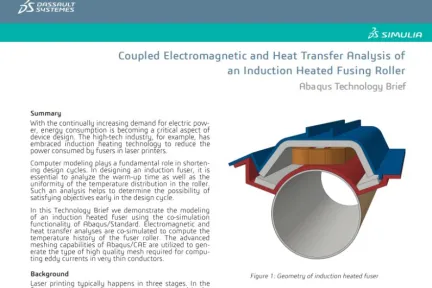
Coupled Electromagnetic and Heat Transfer Analysis of an Induction Heated Fusing Roller

In this Technology Brief we demonstrate the modeling of an introduction heated fuser using the co-simulation functionality of Abaqus/Standard. Electromagnetic and heat transfer analyses are co-simulated to compute the temperature history of the fuser roller. The advanced meshing capabilities of Abaqus/CAE are utilized to generate the type of high quality mesh required for computing eddy currents in very thin conductors.

Tech Notes
Coupled Electromagnetic and Heat Transfer Analysis of an Induction Heated Fusing Roller
Improved Quality Prediction of Injection Molded Fiber Reinforced Components by Considering Fiber Orientations

For fiber reinforced parts the consideration of anisotropic material behavior is required to receive reliable results. In the scope of this fact a procedure is described how to consider these effects in terms of process-structure interaction and how to achieve possible benefits such as weight reduction and shorter development cycles shown for examples of the industry . The developed procedures show how to consider the anisotropic mechanical behavior of injection molded short-fiber-reinforced plastics parts in FE analysis. It is shown how the existing information, which is provided by injection molding simulation software, can be processed and transferred into mechanical simulation models. The procedure is outlined with practical applications.

Customer Papers

Improved Quality Prediction of Injection Molded Fiber Reinforced Components by Considering Fiber Orientations
Structural Topology Optimization of Car Body Using ATOM

The weight reduction of components and systems is of utmost importance in the automotive industry. Reducing weight translates into higher performance and lower fuel consumption. In this paper, we suggest an optimization process for linear and nonlinear load cases of car body. In order to achieve this goal without sacrificing the current performance of selected model, we use Abaqus Topology Optimization Module (ATOM).

Customer Papers

Structural Topology Optimization of Car Body Using ATOM
Hot Rolling and Accelerated Cooling Simulations using ABAQUS – a Fertile Basis for Fast Online Algorithms in Heavy Steel Plate Production

Increasing customer requirements concerning product quality (e.g. dimensional tolerances, mechanical properties) in heavy steel plate production, require permanent enhancement of online control systems. Focusing on the main production steps “hot rolling” and “accelerated cooling“, the prediction of the local thermomechanical behavior applying physically based modeling techniques is of vital importance.

Customer Papers

Hot Rolling and Accelerated Cooling Simulations using ABAQUS – a Fertile Basis for Fast Online Algorithms in Heavy Steel Plate Production
Numerical Method for Laser Welding Simulation

Numerical methods using Abaqus to simulate welding processes have been available for several years. These methods typically are based on arc welding procedures where one is depositing a bead or beads and the interest is in the thermal/stress history in the local heat affected zone. The significant thermal cycle found during welding does introduce residual stress in the structure. This residual stress must either be managed with a post weld heat treatment or the welding process and variables must be adjusted to minimize residual stress.

Customer Papers

Numerical Method for Laser Welding Simulation
DOE Analysis for Internal Cooling Configuration of Gas Turbine Blade

Today manufacturing companies are more and more often characterized by a growing complexity of products and processes. Projects need the participation of teams that have to collaborate in a multidisciplinary and integrated way. The gas turbine blade design process is typically multidisciplinary where the variables of one discipline can strongly influence the results of other disciplines. For this reason it is important to have a single simulation process that can correlate the different I/O and allow an investigation of the entire Design Space, in order to verify even those solutions that are hardly predictable.

Customer Papers

DOE Analysis for Internal Cooling Configuration of Gas Turbine Blade
Transient analysis of air pressure loaded lightweight fabric and beam structures

SinusPro GmbH is tasked to help ensure the safety of removable lightweight structures which support banner advertisements and wind reduction sails at large sport events. The lightweight structures consist of fabrics, ropes and masts and are built on-sight within a few days. They have to withstand wind forces higher than the event-terminating wind speed (18 m/s) and have to be “unloadable” under full wind load within minutes. SinusPro uses Abaqus/CAE for model setup and postprocessing, and Abaqus/Explicit as solver. To the customer, the rope and mast cross sectional forces were of special interest to provide for proper anchoring and a comfortable safety margin against breaking of a rope.

Customer Papers

Transient analysis of air pressure loaded lightweight fabric and beam structures
Importance of Capturing Non-linear Viscoelastic Material Behavior in Tire Rolling Simulations

Tire engineers are always interested in predicting rolling resistance using a finite element analysis tool. Rolling resistance mainly depends on the viscoelastic energy dissipation of the rubber material used in the tires. Computation of viscoelastic energy dissipation with linear viscoelasticity approach for finite strains is inaccurate and remains a technical challenge so far. With the recent implementation of the Parallel Rheological Framework model (PRF) in Abaqus1,2 , a non-linear viscoelastic approach, the viscoelastic energy dissipation is computed more accurately than it was possible before. This paper provides a theoretical background of the linear and non-linear viscoelastic models available in Abaqus.

White Papers

Importance of Capturing Non-linear Viscoelastic Material Behavior in Tire Rolling Simulations
Collaborative Robust Engine Design Optimization

This paper describes some of the major contents of the set up and technical coupled simulations within an extended enterprise as developed during the European FP7 research project CRESCENDO (2009-2012). Focus is given on the execution of simulation processes (workflows) for collaborative engineering design tasks in the aeronautical industry towards the ability to perform optimization and robust design studies. Different types of simulation workflows will be explained, such as event or process driven under the aspects of low, medium or high frequency access and execution. An industrial example of the implementation of a high frequency process driven workflow in the extended enterprise shall give an impression of the developed workflow execution capabilities in the case of an aero engine design application.

Customer Papers

Collaborative Robust Engine Design Optimization
Evaluate Medical Device Design Robustness by Combining Statistical and Probabilistic Tools with Finite Element Analysis

Finite Element Analysis (FEA) has been widely used to analyze the in vivo structural response of implantable medical devices and assess device performance, reliability and durability. Take stents for example. Several characteristics like radial force, peak stresses and strains and fatigue safety factors can be determined using these modeling techniques. As all physical phenomena are stochastic, all design parameters have built-in variability. On the other hand, stents are typically modeled with nominal dimensions and material properties. Minimum and maximum dimensions are used in certain instances, while other dimensional variances are often not considered. In addition, the in vivo boundary conditions also vary widely across patient population.

Customer Papers

Evaluate Medical Device Design Robustness by Combining Statistical and Probabilistic Tools with Finite Element Analysis
Damage Assessment of Casting Materials in High Temperature Applications Influenced by Varying Plasticity Models

The turbine housing of an exhaust turbocharger is exposed to extensive cyclic thermomechanical loading. Consequently, the design of the turbine housing becomes a major challenge in ensuring the guaranteed lifetime in relation to the high-temperature behavior of the materials. In a first step, a phenomenological lifetime approach together with a rate-independent constitutive plasticity model of Chaboche-type was developed and validated for application on casting materials. The present study deals with the more detailed analysis of rate-dependent plasticity applied in the finite-element analysis with respect to the subsequent creep-fatigue damage calculation procedure.

Customer Papers

Damage Assessment of Casting Materials in High Temperature Applications Influenced by Varying Plasticity Models
257 résultats

Témoignages clients

150 résultats
4 résultats

Auto-apprentissage SIMULIA

Nous proposons plusieurs centaines de modules d'auto-apprentissage pour que vous puissiez continuer à apprendre à votre rythme.

Blogs

Lisez le blog SIMULIA pour connaître les dernières actualités et innovations de nos experts.

703 résultats

Découvrir comment SIMULIA peut vous aider

Contactez un expert SIMULIA pour découvrir comment nos solutions permettent une collaboration transparente et une innovation durable dans des entreprises de toutes tailles.

Commencer

Des formations et des cours sont disponibles pour les étudiants, le monde académique, les professionnels et les sociétés. Trouvez la formation SIMULIA qui vous convient. 

Obtenir de l'aide

Obtenez des informations sur la certification des logiciels et du matériel, les téléchargements de logiciels, la documentation utilisateur, les coordonnées du support et l'offre de services.