1503 résultats
Automated design processes with Isight and their requirements regarding modification of CADmodels

One of the capabilities of Isight is to create processes to involve and control external programmes. Therefore it’s possible to embed several commercial and in-house tools and combine them with each other. In this way processes can be generated which contain different disciplines and working focuses. They can support the search for designs which solve given issues, saving time and finding better designs (compared to manual iteration between disciplines).

Customer Papers
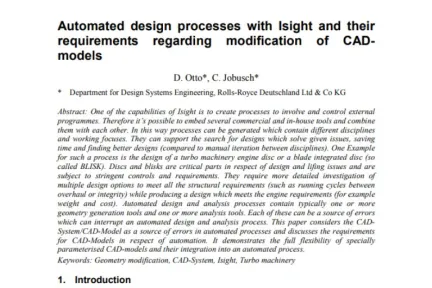
Automated design processes with Isight and their requirements regarding modification of CADmodels
Stresses in armour layers of flexible pipes: comparison of Abaqus models

The accurate modeling of offshore flexible risers behaviour remains a great challenge because of their complex internal structure, the variable nature of the loads along the pipe, and the interactions with structures used to limit the pipe curvature. Technip and IFP Energies Nouvelles have been codeveloping for many years models dedicated to stresses calculation in the armour wires, to assess the flexible lifetime. These models must account for a large number of potential inner contacts as well as external contacts. This paper presents implicit and explicit Abaqus simulations of a cyclic bending test of a flexible pipe with internal pressure and tension. The simulation results are successfully compared to experimental data.

Customer Papers

Stresses in armour layers of flexible pipes: comparison of Abaqus models
FEA Modelling of Stress Distributions in Concrete Test Specimens Compressed through Rubber Sheets

An FE study of the behaviour of concrete blocks compressed against rubber sheets was conducted. The results were compared to experimental tests of the same assembly reported in the literature. It was found that tensile stresses developed within the concrete due to non-uniform compression of the rubber and were likely to have been the cause of failure of the concrete except where the rubber sheet was very thin or absent. The effect disappeared if contact between the rubber and concrete was frictionless.

Customer Papers

FEA Modelling of Stress Distributions in Concrete Test Specimens Compressed through Rubber Sheets
Transition of Plastic Collapse to Elastic Collapse

In this paper, two issues are addressed. First, for given material (fixed Young’s modulus), what is the transition point (D/t) for plastic (yield strength) collapse to elastic collapse? How does the transition point change with the yield strength? A pipe with a thin section of length L is supported by thicker sections at both ends. It is known that the thin section with a large D/t, the shorter the L, the higher the collapse pressure. The question is how short (L/D) must the pipe be to prevent elastic collapse, or in other words, for a given D/t, what is the transition point (L/D)? The transition curves obtained provide useful guidelines for tubular product design and testing when collapse is a concern.

Customer Papers

Transition of Plastic Collapse to Elastic Collapse
Simulation of Peen Forming Process of Aluminum Aeronautic Panel

The shot peen forming is a cold work deformation process consisting of treating the surface of a work piece with a stream of round shots (usually made of steel) with high enough energy to deform plastically the surface. This plastic deformation causes compressive residual stresses under the surface that are able to create a curvature on the component. This process is increasingly being used to create smooth curvatures in large pieces, for example, in the manufacturing of aerodynamic panels in the aeronautic sector.

Customer Papers

Simulation of Peen Forming Process of Aluminum Aeronautic Panel
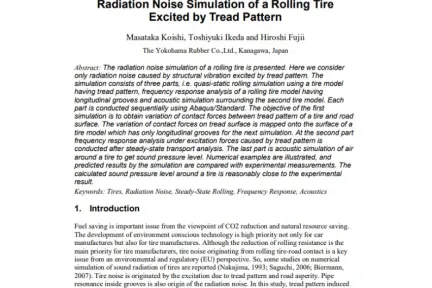
Radiation Noise Simulation of a Rolling Tire Excited by Tread Pattern

The radiation noise simulation of a rolling tire is presented. Here we consider only radiation noise caused by structural vibration excited by tread pattern. The simulation consists of three parts, i.e. quasi-static rolling simulation using a tire model having tread pattern, frequency response analysis of a rolling tire model having longitudinal grooves and acoustic simulation surrounding the second tire model. Each part is conducted sequentially using Abaqus/Standard.

Customer Papers

Radiation Noise Simulation of a Rolling Tire Excited by Tread Pattern
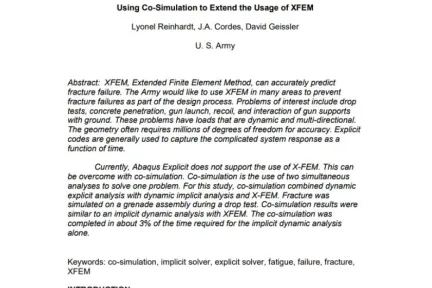
Using Co-Simulation to Extend the Usage of XFEM

XFEM, Extended Finite Element Method, can accurately predict fracture failure. The Army would like to use XFEM in many areas to prevent fracture failures as part of the design process. Problems of interest include drop tests, concrete penetration, gun launch, recoil, and interaction of gun supports with ground. These problems have loads that are dynamic and multi-directional. The geometry often requires millions of degrees of freedom for accuracy. Explicit codes are generally used to capture the complicated system response as a function of time.

Customer Papers

Using Co-Simulation to Extend the Usage of XFEM
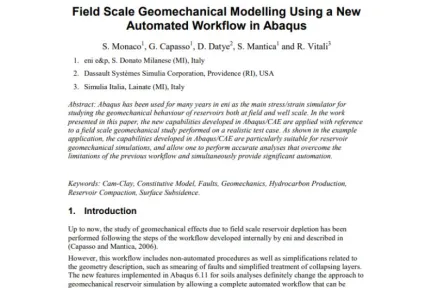
Field Scale Geomechanical Modelling Using a New Automated Workflow in Abaqus

Abaqus has been used for many years in eni as the main stress/strain simulator for studying the geomechanical behaviour of reservoirs both at field and well scale. In the work presented in this paper, the new capabilities developed in Abaqus/CAE are applied with reference to a field scale geomechanical study performed on a realistic test case. As shown in the example application, the capabilities developed in Abaqus/CAE are particularly suitable for reservoir geomechanical simulations, and allow one to perform accurate analyses that overcome the limitations of the previous workflow and simultaneously provide significant automation.

Customer Papers

Field Scale Geomechanical Modelling Using a New Automated Workflow in Abaqus
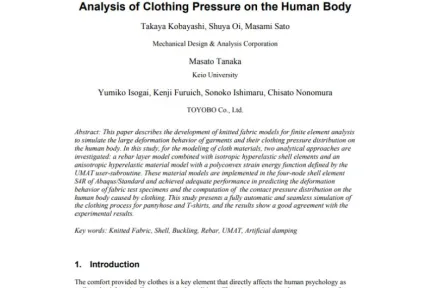
Analysis of Clothing Pressure on the Human Body

This paper describes the development of knitted fabric models for finite element analysis to simulate the large deformation behavior of garments and their clothing pressure distribution on the human body. In this study, for the modeling of cloth materials, two analytical approaches are investigated: a rebar layer model combined with isotropic hyperelastic shell elements and an anisotropic hyperelastic material model with a polyconvex strain energy function defined by the UMAT user-subroutine.

Customer Papers

Analysis of Clothing Pressure on the Human Body
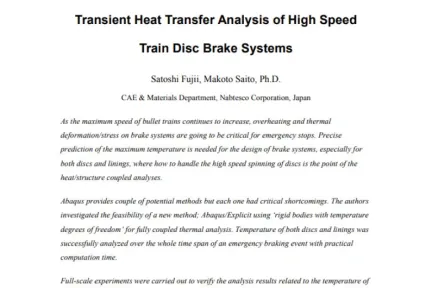
Transient Heat Transfer Analysis of High Speed Train Disc Brake Systems

As the maximum speed of bullet trains continues to increase, overheating and thermal deformation/stress on brake systems are going to be critical for emergency stops. Precise prediction of the maximum temperature is needed for the design of brake systems, especially for both discs and linings, where how to handle the high speed spinning of discs is the point of the heat/structure coupled analyses. Abaqus provides couple of potential methods but each one had critical shortcomings. The authors investigated the feasibility of a new method; Abaqus/Explicit using ‘rigid bodies with temperature degrees of freedom’ for fully coupled thermal analysis. Temperature of both discs and linings was successfully analyzed over the whole time span of an emergency braking event with practical computation time.

Customer Papers

Transient Heat Transfer Analysis of High Speed Train Disc Brake Systems
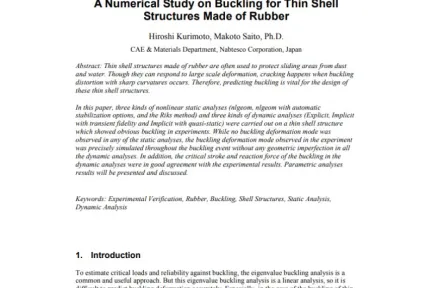
A Numerical Study on Buckling for Thin Shell Structures Made of Rubber

In this paper, three kinds of nonlinear static analyses and three kinds of dynamic analyses were carried out on a thin shell structure which showed obvious buckling in experiments. While no buckling deformation mode was observed in any of the static analyses, the buckling deformation mode observed in the experiment was precisely simulated throughout the buckling event without any geometric imperfection in all the dynamic analyses. In addition, the critical stroke and reaction force of the buckling in the dynamic analyses were in good agreement with the experimental results. Parametric analyses results will be presented and discussed.

Customer Papers

A Numerical Study on Buckling for Thin Shell Structures Made of Rubber
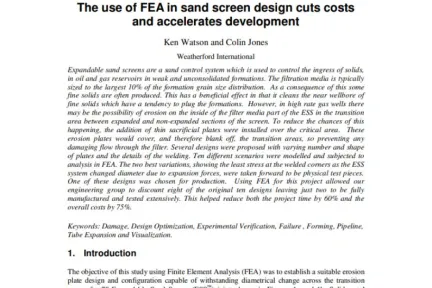
The use of FEA in sand screen design cuts costs and accelerates development

Expandable sand screens are a sand control system which is used to control the ingress of solids, in oil and gas reservoirs in weak and unconsolidated formations. The filtration media is typically sized to the largest 10% of the formation grain size distribution. As a consequence of this some fine solids are often produced. This has a beneficial effect in that it cleans the near wellbore of fine solids which have a tendency to plug the formations. However, in high rate gas wells there may be the possibility of erosion on the inside of the filter media part of the ESS in the transition area between expanded and non-expanded sections of the screen. To reduce the chances of this happening, the addition of thin sacrificial plates were installed over the critical area.

Customer Papers

The use of FEA in sand screen design cuts costs and accelerates development
257 résultats

Témoignages clients

150 résultats
4 résultats

Auto-apprentissage SIMULIA

Nous proposons plusieurs centaines de modules d'auto-apprentissage pour que vous puissiez continuer à apprendre à votre rythme.

Blogs

Lisez le blog SIMULIA pour connaître les dernières actualités et innovations de nos experts.

703 résultats

Découvrir comment SIMULIA peut vous aider

Contactez un expert SIMULIA pour découvrir comment nos solutions permettent une collaboration transparente et une innovation durable dans des entreprises de toutes tailles.

Commencer

Des formations et des cours sont disponibles pour les étudiants, le monde académique, les professionnels et les sociétés. Trouvez la formation SIMULIA qui vous convient. 

Obtenir de l'aide

Obtenez des informations sur la certification des logiciels et du matériel, les téléchargements de logiciels, la documentation utilisateur, les coordonnées du support et l'offre de services.