1503 résultats
Coupled Fluid Structure Interaction Simulation Using Abaqus CEL

For a system which involves a fluid medium contained inside a deformable structure, such as a fuel tank system, a simulation which couples the structure and fluid may be required depending on the system performance metric of interest. With the new CEL function, Abaqus can simulate a coupled fluid / structure dynamic event of several seconds real-time duration in days instead of weeks as compared to other available software. Abaqus/Standard and Abaqus/Explicit CEL function can be used to create a seamless fuel tank system simulation method to assess the fuel tank assembly and road loading performance.

Customer Papers
Coupled Fluid Structure Interaction Simulation Using Abaqus CEL
Failure Analysis of a 105mm Fin Deployment Mechanism

In order for artillery projectile guidance and control systems to meet precision performance requirements it is necessary to utilize fin stabilization rather than the conventional means of spin stabilization of artillery projectiles. Since the munitions are fired from a gun tube it is necessary for the fins to be stowed and secured during launch and then deploy once the projectile has left the muzzle of the weapon.

Customer Papers

Failure Analysis of a 105mm Fin Deployment Mechanism
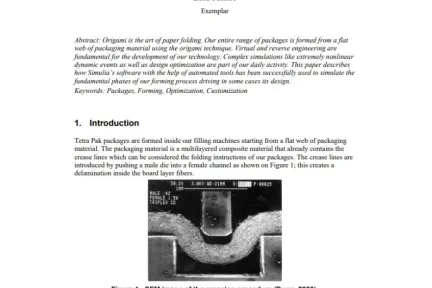
Origami with Abaqus

Origami is the art of paper folding. Our entire range of packages is formed from a flat web of packaging material using the origami technique. Virtual and reverse engineering are fundamental for the development of our technology. Complex simulations like extremely nonlinear dynamic events as well as design optimization are part of our daily activity. This paper describes how Simulia’s software with the help of automated tools has been successfully used to simulate the fundamental phases of our forming process driving in some cases its design.

Customer Papers

Origami with Abaqus
Shape optimization methodology for railway wheels subjected to thermo-mechanical loads

In railway industry a reduction of the wheel mass is at present required so as to achieve a higher energetic efficiency and a decrease of high-frequency vibrations. Wheel warming during the braking process is responsible for high thermal stresses which prove to be more relevant than stresses caused by wheel-rail contact loads. In this work an axisymmetrical finite element model is used to develop an optimization process of the wheel shape.

Customer Papers

Shape optimization methodology for railway wheels subjected to thermo-mechanical loads
Micromechanics-Based Structural Analysis and Multiscale Visualization within AbaqusCAE Environment

A unified framework is presented that enables coupled multiscale analysis of composite structures and associated graphical pre and post processing within the Abaqus/CAE environment. The recently developed, free, Finite Element Analysis - Micromechanics Analysis Code (FEAMAC) software couples NASA's Micromechanics Analysis Code with Generalized Method of Cells (MAC/GMC) with Abaqus/Standard and /Explicit to perform micromechanics based FEA such that the nonlinear composite material response at each integration point is modeled at each increment by MAC/GMC.

Customer Papers

Micromechanics-Based Structural Analysis and Multiscale Visualization within AbaqusCAE Environment
Self-loosening of Nuts due to External Load

Self-loosening of nuts is a practical problem in any situations from a machine to a whole plant. Self-loosening of threaded bolt/nut systems has been researched in number of works and many of them were based on experiment historically and some were based on the finite element analyses in these years. In this paper the following self-loosening were investigated by Abaqus, namely the static loosening of nut due to the lateral motion, dynamic loosening due to the lateral impact of fastened objects and the thermal load to bolt/nut systems.

Customer Papers

Self-loosening of Nuts due to External Load
Determination of Critical Flaw Size in Gun Launched 40mm Grenade

The inspection and screening of flaws in high explosive filled gun fired projectiles are crucial to ensure safety for soldiers using these items. In bore failure of structural components are sure to produce lethal consequences, therefore it is of great importance to determine what the maximum permissible crack size is for a given component coming off of the production floor. The analytical process to determine critical flaw size occurs in two stages. First, ABAQUS Explicit finite element analysis code is used to conduct interior ballistic simulation of a 40mm shape charge projectile. The modeling scope includes interior gun tube geometry with drive band engraving and spin up effects.

Customer Papers

Determination of Critical Flaw Size in Gun Launched 40mm Grenade
Minneapolis I-35W Bridge Collapse – Engineering Evaluations and Finite Element Analyses

The National Transportation Safety Board (NTSB) investigates accidents to identify the probable cause and to make recommendations that would prevent similar accidents. Following the collapse of the I-35W bridge in Minneapolis on August 1, 2007, the NTSB worked with the Federal Highway Administration, the Minnesota Department of Transportation and other parties with information and expertise, including SIMULIA Central, to determine the circumstances that contributed to the collapse of the bridge, completing the investigation in 15 months. The NTSB concluded that the collapse of the bridge was caused by the inadequate load capacity of gusset plates used to connect the truss members, as a result of an error by the bridge design firm, Sverdrup & Parcel and Associates, Inc.

Customer Papers

Minneapolis I-35W Bridge Collapse – Engineering Evaluations and Finite Element Analyses
Simulation Driven Design Enabling Robust Design

The airplane engine business is a highly competitive market and gas turbine engines are at the leading edge of technology development. In recent years, the application of optimization techniques and simulation-driven design during the development of engines has become a standard practice. Using such techniques also shortens the development time for gas turbines and reduces development costs. This in turn helps engine companies remain competitive. The presented paper will discuss the application of automated design processes and robust design techniques for real world development tasks.

Customer Papers

Simulation Driven Design Enabling Robust Design
Analysis of Casing Connections Subjected to Thermal Cycle Loading

There are generally three types of connections used in intermediate or production casing of thermal wells: API (American Petroleum Institute) round, API buttress and proprietary premium connections. This paper presents finite element analysis of these three types of casing connections subjected to thermal cycle loading. Based on analysis results, this paper demonstrates that the premium connection, which has a metal-to-metal seal region, is the most suitable of these three connection designs for the use in thermal wells, in terms of structural integrity and sealability. This paper also presents recommendations for casing connection design for successful service in thermal well applications.

Customer Papers

Analysis of Casing Connections Subjected to Thermal Cycle Loading
The application of ABAQUS in seismic analysis of connected structures

The connected structure refers to the kind of building which is composed of two or more towers connected by the connecting body in a certain height, belonging to the irregular building structure system. According to “Technical Specification for Concrete Structures of Tall Building”, the time-history analysis method should be adopted in the seismic analysis of the connected structure. The structure may have a larger plastic deformation under rare earthquake, so it is difficult to converge when the implicit solution method is used by the conventional finite element software. While the explicit integral technology provided by ABAQUS can solve the nonlinear dynamics problems better, it has a broader application in elastic-plastic dynamic analysis. Taking a specific project as an object, the application of ABAQUS in seismic analysis of connected structures is presented in detail in this paper.

Customer Papers

The application of ABAQUS in seismic analysis of connected structures
257 résultats

Témoignages clients

150 résultats
4 résultats

Auto-apprentissage SIMULIA

Nous proposons plusieurs centaines de modules d'auto-apprentissage pour que vous puissiez continuer à apprendre à votre rythme.

Blogs

Lisez le blog SIMULIA pour connaître les dernières actualités et innovations de nos experts.

703 résultats

Découvrir comment SIMULIA peut vous aider

Contactez un expert SIMULIA pour découvrir comment nos solutions permettent une collaboration transparente et une innovation durable dans des entreprises de toutes tailles.

Commencer

Des formations et des cours sont disponibles pour les étudiants, le monde académique, les professionnels et les sociétés. Trouvez la formation SIMULIA qui vous convient. 

Obtenir de l'aide

Obtenez des informations sur la certification des logiciels et du matériel, les téléchargements de logiciels, la documentation utilisateur, les coordonnées du support et l'offre de services.