Hay 1497 resultados
Evaluation of Brain Stresses during Car Crashes using the SAE Baja Racecar Test Vehicle

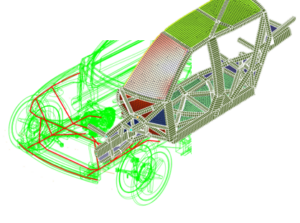
This report describes the result of a research project focused on driver’s brain damage evaluation during front impact of the Baja SAE race car to a wall. Two kinds of situation were considered in this analysis: a driver with and without a seat belt. The goal of this project is to check the amount of stress absorbed by the brain during impact and evaluate the role of the seat belt during impact. The analysis consists of a dynamic simulation of an impact of a car frame on a wall by using Finite Element Analysis (FEA) method. Models were meshed by using HyperMesh (a FEA pre-processing software). After finishing modeling, results were calculated and analyzed by using the Abaqus/Explicit (a computer aided engineering program) explicit solver. Results focus on the stresses, also will include energy, velocity, acceleration and displacements experienced by the following elements of model: brain, neck, dummy body and car frame. The results obtained from the analysis were displayed through charts.

Customer Papers

Evaluation of Brain Stresses during Car Crashes using the SAE Baja Racecar Test Vehicle
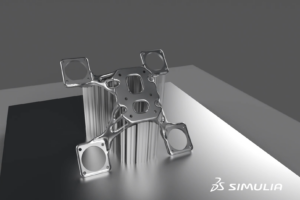
Distortion Prediction of Ti6Al4V Parts in Selective Laser Melting: An Industrial Case Study

Rapid heating and cooling in the Selective Laser Melting (SLM) additive manufacturing process generates large amounts of tensile residual stresses in the component. These stresses lead to part distortions and poor product performance. In most cases, distortions become more significant after cutting the part from the build tray and removing support structures. In this study, a complex topology optimized Gimbal Mount was considered for physical printing and finite element analysis of the print process. Th component was printed using Ti6Al4V material on an SLM machine and measurement points were taken on its outer profile. This data was compared with original geometry and simulation results. A good agreement was found between simulation and experimental results which was helpful in part development and establishing the technology.

Customer Papers

Distortion Prediction of Ti6Al4V Parts in Selective Laser Melting: An Industrial Case Study
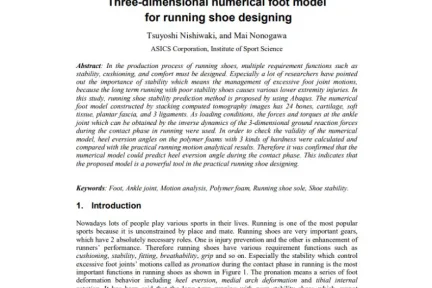
Three-dimensional numerical foot model for running shoe designing

In the production process of running shoes, multiple requirement functions such as stability, cushioning, and comfort must be designed. Especially a lot of researchers have pointed out the importance of stability which means the management of excessive foot joint motions, because the long term running with poor stability shoes causes various lower extremity injuries. In this study, running shoe stability prediction method is proposed by using Abaqus. The numerical foot model constructed by stacking computed tomography images has 24 bones, cartilage, soft tissue, plantar fascia, and 3 ligaments. As loading conditions, the forces and torques at the ankle joint which can be obtained by the inverse dynamics of the 3-dimensional ground reaction forces during the contact phase in running were used.

Customer Papers

Three-dimensional numerical foot model for running shoe designing
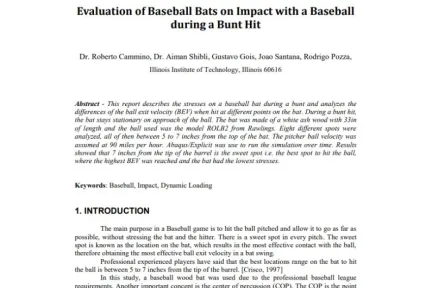
Evaluation of Baseball Bats on Impact with a Baseball during a Bunt Hit

This report describes the stresses on a baseball bat during a bunt and analyzes the differences of the ball exit velocity (BEV) when hit at different points on the bat. During a bunt hit, the bat stays stationary on approach of the ball. The bat was made of a white ash wood with 33in of length and the ball used was the model ROLB2 from Rawlings. Eight different spots were analyzed, all of then between 5 to 7 inches from the top of the bat. The pitcher ball velocity was assumed at 90 miles per hour. Abaqus/Explicit was use to run the simulation over time. Results showed that 7 inches from the tip of the barrel is the sweet spot i.e. the best spot to hit the ball, where the highest BEV was reached and the bat had the lowest stresses.

Customer Papers
Evaluation of Baseball Bats on Impact with a Baseball during a Bunt Hit
Analytical Frame Design for Commercial ZTR Mowers

Computed simulation can be a powerful tool when utilized to predict the behavior and life of a structure. Difficulties in properly utilizing finite element software arise when determining how to implement the loads and boundary conditions into a model so that it correlates with the real world.

Customer Papers
Analytical Frame Design for Commercial ZTR Mowers
ASME Cyclic Creep Evaluation of Critical Piping Component using CREEP Subroutine and ORNL Test Data

A critical piping component, constructed of Alloy 800-HT, is evaluated for cyclic creep concerns. The inelastic strain analysis portion of the analysis is conducted assuming the material as perfectly plastic. This method of perfect plasticity was preferred due to the lack of kinematic hardening data for Alloy 800-HT, especially at temperatures above the 800°F limitation of the ASME Section VIII Div. 2 Code. A CREEP subroutine was created using Oak Ridge National Laboratory test data and curve fitting equations.

Customer Papers

ASME Cyclic Creep Evaluation of Critical Piping Component using CREEP Subroutine and ORNL Test Data
Weight Optimization of a Landing Gear Steering Collar using Tosca in Abaqus

The adoption of topology optimization as a tool in the design cycle of a landing gear was tested using Tosca in Abaqus. The optimization process was carried out in collaboration with one of the leading landing gear manufacturers. The manufacturer is already a user of CATIA and Abaqus and was interested to see the capabilities of Tosca. To test Tosca’s capabilities, a landing gear steering collar which was already in production and had previously gone through several phases of design iterations was used as the sample component. The steering collar weighed 35.155 lb before the optimization and there was little room for further material reduction largely due to multiple contact regions and multiple loading conditions.

Customer Papers

Weight Optimization of a Landing Gear Steering Collar using Tosca in Abaqus
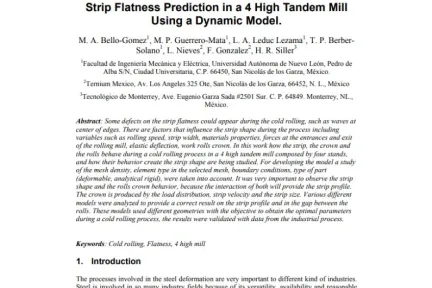
Strip Flatness Prediction in a 4 High Tandem Mill Using a Dynamic Model.

Some defects on the strip flatness could appear during the cold rolling, such as waves at center of edges. There are factors that influence the strip shape during the process including variables such as rolling speed, strip width, materials properties, forces at the entrances and exit of the rolling mill, elastic deflection, work rolls crown. In this work how the strip, the crown and the rolls behave during a cold rolling process in a 4 high tandem mill composed by four stands, and how their behavior create the strip shape are being studied. For developing the model a study of the mesh density, element type in the selected mesh, boundary conditions, type of part (deformable, analytical rigid), were taken into account.

Customer Papers

Strip Flatness Prediction in a 4 High Tandem Mill Using a Dynamic Model.
Optimised design of foundations for wind towers

Environmental, political, and other considerations are leading to the installation of growing numbers of wind turbines for electricity generation. The present paper concentrates on onshore installations, in which the turbine is placed at the end of a tower founded on the ground. A serious problem with the foundation or its connection with the tower entails a global failure. A worrying percentage of the towers built before 2010 is ill designed, often with obvious manifestations of the design problem. On the other hand the new designs attempt to optimise material quantities and costs while providing an adequate behaviour under the demands imposed.

Customer Papers

Optimised design of foundations for wind towers
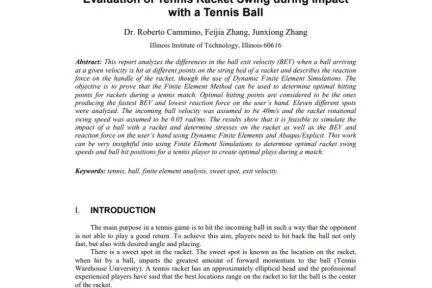
Evaluation of Tennis Racket Swing during Impact with a Tennis Ball

This report analyzes the differences in the ball exit velocity (BEV) when a ball arriving at a given velocity is hit at different points on the string bed of a racket and describes the reaction force on the handle of the racket, though the use of Dynamic Finite Element Simulations. The objective is to prove that the Finite Element Method can be used to determine optimal hitting points for rackets during a tennis match. Optimal hitting points are considered to be the ones producing the fastest BEV and lowest reaction force on the user’s hand. Eleven different spots were analyzed. The incoming ball velocity was assumed to be 40m/s and the racket rotational swing speed was assumed to be 0.05 rad/ms. The results show that it is feasible to simulate the impact of a ball with a racket and determine stresses on the racket as well as the BEV and reaction force on the user’s hand using Dynamic Finite Elements and Abaqus/Explicit.

Customer Papers

Evaluation of Tennis Racket Swing during Impact with a Tennis Ball
Hay 247 resultados

Testimonios de clientes

Hay 132 resultados
Hay 3 resultados

Autoaprendizaje de SIMULIA

Ofrecemos cientos de módulos de autoaprendizaje para que pueda seguir aprendiendo a su ritmo

Blogs

Lea el blog de SIMULIA sobre las últimas noticias e innovaciones de nuestros expertos.

Hay 696 resultados

Descubra lo que SIMULIA puede hacer por usted

Hable con un experto de SIMULIA para descubrir cómo nuestras soluciones permiten colaborar sin problemas e innovar de manera sostenible en organizaciones de todos los tamaños.

Póngase en marcha

Los cursos y las clases están disponibles para estudiantes, instituciones académicas, profesionales y empresas. Encuentre la formación de SIMULIA adecuada para usted. 

Obtener ayuda

Encuentre información sobre certificación de software y hardware, descargas de software, documentación del usuario, contacto con soporte y oferta de servicios