Hay 1497 resultados
Material Modeling of Polylactide

Computational modeling of stents can provide insight into critical locations (high stress/strain regions), help with design iterations/optimization, and reduce the need for bench-top testing. This study focuses on the developmental efforts to create a material model that can capture the mechanical response of poly-L-lactide, the backbone of Abbott Vascular’s ABSORB Bioresorbable Vascular Scaffold.

Customer Papers

Material Modeling of Polylactide
High Performance Computing and CAE within a modern Engineering Environment

The state of the current automotive or heavy duty industries is changing rapidly, especially with the recent recession still in mind or to some extend still looming. In such an environment the competitiveness of a company is tested on every step. Engineering-based companies have to re-define their strategies, what means engineering to them.

Customer Papers

High Performance Computing and CAE within a modern Engineering Environment
Modelling an Advanced Gas-Cooled Reactor Core using ABAQUS

An irradiated graphite material UMAT subroutine models the through life behaviour of the core components, but the whole core structure is so large with many interactions that an ABAQUS model would normally put excessive demands on computational resources. However this difficulty has been overcome by making use of superelements and parallel programming.

Customer Papers

Modelling an Advanced Gas-Cooled Reactor Core using ABAQUS
Biomechanical study of a drop foot brace

A person specific drop foot brace was simulated in the commercial finite element code Abaqus.The geometry was imported from a 3D optical scan of the actual surface and modeled as a composite material layup defined in a local discrete material coordinate system. The finite element model was used in order to model the stance phase in a normal walking. The material choice is a challenging task giving flexibility to the brace together with sufficiently stiffness and fatigue strength. The simulation has been compared with measurements from a strain gauge mounted foot brace tested in use. Based on simulations, a large number of expensive trial and error iterations can be avoided. Simulations show a strong geometry interaction with the loading of the material.

Customer Papers

Biomechanical study of a drop foot brace
Optimization in the Vibro-Acoustic Design of Hearing Instruments

Maximizing gain while minimizing the possibility of feedback requires an optimal choice of design parameters. In this Technology Brief, we outline how Abaqus/Standard and Isight can be combined in a process to optimize the vibro-acoustic characteristics of hearing instruments.

Solution Briefs

Optimization in the Vibro-Acoustic Design of Hearing Instruments
Damage Evaluation Using Advanced Functionalities in Abaqus

Linear-elastic fracture mechanics on the basis of advanced tools in FEM calculation (XFEM, contour integral) enable rapid and realistic evaluation of the fracture growth. This results in new possibilities, for example, for the derivation of testing intervals (damage tolerance analysis, contour integral) and for the carrying out of damage analyses. Using an industrial example, procedures and results of the Abaqus-supported determination of stress intensity factors will be explained. Considerations for the calculation of the fracture course with a dominant strain-induced load will be discussed.

Customer Papers

Damage Evaluation Using Advanced Functionalities in Abaqus
Fracture Mechanics Study of a Compact Tension Specimen Using Abaqus/CAE

Abaqus/CAE includes modeling and postprocessing capabilities for fracture mechanics analyses. These features provide interactive access to the contour integral fracture mechanics technology in Abaqus/Standard. Several fracture-specific tools are available, such as those for creating seam cracks, defining singularities, selecting the crack front and crack tip, defining q-vectors or normals to the crack front, and creating focused meshes. With these tools models can be created to estimate J-integrals, stress intensity factors, and crack propagation directions. In this technology brief a standardized compact tension specimen is modeled, and J-integral results are compared with those generated from applicable American Society for Testing and Materials (ASTM) standards and from a laboratory testing method. It is shown that Abaqus results are in very close conformance with the experimental results.

Solution Briefs

Fracture Mechanics Study of a Compact Tension Specimen Using Abaqus/CAE
Buckling analysis for the long-term integrity evaluation of a hydrocarbon well

During the exploitation of a reservoir the displacements occurring in the near wellbore areas may induce mechanical actions on the well completions, including the steel casing and the cemented annulus, bringing to instability and failure of the well structure, with strong impacts on the economics of the field. The evaluation of the well completion integrity in the long-term is therefore a critical issue in the design phase.

Customer Papers

Buckling analysis for the long-term integrity evaluation of a hydrocarbon well
An Integrated Approach for Transient Rolling of Tires

A wide range of loading conditions must be considered in the design of a tire. Computational simulations of a quasistatic, steady-state dynamic and nonlinear transient dynamic nature must be completed. In addition, the complexity and size of typical tire models highlight the need for efficient solution techniques.

Solution Briefs

An Integrated Approach for Transient Rolling of Tires
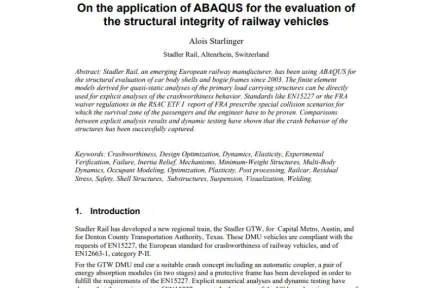
On the application of ABAQUS for the evaluation of the structural integrity of railway vehicles

Stadler Rail, an emerging European railway manufacturer, has been using ABAQUS for the structural evaluation of car body shells and bogie frames since 2003. The finite element models derived for quasi-static analyses of the primary load carrying structures can be directly used for explicit analyses of the crashworthiness behavior. Standards like EN15227 or the FRA waiver regulations in the RSAC ETF I report of FRA prescribe special collision scenarios for which the survival zone of the passengers and the engineer have to be proven. Comparisons between explicit analysis results and dynamic testing have shown that the crash behavior of the structures has been successfully captured.

Customer Papers

On the application of ABAQUS for the evaluation of the structural integrity of railway vehicles
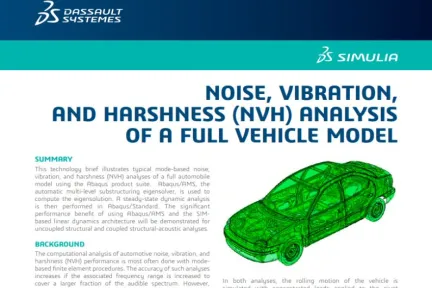
NOISE, VIBRATION, AND HARSHNESS ANALYSIS OF A FULL VEHICLE MODEL

This technology brief illustrates typical mode-based noise, vibration, and harshness (NVH) analyses of a full automobile model using the Abaqus product suite. Abaqus/AMS, the automatic multi-level substructuring eigensolver, is used to compute the eigensolution. A steady-state dynamic analysis is then performed in Abaqus/Standard. The significant performance benefit of using Abaqus/AMS and the SIMbased linear dynamics architecture will be demonstrated for uncoupled structural and coupled structural-acoustic analyses.

Solution Briefs

NOISE, VIBRATION, AND HARSHNESS ANALYSIS OF A FULL VEHICLE MODEL
Hay 247 resultados

Testimonios de clientes

Hay 132 resultados
Hay 3 resultados

Autoaprendizaje de SIMULIA

Ofrecemos cientos de módulos de autoaprendizaje para que pueda seguir aprendiendo a su ritmo

Blogs

Lea el blog de SIMULIA sobre las últimas noticias e innovaciones de nuestros expertos.

Hay 696 resultados

Descubra lo que SIMULIA puede hacer por usted

Hable con un experto de SIMULIA para descubrir cómo nuestras soluciones permiten colaborar sin problemas e innovar de manera sostenible en organizaciones de todos los tamaños.

Póngase en marcha

Los cursos y las clases están disponibles para estudiantes, instituciones académicas, profesionales y empresas. Encuentre la formación de SIMULIA adecuada para usted. 

Obtener ayuda

Encuentre información sobre certificación de software y hardware, descargas de software, documentación del usuario, contacto con soporte y oferta de servicios