有 1511 个结果
Simulation of Peen Forming Process of Aluminum Aeronautic Panel

The shot peen forming is a cold work deformation process consisting of treating the surface of a work piece with a stream of round shots (usually made of steel) with high enough energy to deform plastically the surface. This plastic deformation causes compressive residual stresses under the surface that are able to create a curvature on the component. This process is increasingly being used to create smooth curvatures in large pieces, for example, in the manufacturing of aerodynamic panels in the aeronautic sector.

Customer Papers
Simulation of Peen Forming Process of Aluminum Aeronautic Panel
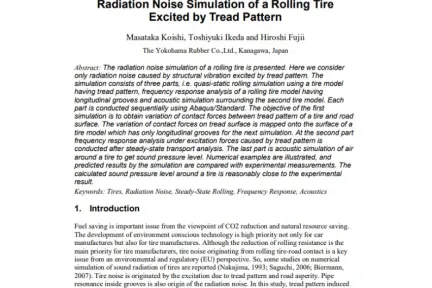
Radiation Noise Simulation of a Rolling Tire Excited by Tread Pattern

The radiation noise simulation of a rolling tire is presented. Here we consider only radiation noise caused by structural vibration excited by tread pattern. The simulation consists of three parts, i.e. quasi-static rolling simulation using a tire model having tread pattern, frequency response analysis of a rolling tire model having longitudinal grooves and acoustic simulation surrounding the second tire model. Each part is conducted sequentially using Abaqus/Standard.

Customer Papers

Radiation Noise Simulation of a Rolling Tire Excited by Tread Pattern
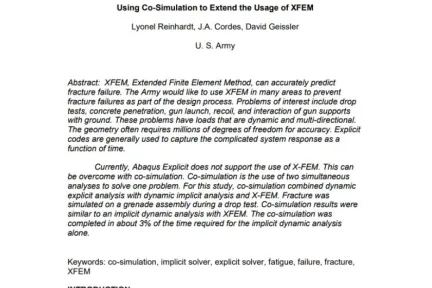
Using Co-Simulation to Extend the Usage of XFEM

XFEM, Extended Finite Element Method, can accurately predict fracture failure. The Army would like to use XFEM in many areas to prevent fracture failures as part of the design process. Problems of interest include drop tests, concrete penetration, gun launch, recoil, and interaction of gun supports with ground. These problems have loads that are dynamic and multi-directional. The geometry often requires millions of degrees of freedom for accuracy. Explicit codes are generally used to capture the complicated system response as a function of time.

Customer Papers

Using Co-Simulation to Extend the Usage of XFEM
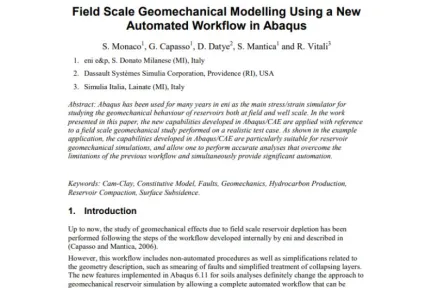
Field Scale Geomechanical Modelling Using a New Automated Workflow in Abaqus

Abaqus has been used for many years in eni as the main stress/strain simulator for studying the geomechanical behaviour of reservoirs both at field and well scale. In the work presented in this paper, the new capabilities developed in Abaqus/CAE are applied with reference to a field scale geomechanical study performed on a realistic test case. As shown in the example application, the capabilities developed in Abaqus/CAE are particularly suitable for reservoir geomechanical simulations, and allow one to perform accurate analyses that overcome the limitations of the previous workflow and simultaneously provide significant automation.

Customer Papers

Field Scale Geomechanical Modelling Using a New Automated Workflow in Abaqus
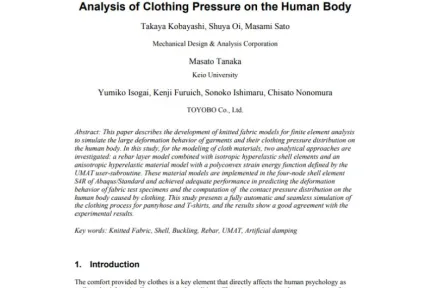
Analysis of Clothing Pressure on the Human Body

This paper describes the development of knitted fabric models for finite element analysis to simulate the large deformation behavior of garments and their clothing pressure distribution on the human body. In this study, for the modeling of cloth materials, two analytical approaches are investigated: a rebar layer model combined with isotropic hyperelastic shell elements and an anisotropic hyperelastic material model with a polyconvex strain energy function defined by the UMAT user-subroutine.

Customer Papers

Analysis of Clothing Pressure on the Human Body
Transient Heat Transfer Analysis of High Speed Train Disc Brake Systems

As the maximum speed of bullet trains continues to increase, overheating and thermal deformation/stress on brake systems are going to be critical for emergency stops. Precise prediction of the maximum temperature is needed for the design of brake systems, especially for both discs and linings, where how to handle the high speed spinning of discs is the point of the heat/structure coupled analyses. Abaqus provides couple of potential methods but each one had critical shortcomings. The authors investigated the feasibility of a new method; Abaqus/Explicit using ‘rigid bodies with temperature degrees of freedom’ for fully coupled thermal analysis. Temperature of both discs and linings was successfully analyzed over the whole time span of an emergency braking event with practical computation time.

Customer Papers

Transient Heat Transfer Analysis of High Speed Train Disc Brake Systems
A Numerical Study on Buckling for Thin Shell Structures Made of Rubber

In this paper, three kinds of nonlinear static analyses and three kinds of dynamic analyses were carried out on a thin shell structure which showed obvious buckling in experiments. While no buckling deformation mode was observed in any of the static analyses, the buckling deformation mode observed in the experiment was precisely simulated throughout the buckling event without any geometric imperfection in all the dynamic analyses. In addition, the critical stroke and reaction force of the buckling in the dynamic analyses were in good agreement with the experimental results. Parametric analyses results will be presented and discussed.

Customer Papers

A Numerical Study on Buckling for Thin Shell Structures Made of Rubber
The use of FEA in sand screen design cuts costs and accelerates development

Expandable sand screens are a sand control system which is used to control the ingress of solids, in oil and gas reservoirs in weak and unconsolidated formations. The filtration media is typically sized to the largest 10% of the formation grain size distribution. As a consequence of this some fine solids are often produced. This has a beneficial effect in that it cleans the near wellbore of fine solids which have a tendency to plug the formations. However, in high rate gas wells there may be the possibility of erosion on the inside of the filter media part of the ESS in the transition area between expanded and non-expanded sections of the screen. To reduce the chances of this happening, the addition of thin sacrificial plates were installed over the critical area.

Customer Papers

The use of FEA in sand screen design cuts costs and accelerates development
Abaqus & OpenFOAM Interface for Thermal-Stress Analysis

In this paper the interface between Abaqus and OpenFOAM is described in the context of a case study of a thermal stress analysis of a coolant tank. The generated interface extracts the pressure, wall temperature and convection coefficient distribution from the OpenFOAM analysis and maps the mechanical and thermal loads over the structural ABAQUS FE-model. This interface allows the engineering team to carry out the thermal stress structural development with an accurate thermal and mechanical load prediction based on CFD analysis without compromising the development cost.

Customer Papers

Abaqus & OpenFOAM Interface for Thermal-Stress Analysis
Closed-Loop Geometry Optimization of a Coronary Stent Using Three-Dimensional Structural Analysis

A numerical procedure for optimization of a coronary stent geometry using three dimensional analysis techniques is presented. The objective of the optimization analyses is to maximize the long term durability (fatigue-safety), while keeping acute structural safety (plastic strains) below a given threshold. The expanded and crimped radial stiffness, as well as diametrical expansion recoil output quantities of each optimization simulation are also monitored. The software used during the optimization process consists of HEEDS, an optimization software package developed by Red Cedar Technology, coupled to Abaqus/Explicit.

Customer Papers

Closed-Loop Geometry Optimization of a Coronary Stent Using Three-Dimensional Structural Analysis
Achieving a more Accurate Prediction of a Polymer Snap Deformation Pattern

From simple geometry loading to virtual prototyping, this paper exemplifies the stepwise progress towards a successful match between load case, measurement setup and numerical model validation. It also deals with the gaps at the current numerical model availability and proposes optional enhancements.

Customer Papers

Achieving a more Accurate Prediction of a Polymer Snap Deformation Pattern
Abaqus Thermal Analysis of the Fusion Welding of a P92 Steel Pipe

In this paper, the FE thermal analysis of the arc welding of a typical P92 pipe is presented. The two parts of the P92 steel pipe are joined together using a dissimilar material, made of Inconel weld consumables, producing a multi-pass butt weld from 36 circumferential weld beads. Following the generation of the FE model, the FE mesh is controlled using Model Change in Abaqus to activate the weld elements for each bead at a time corresponding to weld deposition. The thermal analysis is simulated by applying a distributed heat flux to the model, the accuracy of which is judged by considering the fusion zones in both the parent pipe as well as the deposited weld metal. For realistic fusion zones, the heat flux must be prescribed in the deposited weld pass and also the adjacent pipe elements. The FE thermal results are validated by comparing experimental temperatures measured by five thermocouples on the pipe outside surface with the FE temperature history at corresponding nodal points.

Customer Papers

Abaqus Thermal Analysis of the Fusion Welding of a P92 Steel Pipe
有 250 个结果

客户成功故事

有 151 个结果
有 4 个结果

SIMULIA 自学

我们提供数百个自学模块,以便您能够在方便的时间不断学习

博客

欢迎阅读 SIMULIA 博客,了解最新报道以及我们专家的最新创新。

有 701 个结果

了解 SIMULIA 可以为您带来哪些价值

与 SIMULIA 专家交流,了解我们的解决方案如何在各种规模的企业中实现无缝协作和可持续创新。

开始使用

现为学生、学术机构、专业人士和企业提供各类课程与培训。查找适合您的 SIMULIA 培训。 

获取帮助

查找有关软硬件认证、软件下载、用户文档、支持联系人和服务项目的信息