1495개의 결과가 있습니다.
Analysis of Oil Well Casing Connections Subjected to Non-axisymmetric Loads

Oilfield casings employ threaded connections which are designed to provide both structural and sealing integrity under installation and service loads. This paper presents a finite element methodology for analyzing casing connections subjected to non-axisymmetric loads. The analysis approach can be used for assessing connection structural integrity, sealability and fatigue life.

Customer Papers
Analysis of Oil Well Casing Connections Subjected to Non-axisymmetric Loads
CONSIDERATIONS ABOUT NON-LINEARITIES ON ENGINEERING PLASTICS

This work makes a revision of the main relative aspects of the nonlinear structural analysis in engineering plastic structures using the software ABAQUS Standard V6.5. Effects of temperature, mechanical effort, fluency and relaxation are considered. Mechanical properties of plastics were shown to be highly sensitivity with temperature. Then it ́s important that these kind of effects will be considered for most plastics structural analysis. Another important aspect is relative to time effects due to viscoelastic nature of polymers. The work validates experimental results relative to creep and relaxation through a numerical study coupling thermo-mechanical and viscous material effects.

Customer Papers

CONSIDERATIONS ABOUT NON-LINEARITIES ON ENGINEERING PLASTICS
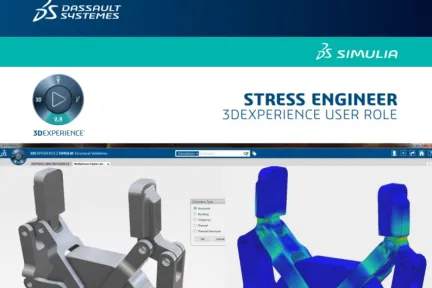
STRESS ENGINEER 3DEXPERIENCE USER ROLE

Stress Engineer delivers static, thermal, bucking and durability simulation capabilities for product behavior assessment on the 3DEXPERIENCE platform . It provides simulation-based design guidance during product development to improve product performance and quality while reducing the time requirement and cost of physical prototyping. To accelerate adoption of design simulation in the product development process, Stress Engineer is intuitive for design engineers, while still including the functionality required to simulate the complexities of real-world behavior accurately. Models built using Stress Engineer can be shared for collaboration with SIMULIA analyst tools, providing a unique and smooth workflow between product engineers and analysts.

Brochures

STRESS ENGINEER 3DEXPERIENCE USER ROLE
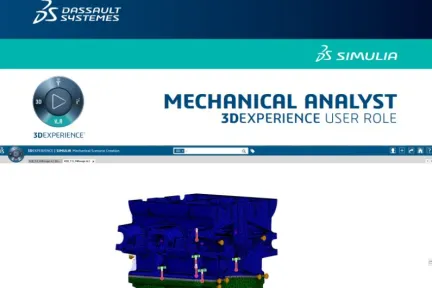
MECHANICAL ANALYST 3DEXPERIENCE USER ROLE

The Mechanical Analyst uses advanced finite element simulation techniques to understand and validate complex engineering problems. With an extensive toolset to enhance productivity and efficiency, the Mechanical Analyst is equipped to conduct structural static, dynamic, and thermal simulation of product designs and assemblies within the 3DEXPERIENCE platform. Fully integrated with both the environment and with the geometry, Mechanical Analyst provides a unique platform to collaborate, simulate, and impact design processes throughout the extended enterprise using state-of-the-art Abaqus simulation technology.

Brochures

MECHANICAL ANALYST 3DEXPERIENCE USER ROLE
A Study on Predicting the Long-term Creep Behavior of Plastics using the Short-term Creep Test

The creep performance of plastics is one of the main criteria for a variety of applications with strict dimensional stability needs, including electrical/electronic parts and various automotive applications. However obtaining or generating accurate creep data is very difficult for both resin suppliers and product designers because the creep property is time dependent, which means it takes over several weeks or even a year time span. Hence a faster and more reliable method of predicting creep behavior of plastics is required when designing plastic products that will encounter long-term loading. This work presents an easy method for predicting the long-term creep behavior of plastics using the short-term creep experimental data.

Customer Papers

A Study on Predicting the Long-term Creep Behavior of Plastics using the Short-term Creep Test
Simulation of powder compaction using to optimize the compaction and ejection process.

Compaction of powder is is used in p/m (powder metal) components, hard metals, ceramics and pharmaceutical industries. Optimisation of the punch / die / kinematics is of importance to the designer to obtain uniform density distribution. An understanding of the compaction behavior is essential to design the process and the tooling for a given component production by p/m route. FEM analysis of p/m compaction is an useful tool to minimize the tool and die development design cycle. The designer can explore various possibilities of tool and die as well as process design using FEM simulation. A robust yield function that describes the yielding and densification of the powder, availability of a valid constitutive behavior of the powder material, incorporation of the process model in FEM simulation are critical issues.

Customer Papers

Simulation of powder compaction using to optimize the compaction and ejection process.
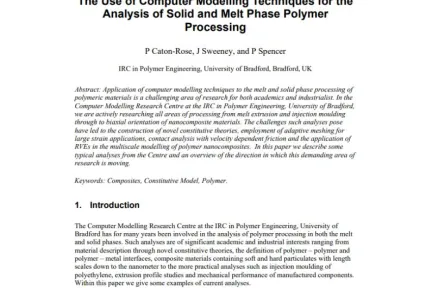
The Use of Computer Modelling Techniques for the Analysis of Solid and Melt Phase Polymer Processing

Application of computer modelling techniques to the melt and solid phase processing of polymeric materials is a challenging area of research for both academics and industrialist. In the Computer Modelling Research Centre at the IRC in Polymer Engineering, University of Bradford, we are actively researching all areas of processing from melt extrusion and injection moulding through to biaxial orientation of nanocomposite materials. The challenges such analyses pose have led to the construction of novel constitutive theories, employment of adaptive meshing for large strain applications, contact analysis with velocity dependent friction and the application of RVEs in the multiscale modelling of polymer nanocomposites. In this paper we describe some typical analyses from the Centre and an overview of the direction in which this demanding area of research is moving.

Customer Papers

The Use of Computer Modelling Techniques for the Analysis of Solid and Melt Phase Polymer Processing
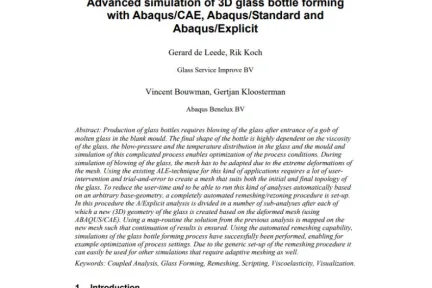
Advanced simulation of 3D glass bottle forming with AbaqusCAE, AbaqusStandard and AbaqusExplicit

Production of glass bottles requires blowing of the glass after entrance of a gob of molten glass in the blank mould. The final shape of the bottle is highly dependent on the viscosity of the glass, the blow-pressure and the temperature distribution in the glass and the mould and simulation of this complicated process enables optimization of the process conditions. During simulation of blowing of the glass, the mesh has to be adapted due to the extreme deformations of the mesh. Using the existing ALE-technique for this kind of applications requires a lot of userintervention and trial-and-error to create a mesh that suits both the initial and final topology of the glass.

Customer Papers

Advanced simulation of 3D glass bottle forming with AbaqusCAE, AbaqusStandard and AbaqusExplicit
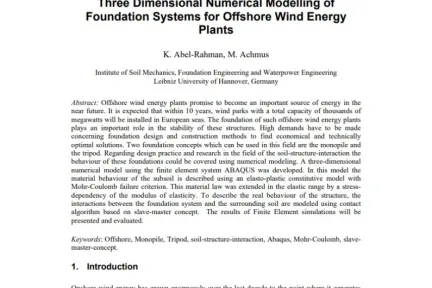
Three Dimensional Numerical Modelling of Foundation Systems for Offshore Wind Energy Plants

Offshore wind energy plants promise to become an important source of energy in the near future. It is expected that within 10 years, wind parks with a total capacity of thousands of megawatts will be installed in European seas. The foundation of such offshore wind energy plants plays an important role in the stability of these structures. High demands have to be made concerning foundation design and construction methods to find economical and technically optimal solutions. Two foundation concepts which can be used in this field are the monopile and the tripod.

Customer Papers

Three Dimensional Numerical Modelling of Foundation Systems for Offshore Wind Energy Plants
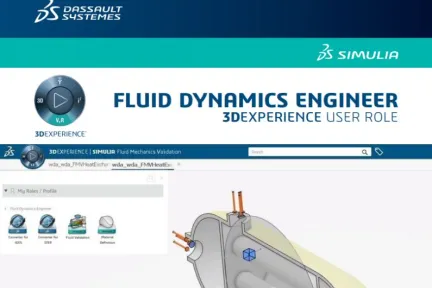
FLUID DYNAMICS ENGINEER 3DEXPERIENCE USER ROLE

Fluid Dynamics Engineer provides designers and design engineers with the ability to validate fluid performance for internal and external flows. The users can make use of the obtained results to optimize their designs for flow distribution, thermal performance, pressure loss and turbulence. Computational Fluid Dynamics (CFD) technology is employed during the product design process with minimal knowledge of CFD principles and applications.

Brochures

FLUID DYNAMICS ENGINEER 3DEXPERIENCE USER ROLE
Simulation of Descaling during Continuous Hot Rolling

Oxidation of the steel surface is always present during hot rolling and the oxide has to be eliminated before deformation to avoid imprinting and damaging the surface. It is normal practice to use high pressure water jets (descaling) to break and remove the oxide layer formed at different stages. The design of the descaling stations is carried out by trail and error without a systematic way to confirm the benefits of a given design. A model was developed using the commercial software ABAQUSTM/Standard in order to evaluate the mechanical integrity of the secondary oxide found on low carbon steel during hot rolling.

Customer Papers

Simulation of Descaling during Continuous Hot Rolling
260개의 결과가 있습니다.

고객 사례

150개의 결과가 있습니다.
3개의 결과가 있습니다.

SIMULIA 자기 주도 학습

학습자가 편리하게 학습을 꾸준히 이어갈 수 있도록 수백 개의 자기 주도 학습 모듈을 제공합니다.

블로그

SIMULIA 블로그에서 당사 전문가들이 전하는 최신 뉴스와 혁신에 대해 알아보세요.

775개의 결과가 있습니다.

SIMULIA의 지원 서비스 알아보기

SIMULIA 전문가와 상담하여 당사의 솔루션이 모든 규모의 조직에서 원활한 협업과 지속 가능한 혁신을 실현하는 방법에 대해 알아보세요.

시작하기

학생, 교육, 전문가 및 회사를 위한 교육 과정과 강의가 제공됩니다. 당신에게 맞는 SIMULIA 교육을 찾아보세요. 

도움받기

소프트웨어 및 하드웨어 인증, 소프트웨어 다운로드, 사용자 설명서, 지원 연락처 및 서비스 제공에 대한 정보를 확인하세요.