1495개의 결과가 있습니다.
Application of Predictive Engineering Tool to Determine Optimize Rubber Door Harness Grommet Design

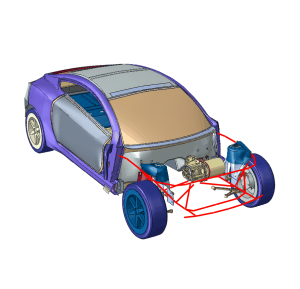
A cable grommet is a tube ring through which an electric cable passes. They are usually made of rubber or metal. The cable grommet is used to protect, improve friction or seal cables passing through it, from a possible mechanical or chemical attack and for aesthetic look. It becomes very important to determine the optimum length of the grommet used for particular application. Bigger length will have results into folding of grommet and lesser length will yield into stretching of rubber grommet. Finite element simulation technique presented in this paper can be used to determine the optimum geometry of the grommet. Component used for this study is an automotive door harness rubber grommet.

Customer Papers
Application of Predictive Engineering Tool to Determine Optimize Rubber Door Harness Grommet Design
Strength Assessment of Injection Molded ShortFiber-Reinforced Plastic Components

Components made of short-fiber-reinforced plastics (SFRP) are stressed highly both mechanically and thermally. Therefore an intelligent component design is required in order to fully exploit the potential of these materials. Hence, the design of such components must be based on a reliable strength assessment. For this purpose models for the description of the anisotropic and elasto-plastic failure behavior of SFRP are required. In contrast to the widespread use of SFRP, methods for a reliable strength assessment based on FE analyses for components made of these materials have not been sufficiently developed yet. This paper presents an approach for the strength assessment of SFRP components based on FE analyses. In the scope of this appropriate failure limits and failure criteria for these materials are presented.

Customer Papers

Strength Assessment of Injection Molded ShortFiber-Reinforced Plastic Components
Topology optimization of a motorcycle swing arm under service loads using Abaqus and Tosca

In research and development environment and concept design, people involved in new projects often need to design a completely new shape for the structure target of the analysis. The loading conditions and constraints are usually known but the designer hardly knows how to create the geometry of the structure that meets the requirements of the project and that can be manufactured at the same time respecting the target costs. In this paper is presented the topology optimization of a motorcycle swing arm, starting from a design space which takes into account the overall dimensions, and trying to minimize the mass while maximizing stiffness. The use of Tosca Structure, that drives the FEM simulation of the swing arm performed with Abaqus, allowed to obtain a shape that can be manufactured in compliance with the requirements of the project.

Customer Papers
Topology optimization of a motorcycle swing arm under service loads using Abaqus and Tosca
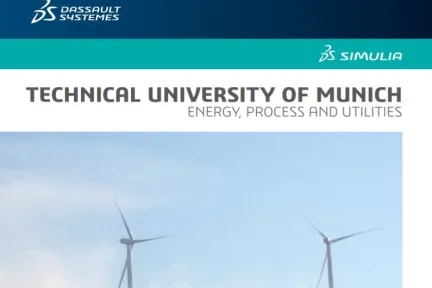
TECHNICAL UNIVERSITY OF MUNICH ENERGY, PROCESS AND UTILITIES

Research Associate Stefan Sicklinger employed SIMULIA’s co-simulation engine (CSE) to link four physics—flow, structure, multi-body dynamics and control—into highly accurate 3D models of wind turbine startup, run and emergency braking. Abaqus FEA’s robust solver provided extremely realistic simulations of the flexible turbine blades during operation.

Tech Notes

TECHNICAL UNIVERSITY OF MUNICH ENERGY, PROCESS AND UTILITIES
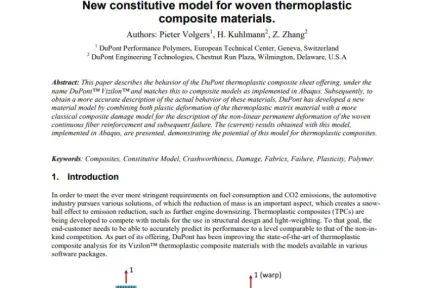
New constitutive model for woven thermoplastic composite materials.

This paper describes the behavior of the DuPont thermoplastic composite sheet offering, under the name DuPontTM VizilonTM and matches this to composite models as implemented in Abaqus. Subsequently, to obtain a more accurate description of the actual behavior of these materials, DuPont has developed a new material model by combining both plastic deformation of the thermoplastic matrix material with a more classical composite damage model for the description of the non-linear permanent deformation of the woven continuous fiber reinforcement and subsequent failure. The (current) results obtained with this model, implemented in Abaqus, are presented, demonstrating the potential of this model for thermoplastic composites.

Customer Papers

New constitutive model for woven thermoplastic composite materials.
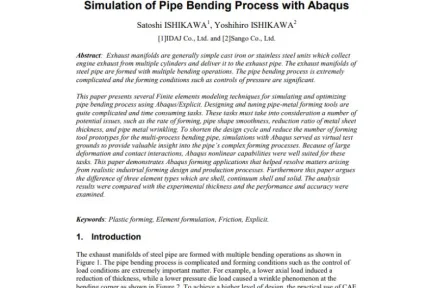
Simulation of Pipe Bending Process with Abaqus

This paper presents several Finite elements modeling techniques for simulating and optimizing pipe bending process using Abaqus/Explicit. Designing and tuning pipe-metal forming tools are quite complicated and time consuming tasks. These tasks must take into consideration a number of potential issues, such as the rate of forming, pipe shape smoothness, reduction ratio of metal sheet thickness, and pipe metal wrinkling. This paper demonstrates Abaqus forming applications that helped resolve matters arising from realistic industrial forming design and production processes. Furthermore this paper argues the difference of three element types which are shell, continuum shell and solid.

Customer Papers

Simulation of Pipe Bending Process with Abaqus
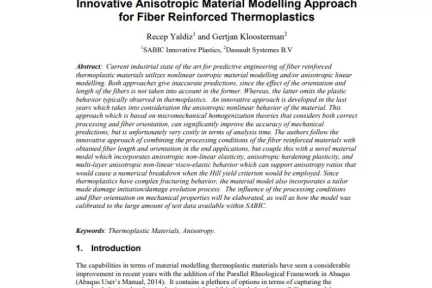
Innovative Anisotropic Material Modelling Approach for Fiber Reinforced Thermoplastics

Current industrial state of the art for predictive engineering of fiber reinforced thermoplastic materials utilizes nonlinear isotropic material modelling and/or anisotropic linear modelling. Both approaches give inaccurate predictions, since the effect of the orientation and length of the fibers is not taken into account in the former. Whereas, the latter omits the plastic behavior typically observed in thermoplastics. An innovative approach is developed in the last years which takes into consideration the anisotropic nonlinear behavior of the material. This approach which is based on micromechanical homogenization theories that considers both correct processing and fiber orientation, can significantly improve the accuracy of mechanical predictions, but is unfortunately very costly in terms of analysis time.

Customer Papers

Innovative Anisotropic Material Modelling Approach for Fiber Reinforced Thermoplastics
IDIADA’s Virtual Proving Ground for durability analysis

It is usual that the loads applied on structural elements are in fluctuating situations. Sometimes the component can break under its ultimate or its yield strength. This breakage situation is due to the fluctuating loads that have been applied over long periods. For this purpose this breakage type is called “fatigue breaking”. Fatigue breaking is a consequence of crack growth. When no prototypes are available, it is necessary to calculate the life prediction as soon as possible. Simulation through the VPG is increasingly being used for life prediction. The present work shows a methodology that uses a finite element model (FEM) that runs on a proving ground. In this case, no MBS (multibody software) model is used to obtain the loads on the structure.

Customer Papers

IDIADA’s Virtual Proving Ground for durability analysis
Simulation of Fully Coupled Thermo-Mechanical Effects in a Disc Brake Rotor

In this paper, a fully- coupled, temperature- displacement analysis using Abaqus/Standard was carried out to take into the account both thermal and structural effects on the brake rotor. The effect on thermal performance of rotational speed (corresponding to braking conditions) and rotor temperature, due to the rotating heat source, has been evaluated. Disc thickness variations are shown to arise from the temperature profile across the disc cheek surface. The scenario simulated considers the thermal effect of braking a vehicle which was prone to generating an audible rumble noise. The simulation measured the thermal and geometric changes in the disc, demonstrating the disc thickness variation and thermal banding of the rotor, and the location of these on the disc surface due to the effect of the thermo-mechanical loading.

Customer Papers

Simulation of Fully Coupled Thermo-Mechanical Effects in a Disc Brake Rotor
Modeling the draping of NCF composite preforms.

Non-Crimp Fabrics (NCF) are widely used textile reinforcements in fibre reinforced composite structures. The most important prediction from a draping analysis featuring preforms from these materials is their resulting fibre orientations; the orientations influence several other properties including fabric permeability and final component strength. The analysis is complicated by the influence of localized stitching patterns and their constraint on relative sliding of individual layers within a single ply during the draping process. The modeling procedure involves a process of material characterization valid for fabric preform materials and has been carried out using the Abaqus/Explicit finite element analysis code.

Customer Papers

Modeling the draping of NCF composite preforms.
260개의 결과가 있습니다.

고객 사례

150개의 결과가 있습니다.
3개의 결과가 있습니다.

SIMULIA 자기 주도 학습

학습자가 편리하게 학습을 꾸준히 이어갈 수 있도록 수백 개의 자기 주도 학습 모듈을 제공합니다.

블로그

SIMULIA 블로그에서 당사 전문가들이 전하는 최신 뉴스와 혁신에 대해 알아보세요.

775개의 결과가 있습니다.

SIMULIA의 지원 서비스 알아보기

SIMULIA 전문가와 상담하여 당사의 솔루션이 모든 규모의 조직에서 원활한 협업과 지속 가능한 혁신을 실현하는 방법에 대해 알아보세요.

시작하기

학생, 교육, 전문가 및 회사를 위한 교육 과정과 강의가 제공됩니다. 당신에게 맞는 SIMULIA 교육을 찾아보세요. 

도움받기

소프트웨어 및 하드웨어 인증, 소프트웨어 다운로드, 사용자 설명서, 지원 연락처 및 서비스 제공에 대한 정보를 확인하세요.