1495개의 결과가 있습니다.
Comparison of ALE, CEL and SPH for Self-piercing riveting

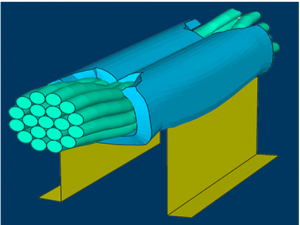
SPR (Self-piercing riveting) is a cold forming process that is used to fasten together two or more sheets of different materials mechanically with a rivet. Also SPR emulates the results and quality of spot welding without many of the risks, such as toxic fumes, sparks and noise. Thus circumstanced, this technique is widely used on the various filed especially within automobile industry. SPR, in particular, is excellent for lightweight manufacturing and for precise working while dramatically reducing cost and production time. The process deformation depends on the sheet size, shape of die, material flow, stiffness, etc. Also material deformation in both of rivet and workpiece sheets is tremendous large, for instance thinning, necking, shear and penetration.

Customer Papers

Comparison of ALE, CEL and SPH for Self-piercing riveting
Reliability Based Design Optimization of Subsystems / Component using Monte Carlo Simulation of Isight

With the advent of CAE high fidelity simulations, both non parametric and parametric optimization methods are gaining rapid momentum in order to find the optimum design that satisfies the performance requirements. Usually, each input design variable such as material property, load and manufacturing processes of a component / sub-system will have uncertainties which have to be accounted while performing the optimization. Since, the output parameters of mechanical sub-systems are highly nonlinear and sensitive to variation of input design variables. The Monte Carlo Simulation (MCS) method of Isight has been used to define variation of input design variables thereby to assess the risk factor of the optimum design.

Customer Papers
Reliability Based Design Optimization of Subsystems / Component using Monte Carlo Simulation of Isight
Front-End Loader Linkage Durability Analysis Using Load Input from True-Load

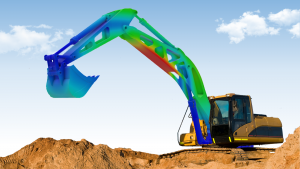
This document describes the use of Abaqus/CAE, Abaqus/Standard, True-Load, and Verity weld analysis in fe-safe software to evaluate the durability of a front-end loader linkage. Dynamic field loading for FEA of construction equipment is not always easily replicated by traditional linear static loading methods. Wolf Star Technologies True-Load software along with unit load FEA in Abaqus was used to determine time history loads for a field operation with dynamic loading that resulted in fatigue failures of the linkage. The time history loading was then used in fe-safe to compare the durability of design alternatives and determine a design that met the simulation criteria. The methodology greatly improved the confidence of the design developed through simulation because the field loading was accurately reproduced.

Customer Papers
Front-End Loader Linkage Durability Analysis Using Load Input from True-Load
Mechanical Testing of FDM Parts for Process Simulation

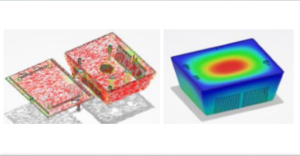
In this study, the relationship between the layer-by-layer build process and the resulting mechanical properties is investigated. The build orientations are selected based on the assumption that the printed parts demonstrate orthotropic behavior, in which the properties will vary in the primary directions orthotropic to the build layer plane. This assumption is validated by mechanical testing of tensile and Iosipescu (shear) specimens fabricated with layer-by-layer orientations orthotropic to the loading axes. Properties that are obtained from the mechanical testing include tensile modulus, tensile strength, shear modulus and Poisson’s ratio.

Customer Papers
Mechanical Testing of FDM Parts for Process Simulation
Fatigue Crack Propagation Comparison of a Hydropower Main Inlet Valve Using 3D Crack Meshes in a Full Model Versus a Sub-mode

Fatigue crack propagation of a surface crack in a hydropower main inlet valve is evaluated and compared by two approaches using Abaqus/Standard. Crack propagation is modeled using a series of 3D crack meshes to compute the crack front stress intensity values, used to compute the crack growth rates. The first approach inserts the crack mesh into the global model and connects it with tied contact, solving the combined mesh including the crack. The second approach uses a sub-model containing just the crack, where the boundary displacements are obtained from the uncracked global model results. The two methods are introduced and compared.

Customer Papers

Fatigue Crack Propagation Comparison of a Hydropower Main Inlet Valve Using 3D Crack Meshes in a Full Model Versus a Sub-mode
Fatigue Life Prediction of Welds in Motorcycle Frames on a Rough Road

Motorcycle production is increasing with strong demand for commuter models. These models are used for commuting and transporting goods with total demand in excess of 40 million units per year mostly in Asia. For production efficiency and lower cost, frames are made by welding steel pipes together forming different welded joints. The welded joints are used to make the frame compact and to provide necessary stiffness. With most welded parts, the most prone to fatigue failure is at or near the weld. Although reinforcing or strengthening can be done, cracks will just grow on different parts of the weld or joint. Thus, the need for simulation is very important to investigate the problem and consider proper design early in the development stage. This paper compares the Hot Spot Stress method and Equivalent Structural Stress Method (Verity method) to predict fatigue life of the welded joint.

Customer Papers

Fatigue Life Prediction of Welds in Motorcycle Frames on a Rough Road
Making Efficient and Effective Use of Simulation Results for Critical Design Decisions

Mechanical design of products like mobile phones is a difficult task due to the sheer number of components and design decisions. In order to ship a high quality product, teams manage every little dimension, round, tolerance gap and material choice. Finite element simulations have proven over time to be an unmatched tool in its ability to avoid failures and aide in the design process. This is especially true when designing for drop events, which can be catastrophic. Finite element analysis tools allow us to simulate these types of events and optimize the design to improve the probability of survival. In some regions of the world, network carriers require certain minimum reliability performances to ensure low field failure rates. It is our goal as simulation engineers to ensure we not only meet these specification, but we provide unmatched quality and reliability to our customers around the world.

Customer Papers

Making Efficient and Effective Use of Simulation Results for Critical Design Decisions
A Concurrent Patient-specific Musculoskeletal and Finite Element Modeling Framework for Predicting in Vivo Kinematics and Contact Mechanics of Total Knee Replacement

Understanding the kinematic and contact mechanics for in vivo specific patient has dictated the success of current total knee replacement (TKR) prostheses. In this paper, an in vivo predicting method to analyze kinematic and contact mechanics within specific TKR knee joint has been proposed and experimentally verified based on concurrent dynamic finite element model (FEM) and patient-specific musculoskeletal (MS) technology, which was achieved by the commercial software Abaqus and Isight from Dassault Systemes. The hybrid MS model was built mainly including three parts, namely cadaver-based MS model, subknee model and deformable FE prosthesis model, based on CT images.

Customer Papers

A Concurrent Patient-specific Musculoskeletal and Finite Element Modeling Framework for Predicting in Vivo Kinematics and Contact Mechanics of Total Knee Replacement
Multi-Stage, Multi-Wellbore Hydraulic Fracturing Simulation in Naturally Fractured Reservoirs Using Cohesive Zone Model

The model quantified limited cluster stimulation, the activation of a complex NF network, and fluid infiltration depending on the stimulation scenario, wellbore pressure drop, randomly distributed perforation lengths, and fracturing fluid viscosity. The complex stimulation patterns is featured by further control on cluster stimulation in the sequential fracturing case compared to the simultaneous case especially in the presence of non-uniform shaped-charge perforations. This improved model enhances the reliability on numerical simulations for hydraulic fracturing design.

Customer Papers

Multi-Stage, Multi-Wellbore Hydraulic Fracturing Simulation in Naturally Fractured Reservoirs Using Cohesive Zone Model
Dynamic Simulation Methodology of Half-toroidal IVT Variator System with Feedback Control

Dynamic simulation methodology of a half-toroidal IVT variator system using a traction drive was developed. The rheological properties of a traction fluid dependent on surface pressure, sliding velocity, and contact surface temperature were identified from four-roller test apparatus by considering Hertzian pressure distribution on traction surface. Since a half-toroidal CVT variator system was required to analyze simultaneously the vibration, deformation, and contact behavior, Abaqus/Explicit solver was used. Additionally, this approach provides arbitrary control of the variator speed ratio, a mechanical sensor-less control logic that combined a state estimation observer with feedback control was also coupled with the solver. These methods made it possible to quantify the torque capacity and power transmission efficiency of a half-toroidal variator, and also enabled visualization of the friction force spinning behavior on traction surface.

Customer Papers

Dynamic Simulation Methodology of Half-toroidal IVT Variator System with Feedback Control
260개의 결과가 있습니다.

고객 사례

150개의 결과가 있습니다.
3개의 결과가 있습니다.

SIMULIA 자기 주도 학습

학습자가 편리하게 학습을 꾸준히 이어갈 수 있도록 수백 개의 자기 주도 학습 모듈을 제공합니다.

블로그

SIMULIA 블로그에서 당사 전문가들이 전하는 최신 뉴스와 혁신에 대해 알아보세요.

775개의 결과가 있습니다.

SIMULIA의 지원 서비스 알아보기

SIMULIA 전문가와 상담하여 당사의 솔루션이 모든 규모의 조직에서 원활한 협업과 지속 가능한 혁신을 실현하는 방법에 대해 알아보세요.

시작하기

학생, 교육, 전문가 및 회사를 위한 교육 과정과 강의가 제공됩니다. 당신에게 맞는 SIMULIA 교육을 찾아보세요. 

도움받기

소프트웨어 및 하드웨어 인증, 소프트웨어 다운로드, 사용자 설명서, 지원 연락처 및 서비스 제공에 대한 정보를 확인하세요.