1495개의 결과가 있습니다.
Precise Calculation of Mesh Stiffness Fluctuation for Predicting Gear Noise

Nabtesco manufactures diverse configurations of reduction gears for varied applications in a wide range of industries worldwide. With changing markets demanding quieter operation, the perennial issue of noise generated by spur gears has become an even greater concern. Our traditional development strategy was designing gear shape modifications empirically and producing prototypes for testing. However, producing multiple gears and conducting noise evaluations is very cost and time intensive. We could not determine the exact effect various shape modifications would have on noise and why. While there are some longestablished methods for analyzing gearbox noise, these methods are not appropriate for predicting gear shapes as size differences among gear shape modifications are much smaller than parameters established for gearbox noise evaluation.

Customer Papers
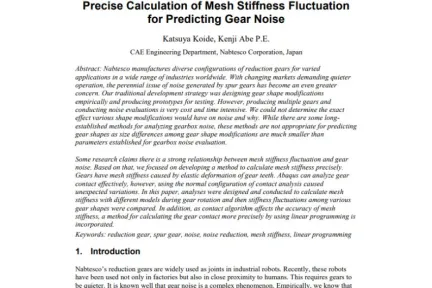
Precise Calculation of Mesh Stiffness Fluctuation for Predicting Gear Noise
Effect of Tolerance Analysis in Simulations Using Finite Element Methods

This paper explores the effects of tolerance analysis in finite element simulations. Simulations in bending, tension, and torsion were run for a beam. For each situation, 100 different simulations were run using slight variations in the dimensions and material properties of the beam. In doing so, the tolerances of these properties were captured; all were within two percent of the mean value. The computer-generated data for maximum stress and maximum deflection was compared to the theoretical values. The goal was to determine if Abaqus/CAE can capture variations in the maximum deflection and maximum stress. Probability density functions were generated to see if the data followed a normal distribution.

Customer Papers

Effect of Tolerance Analysis in Simulations Using Finite Element Methods
Virtual Human Model CASIMIR - A Chance and a Challenge for the Aetiology Understanding of Pressure Injury Development

The human body model CASIMIR was developed at the TU of Darmstadt [Buck 1997]. The goal was the risk evaluation of a possible lumbar spine degeneration due to vibrations exposed in working environments. Currently it is used by OEM and Tier-1 suppliers for the virtual analysis of static and dynamic seating comfort in passenger cars. Finally, a case study of an intensive care bed is presented showing the application of the simulation method with the human body model CASIMIR. In the study, relevant mechanical quantities for the risk evaluation of pressure injuries are analyzed for different bed designs. Further, a comparison to a real measurement procedure via motion capture is presented.

Customer Papers
Virtual Human Model CASIMIR - A Chance and a Challenge for the Aetiology Understanding of Pressure Injury Development
Simulation of Controlled Deflation, Folding and Inflation of Large-Scale Confined Inflatable Structures

Transportation tunnels have been identified as particularly vulnerable to different threats such as propagation of toxic gases, or smoke originated by human activities, or flooding originated by extreme climatic events such as hurricanes and severe weather. The implementation of large-scale inflatable structures to plug specific locations of the tunnel system to minimize the consequences of the propagation of disastrous events is now possible. The finite element simulations presented in this work are focused on reproducing deflation, folding, and placement procedures for deployment and inflation of a largescale inflatable from the ceiling of a tunnel segment.

Customer Papers

Simulation of Controlled Deflation, Folding and Inflation of Large-Scale Confined Inflatable Structures
Brake Caliper Design for Revolve NTNU

With the large amount of dynamic loads and heat the brake system of a Formula Student racecar experiences, the system requires resistance to both heat and external loads in several of its components. With respect to both, loading conditions have been defined and evaluated for the redesign of the brake calipers for Revolve NTNU’s 2018 racecar, Atmos. Suitable production methods for manufacturing of the brake calipers have been evaluated concerning availability and impact on the final design. Topology optimization has been conducted in Tosca, subject to the evaluated loading conditions. The optimization has yielded a weight reduction of 28% and 38% for the front and rear brake calipers, respectively, compared to commercially available calipers of the same class.

Customer Papers

Brake Caliper Design for Revolve NTNU
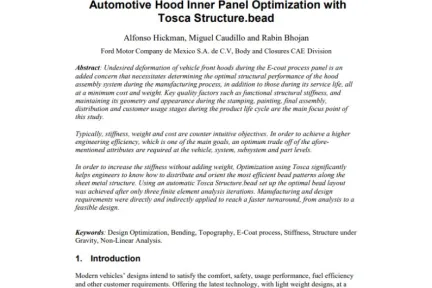
Automotive Hood Inner Panel Optimization with Tosca Structure.bead

Undesired deformation of vehicle front hoods during the E-coat process panel is an added concern that necessitates determining the optimal structural performance of the hood assembly system during the manufacturing process, in addition to those during its service life, all at a minimum cost and weight. Key quality factors such as functional structural stiffness, and maintaining its geometry and appearance during the stamping, painting, final assembly, distribution and customer usage stages during the product life cycle are the main focus point of this study.

Customer Papers

Automotive Hood Inner Panel Optimization with Tosca Structure.bead
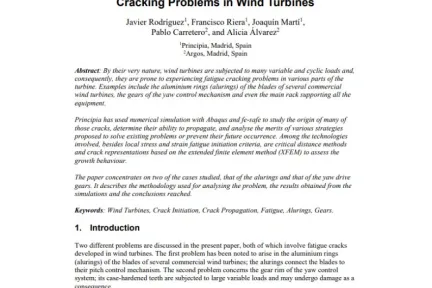
Cracking Problems in Wind Turbines

By their very nature, wind turbines are subjected to many variable and cyclic loads and, consequently, they are prone to experiencing fatigue cracking problems in various parts of the turbine. Examples include the aluminium rings (alurings) of the blades of several commercial wind turbines, the gears of the yaw control mechanism and even the main rack supporting all the equipment. The paper concentrates on two of the cases studied, that of the alurings and that of the yaw drive gears. It describes the methodology used for analysing the problem, the results obtained from the simulations and the conclusions reached.

Customer Papers

Cracking Problems in Wind Turbines
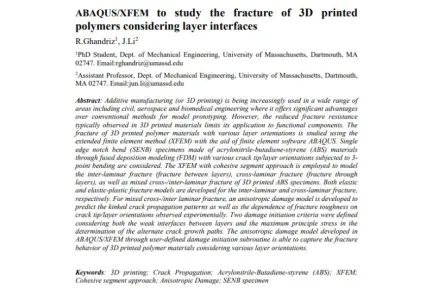
ABAQUS/XFEM to study the fracture of 3D printed polymers considering layer interfaces

Additive manufacturing (or 3D printing) is being increasingly used in a wide range of areas including civil, aerospace and biomedical engineering where it offers significant advantages over conventional methods for model prototyping. However, the reduced fracture resistance typically observed in 3D printed materials limits its application to functional components. The fracture of 3D printed polymer materials with various layer orientations is studied using the extended finite element method (XFEM) with the aid of finite element software ABAQUS. Single edge notch bend (SENB) specimens made of acrylonitrile-butadiene-styrene (ABS) materials through fused deposition modeling (FDM) with various crack tip/layer orientations subjected to 3- point bending are considered.

Customer Papers

ABAQUS/XFEM to study the fracture of 3D printed polymers considering layer interfaces
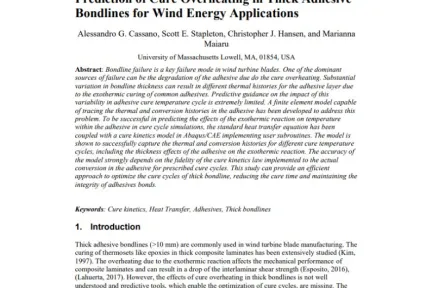
Prediction of Cure Overheating in Thick Adhesive Bondlines for Wind Energy Applications

Bondline failure is a key failure mode in wind turbine blades. One of the dominant sources of failure can be the degradation of the adhesive due do the cure overheating. Substantial variation in bondline thickness can result in different thermal histories for the adhesive layer due to the exothermic curing of common adhesives. Predictive guidance on the impact of this variability in adhesive cure temperature cycle is extremely limited. A finite element model capable of tracing the thermal and conversion histories in the adhesive has been developed to address this problem. To be successful in predicting the effects of the exothermic reaction on temperature within the adhesive in cure cycle simulations, the standard heat transfer equation has been coupled with a cure kinetics model in Abaqus/CAE implementing user subroutines.

Customer Papers

Prediction of Cure Overheating in Thick Adhesive Bondlines for Wind Energy Applications
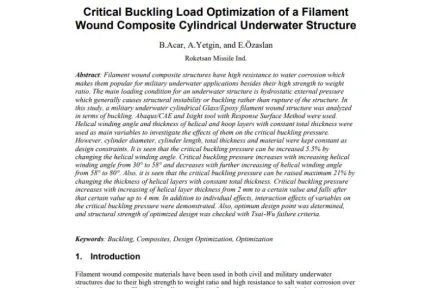
Critical Buckling Load Optimization of a Filament Wound Composite Cylindrical Underwater Structure

Filament wound composite structures have high resistance to water corrosion which makes them popular for military underwater applications besides their high strength to weight ratio. The main loading condition for an underwater structure is hydrostatic external pressure which generally causes structural instability or buckling rather than rupture of the structure. In this study, a military underwater cylindrical Glass/Epoxy filament wound structure was analyzed in terms of buckling. Abaqus/CAE and Isight tool with Response Surface Method were used. Helical winding angle and thickness of helical and hoop layers with constant total thickness were used as main variables to investigate the effects of them on the critical buckling pressure.

Customer Papers

Critical Buckling Load Optimization of a Filament Wound Composite Cylindrical Underwater Structure
260개의 결과가 있습니다.

고객 사례

150개의 결과가 있습니다.
3개의 결과가 있습니다.

SIMULIA 자기 주도 학습

학습자가 편리하게 학습을 꾸준히 이어갈 수 있도록 수백 개의 자기 주도 학습 모듈을 제공합니다.

블로그

SIMULIA 블로그에서 당사 전문가들이 전하는 최신 뉴스와 혁신에 대해 알아보세요.

775개의 결과가 있습니다.
FEM, BEM, SEA 방법을 적용한 Wave6의 소음해석 방법 소개

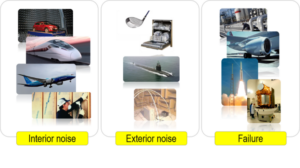
그동안 여러 산업 군에서 소음진동 현상과 관련된 문제는 다루기 어려운 난제 중 하나였습니다.​그중 진동의 경우 유한요소해석 소프트웨어를 이용하여 많은 연구가 진행되었으나 소음 문제의 경우 높은 주파수 특성으로 인해 해석 비용의 증가 및 다양한 소음 원(구조, 유동, 전자기력,

기사

FEM, BEM, SEA 방법을 적용한 Wave6의 소음해석 방법 소개

SIMULIA의 지원 서비스 알아보기

SIMULIA 전문가와 상담하여 당사의 솔루션이 모든 규모의 조직에서 원활한 협업과 지속 가능한 혁신을 실현하는 방법에 대해 알아보세요.

시작하기

학생, 교육, 전문가 및 회사를 위한 교육 과정과 강의가 제공됩니다. 당신에게 맞는 SIMULIA 교육을 찾아보세요. 

도움받기

소프트웨어 및 하드웨어 인증, 소프트웨어 다운로드, 사용자 설명서, 지원 연락처 및 서비스 제공에 대한 정보를 확인하세요.