
Real-Time Execution of SIMPACK Models under Simulation Workbench
Real-Time Execution of SIMPACK Models under Simulation Workbench
E-seminars
SIMULIA에 대해 필요한 모든 것을 찾아보세요
Real-Time Execution of SIMPACK Models under Simulation Workbench
E-seminars
Defects induced in the fabrication and application of composite laminates have substantial influence on the performance of composite structures. The effects of these undesired defects on the static and fatigue mechanical behavior are very important in the reliability and sustainability assessment. An integrative approach is developed to evaluate the major defects including voids and ply waviness from Computed Tomography (CT) scanning to multiscale modeling. Based on the CT scan results, voids and ply waviness can be captured quantitatively. These defects can be analyzed by using the represented volume element (RVE) model and statistical model in micro scale and their effects on the material properties (stiffness, strength and fracture toughness) are included into the macroscale model using a possibilistic uncertainty model.
Customer Papers
5MW Wind Database and Wind Wizard 4th Wind and Drivetrain Conference 19 April 2018, Hamburg, Germany
E-seminars
rFpro & DS Products: Integrated development software for human and autonomously driven vehicles
E-seminars
Additive manufacturing (AM) has enabled representative models and structures to be produced in a time-efficient manner relative to conventional subtractive manufacturing methods. In general, there has been wide-spread observation of fiber reinforce d polymers improving the overall mechanical property of a part relative to the bulk resin or printed polymer whether the fibers are continuous or discontinuous. The strength and stiffness increases with fiber length; however, both stiffness and strength can be also greatly influenced by the type of AM process by which ultimately defines the microstructure of the material.
Customer Papers
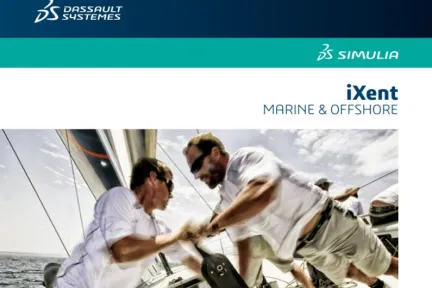
Competitive sailing requires robust part design in order to withstand the higher loads placed on the boat and its components during aggressive racing. At the same time, the designs must be as lightweight as possible to remain within race-class weight requirements. Advanced engineering company iXent was called on by the owner of racing sailboat Alegre 3 to contribute to strengthening and lightweighting a key component design.
Tech Notes
Continuous fiber prepreg tape can be transformed into platelets and used as an advanced compression-molding compound. The resulting prepreg platelet molded composite (PPMC) has a meso-scale heterogeneous structure, which means that the stress concentrations resulting from interactions between individual platelets and semi-laminated composition of the system defines the PPMC effective mechanical properties. In the present investigation, the authors developed a computational finite-element model to simulate the effective stiffness and strength of a PPMC tensile coupon. Progressive failure analysis is used to study the damaged deformation up to ultimate failure in full-sized virtual coupons with explicitly modeled stochastic meso-scale morphology and deterministic platelet size to assess the variability of PPMC stochastic effective mechanical properties.
Customer Papers
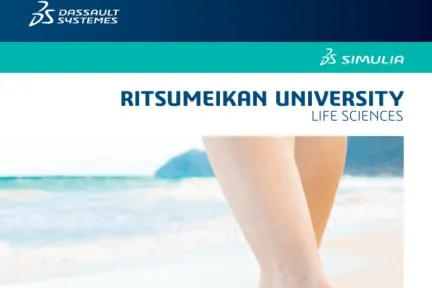
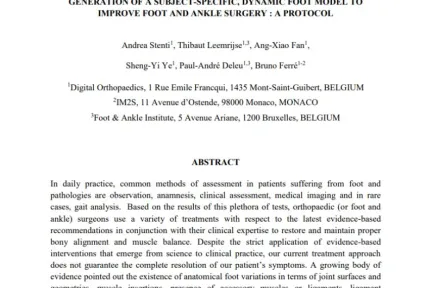
A university researcher received a request from a medical school to provide simulations of the human foot that would help surgeons plan corrective treatment for flatfoot disorder. Human tissue modeling is one of the most difficult simulations to perform and the researcher’s existing FEA software was not up to the task. Abaqus FEA from Dassault Systèmes SIMULIA provided advanced nonlinear capabilities, automatic meshing, and fast pre-and post-processing for contact, deformation and stress, plus quality graphics.
Tech Notes
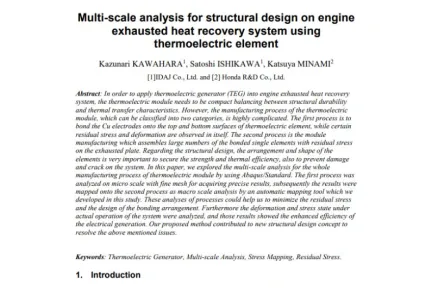
In order to apply thermoelectric generator (TEG) into engine exhausted heat recovery system, the thermoelectric module needs to be compact balancing between structural durability and thermal transfer characteristics. However, the manufacturing process of the thermoelectric module, which can be classified into two categories, is highly complicated. The first process is to bond the Cu electrodes onto the top and bottom surfaces of thermoelectric element, while certain residual stress and deformation are observed in itself. The second process is the module manufacturing which assembles large numbers of the bonded single elements with residual stress on the exhausted plate. In this paper, we explored the multi-scale analysis for the whole manufacturing process of thermoelectric module by using Abaqus/Standard.
Customer Papers
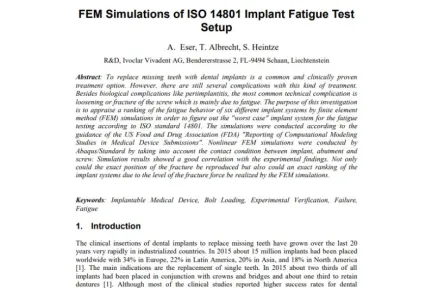
To replace missing teeth with dental implants is a common and clinically proven treatment option. However, there are still several complications with this kind of treatment. Besides biological complications like periimplantitis, the most common technical complication is loosening or fracture of the screw which is mainly due to fatigue. The purpose of this investigation is to appraise a ranking of the fatigue behavior of six different implant systems by finite element method (FEM) simulations in order to figure out the "worst case" implant system for the fatigue testing according to ISO standard 14801. The simulations were conducted according to the guidance of the US Food and Drug Association (FDA) "Reporting of Computational Modeling Studies in Medical Device Submissions".
Customer Papers
Customer Papers
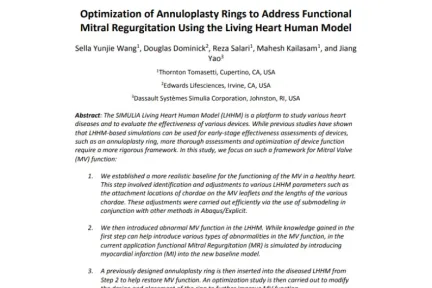
The SIMULIA Living Heart Human Model (LHHM) is a platform to study various heart diseases and to evaluate the effectiveness of various devices. While previous studies have shown that LHHM‐based simulations can be used for early‐stage effectiveness assessments of devices, such as an annuloplasty ring, more thorough assessments and optimization of device function require a more rigorous framework. In this study, we focus on such a framework for Mitral Valve (MV) function. This study demonstrates that the Living Heart Human Model can be used as a platform to better understand cardiac functioning of healthy hearts, which then allows the potential to introduce disease states, and to simulate effectiveness of potential treatment options in increasingly rigorous manners.
Customer Papers
학습자가 편리하게 학습을 꾸준히 이어갈 수 있도록 수백 개의 자기 주도 학습 모듈을 제공합니다.
SIMULIA 블로그에서 당사 전문가들이 전하는 최신 뉴스와 혁신에 대해 알아보세요.
Recently, SIMULIA introduced the 2020 SIMULIA Champions, the inaugural team of brand ambassadors...
Article
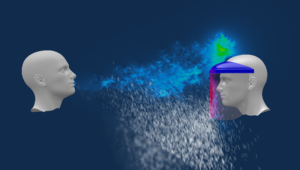
One of the automotive industry’s greatest hopes for the future is the...
Article

Below is an excerpt from a recent interview with SIMULIA‘s Director of...
Article
Recently, SIMULIA introduced the 2020 SIMULIA Champions, the inaugural team of brand ambassadors...
Article

Recently, SIMULIA introduced the 2020 SIMULIA Champions, the inaugural team of brand ambassadors...
Article
The COVID-19 crisis is unlike anything most of us have seen in...
Article
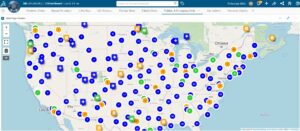
Imagine creating a product and testing out every single feature and nuance...
Article
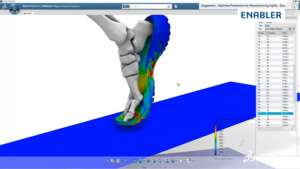
Want to use your structural engineering skills to contribute to progressing the...
Article
Recently, SIMULIA introduced the 2020 SIMULIA Champions, the inaugural team of brand...
Article
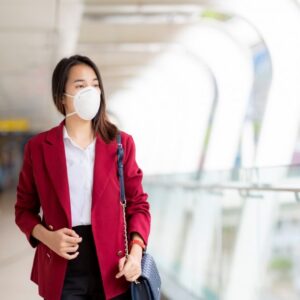
Air travelers’ confidence has been hit hard by the COVID-19 pandemic. Figures...
Article
Below is an excerpt from a recent interview with Rachel Fu, an...
Article
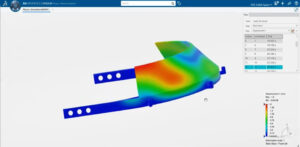
Recently, SIMULIA introduced the 2020 SIMULIA Champions, the inaugural team of brand...
Article
SIMULIA 전문가와 상담하여 당사의 솔루션이 모든 규모의 조직에서 원활한 협업과 지속 가능한 혁신을 실현하는 방법에 대해 알아보세요.
학생, 교육, 전문가 및 회사를 위한 교육 과정과 강의가 제공됩니다. 당신에게 맞는 SIMULIA 교육을 찾아보세요.
소프트웨어 및 하드웨어 인증, 소프트웨어 다운로드, 사용자 설명서, 지원 연락처 및 서비스 제공에 대한 정보를 확인하세요.