1495개의 결과가 있습니다.
Self-loosening of Nuts due to External Load

Self-loosening of nuts is a practical problem in any situations from a machine to a whole plant. Self-loosening of threaded bolt/nut systems has been researched in number of works and many of them were based on experiment historically and some were based on the finite element analyses in these years. In this paper the following self-loosening were investigated by Abaqus, namely the static loosening of nut due to the lateral motion, dynamic loosening due to the lateral impact of fastened objects and the thermal load to bolt/nut systems.

Customer Papers

Self-loosening of Nuts due to External Load
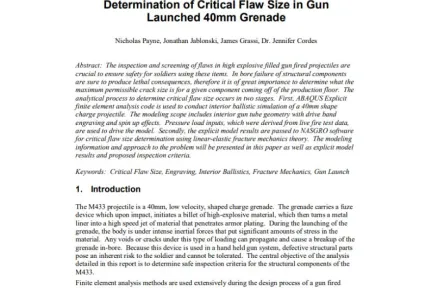
Determination of Critical Flaw Size in Gun Launched 40mm Grenade

The inspection and screening of flaws in high explosive filled gun fired projectiles are crucial to ensure safety for soldiers using these items. In bore failure of structural components are sure to produce lethal consequences, therefore it is of great importance to determine what the maximum permissible crack size is for a given component coming off of the production floor. The analytical process to determine critical flaw size occurs in two stages. First, ABAQUS Explicit finite element analysis code is used to conduct interior ballistic simulation of a 40mm shape charge projectile. The modeling scope includes interior gun tube geometry with drive band engraving and spin up effects.

Customer Papers

Determination of Critical Flaw Size in Gun Launched 40mm Grenade
Minneapolis I-35W Bridge Collapse – Engineering Evaluations and Finite Element Analyses

The National Transportation Safety Board (NTSB) investigates accidents to identify the probable cause and to make recommendations that would prevent similar accidents. Following the collapse of the I-35W bridge in Minneapolis on August 1, 2007, the NTSB worked with the Federal Highway Administration, the Minnesota Department of Transportation and other parties with information and expertise, including SIMULIA Central, to determine the circumstances that contributed to the collapse of the bridge, completing the investigation in 15 months. The NTSB concluded that the collapse of the bridge was caused by the inadequate load capacity of gusset plates used to connect the truss members, as a result of an error by the bridge design firm, Sverdrup & Parcel and Associates, Inc.

Customer Papers

Minneapolis I-35W Bridge Collapse – Engineering Evaluations and Finite Element Analyses
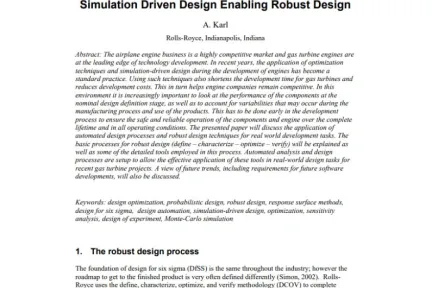
Simulation Driven Design Enabling Robust Design

The airplane engine business is a highly competitive market and gas turbine engines are at the leading edge of technology development. In recent years, the application of optimization techniques and simulation-driven design during the development of engines has become a standard practice. Using such techniques also shortens the development time for gas turbines and reduces development costs. This in turn helps engine companies remain competitive. The presented paper will discuss the application of automated design processes and robust design techniques for real world development tasks.

Customer Papers

Simulation Driven Design Enabling Robust Design
Analysis of Casing Connections Subjected to Thermal Cycle Loading

There are generally three types of connections used in intermediate or production casing of thermal wells: API (American Petroleum Institute) round, API buttress and proprietary premium connections. This paper presents finite element analysis of these three types of casing connections subjected to thermal cycle loading. Based on analysis results, this paper demonstrates that the premium connection, which has a metal-to-metal seal region, is the most suitable of these three connection designs for the use in thermal wells, in terms of structural integrity and sealability. This paper also presents recommendations for casing connection design for successful service in thermal well applications.

Customer Papers

Analysis of Casing Connections Subjected to Thermal Cycle Loading
The application of ABAQUS in seismic analysis of connected structures

The connected structure refers to the kind of building which is composed of two or more towers connected by the connecting body in a certain height, belonging to the irregular building structure system. According to “Technical Specification for Concrete Structures of Tall Building”, the time-history analysis method should be adopted in the seismic analysis of the connected structure. The structure may have a larger plastic deformation under rare earthquake, so it is difficult to converge when the implicit solution method is used by the conventional finite element software. While the explicit integral technology provided by ABAQUS can solve the nonlinear dynamics problems better, it has a broader application in elastic-plastic dynamic analysis. Taking a specific project as an object, the application of ABAQUS in seismic analysis of connected structures is presented in detail in this paper.

Customer Papers

The application of ABAQUS in seismic analysis of connected structures
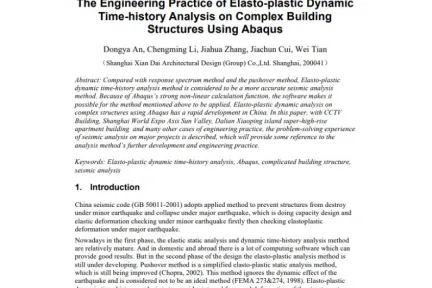
The Engineering Practice of Elasto-plastic Dynamic Time-history Analysis on Complex Building Structures Using Abaqus

Compared with response spectrum method and the pushover method, Elasto-plastic dynamic time-history analysis method is considered to be a more accurate seismic analysis method. Because of Abaqus’s strong non-linear calculation function, the software makes it possible for the method mentioned above to be applied. Elasto-plastic dynamic analysis on complex structures using Abaqus has a rapid development in China. In this paper, with CCTV Building, Shanghai World Expo Axis Sun Valley, Dalian Xiaoping island super-high-rise apartment building and many other cases of engineering practice, the problem-solving experience of seismic analysis on major projects is described, which will provide some reference to the analysis method’s further development and engineering practice.

Customer Papers

The Engineering Practice of Elasto-plastic Dynamic Time-history Analysis on Complex Building Structures Using Abaqus
Calibration of Nonlinear Viscoelastic Materials in Abaqus Using the Adaptive Quasi-Linear Viscoelastic Model

This work presents a method for calibrating the built-in Abaqus hyperelasticviscoelastic material models based on test data from soft material loading and relaxation tests. This approach can be used to represent the uniaxial material behavior with 1-D Abaqus connector elements or by using the built-in 3-D material models. It is based on the Adaptive Quasi-Linear Viscoelastic (AQLV) theory, developed by Nekouzadeh, Pryse, Elson, and Genin, which offers an easy and powerful method for the calibration of highly viscoelastic materials such as soft tissue. In this paper, we first implement the AQLV method in ABAQUS using connector elements.

Customer Papers

Calibration of Nonlinear Viscoelastic Materials in Abaqus Using the Adaptive Quasi-Linear Viscoelastic Model
Linear Elastic Fracture Mechanics Analysis of Flaws within Residual Stress Fields

A procedure for calculating Linear Elastic Fracture Mechanics (LEFM) Stress Intensity Factors associated with postulated flaws located within regions of residual stress that result from large strain forming processes is presented. The procedure is validated by analyzing a structural system with residual stresses representative of a plane strain 3-point bending configuration, for which a known solution exists. The procedure is also applicable to the analysis of flaws in residual stress fields that result from in-service loads leading to large plastic strains, as illustrated by the determination of stress intensity factors associated with a postulated flaw in a deployed coronary stent. The procedure utilizes the ABAQUS import capability where the residual stresses are imported along with the updated model geometry.

Customer Papers

Linear Elastic Fracture Mechanics Analysis of Flaws within Residual Stress Fields
Application of «Soil» Dashpots in Modal Method Analysis of Civil Structures of Nuclear Power Plants

Now in world practice there are two methods of dynamic analysis, which are intensively used, that are direct integration method and modal method. Advantage of a modal method is the opportunity of the account of normative values of attenuation in soil-structure systems by means of using special option *Modal Composite in Abaqus. In direct integration method there is an activization of dashpot elements, which are necessary for the account of radiating attenuation, but used in materials Reyleigh damping provides too conservative results in comparison with normative values. For overcoming the arisen problem in the present work opportunities of the new approach developed in Abaqus which is the combination of the named two methods realized with help of SIM architecture are investigated.

Customer Papers

Application of «Soil» Dashpots in Modal Method Analysis of Civil Structures of Nuclear Power Plants
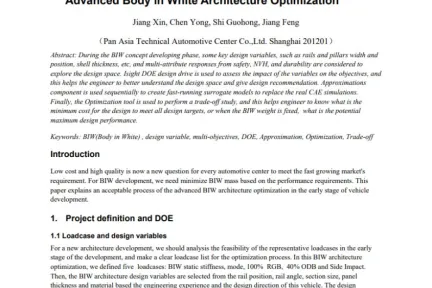
Advanced Body in White Architecture Optimization

During the BIW concept developing phase, some key design variables, such as rails and pillars width and position, shell thickness, etc, and multi-attribute responses from safety, NVH, and durability are considered to explore the design space. Isight DOE design drive is used to assess the impact of the variables on the objectives, and this helps the engineer to better understand the design space and give design recommendation. Approximations component is used sequentially to create fast-running surrogate models to replace the real CAE simulations. Finally, the Optimization tool is used to perform a trade-off study, and this helps engineer to know what is the minimum cost for the design to meet all design targets, or when the BIW weight is fixed, what is the potential maximum design performance.

Customer Papers

Advanced Body in White Architecture Optimization
Fracture analysis of the battery cans for Implantable Pulse Generators

The stresses in a battery housing used in Implantable Pulse Generators (IPGs), also known as pacemakers, were investigated using Abaqus/Standard. There were three levels of analysis: the global level, the three-dimensional submodel level and the plane strain submodel level. The output of the global analysis was fed into the three-dimensional submodel analysis and subsequently the output of the three-dimensional submodel analysis was fed into the plane strain submodel analysis. The simulation results of the global model were used to drive the more detailed three-dimensional submodels on long and short sides of the battery models.

Customer Papers

Fracture analysis of the battery cans for Implantable Pulse Generators
260개의 결과가 있습니다.

고객 사례

150개의 결과가 있습니다.
3개의 결과가 있습니다.

SIMULIA 자기 주도 학습

학습자가 편리하게 학습을 꾸준히 이어갈 수 있도록 수백 개의 자기 주도 학습 모듈을 제공합니다.

블로그

SIMULIA 블로그에서 당사 전문가들이 전하는 최신 뉴스와 혁신에 대해 알아보세요.

775개의 결과가 있습니다.

SIMULIA의 지원 서비스 알아보기

SIMULIA 전문가와 상담하여 당사의 솔루션이 모든 규모의 조직에서 원활한 협업과 지속 가능한 혁신을 실현하는 방법에 대해 알아보세요.

시작하기

학생, 교육, 전문가 및 회사를 위한 교육 과정과 강의가 제공됩니다. 당신에게 맞는 SIMULIA 교육을 찾아보세요. 

도움받기

소프트웨어 및 하드웨어 인증, 소프트웨어 다운로드, 사용자 설명서, 지원 연락처 및 서비스 제공에 대한 정보를 확인하세요.