SIMULIA リソース・センター

SIMULIA に関する必要な情報すべてが見つかります 

検索条件に一致する項目が1509件あります
System Integration as Key for Improving and Speeding up the Preliminary Design Phase of Aero Engines

Usually the development of a new engine is initialized by the request of an aircraft manufacturer who formulates basic requirements for the propulsion system. Preliminary engine design is then the first design phase at the aero-engine manufacturer where the engineer’s task is to develop a proper engine concept fulfilling all requirements and to respond to the aircraft company in a short time. At this early design stage only simple models can be used, but the decisions made are far-reaching and need to be precise. Therefore, engine component scaling tools are applied to increase prediction accuracy.

Customer Papers
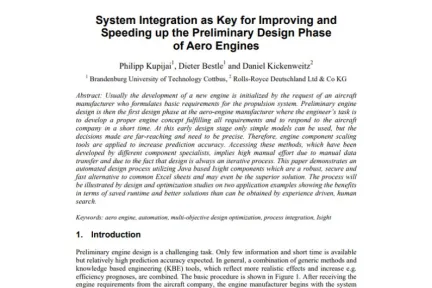
System Integration as Key for Improving and Speeding up the Preliminary Design Phase of Aero Engines
Multiphysics Simulations of Representative Hypersonic Vehicle Structures

This paper extends a previously developed computational framework for coupled aerothermoelastic simulations for hypersonic vehicle structures in extreme environments. An aeroheating verification and validation case is first conducted on a Mach 6.5+ spherical dome protuberance that was tested in a NASA wind tunnel. ATA’s simulation includes aerothermoelasticity in the physics and captures the heating of the compliant dome structure during the first five seconds of exposure to hypersonic flow. This case is followed by a coupled quasi-static aerothermoelastic analysis of an acreage panel-level structural component for a sustained, reusable, air-breathing Mach 5–7 cruise horizontal-takeoff platform.

Customer Papers

Multiphysics Simulations of Representative Hypersonic Vehicle Structures
Modeling of High-Rate Ballistic Impact of Brittle Armors with Abaqus/Explicit

Accurate modeling and simulation of brittle armor panels under projectile impact is a challenging problem involving costly experimental characterization of material properties and verification of ballistic impact response with actual test data. The nature of impact of brittle armors, specifically those made of cementitious materials, is a problem of much complexity, due to high-rate fragmentation caused by strong compressive shock waves followed by reflected tensile waves. Traditional Lagrangian FEM of these problems can introduce errors and issues of convergence as a direct result of the resulting large deformations of free surfaces. Introducing element erosion can resolve some of the issues related to excessive distortion of elements, but presents new problems involving conservation of mass.

Customer Papers

Modeling of High-Rate Ballistic Impact of Brittle Armors with Abaqus/Explicit
Finite Element Analysis of Head Impact in Contact Sports

Traumatic brain injury (TBI) is one of the world’s major causes of death and disability. To aid companies in designing safer and improved protective gear and to aid the medical community in producing improved quantitative TBI diagnosis and assessment tools, a multiscale finite element model of the human brain, head and neck is being developed. Recorded impact data from football and hockey helmets instrumented with accelerometers are compared to simulated impact data in the laboratory. Using data from these carefully constructed laboratory experiments, we can quantify impact location, magnitude, and linear and angular accelerations of the head. The resultant forces and accelerations are applied to a fully meshed head-form created from MRI data by Simpleware.

Customer Papers

Finite Element Analysis of Head Impact in Contact Sports
Periodic media transport and its application at voestalpine Krems

voestalpine Krems is a roll forming corporation constantly working on the improvement of product quality as well as the development of new production processes. Abaqus is used in both areas. Within this paper both approaches are shown and compared to each other. The first example problem shows a planetary rolling mill where we performed a feasibility study. The second example problem covers the whole roll forming process. The results are directly fed back to our engineering team to optimize the process. Critical further processing steps can be modeled afterwards by using predamaged parts.

Customer Papers

Periodic media transport and its application at voestalpine Krems
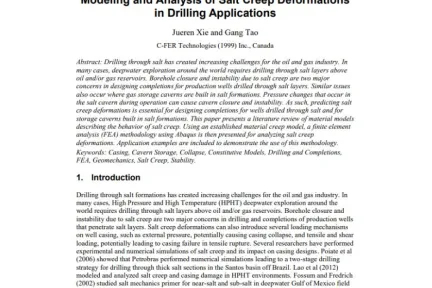
Modeling and Analysis of Salt Creep Deformations in Drilling Applications

Drilling through salt has created increasing challenges for the oil and gas industry. In many cases, deepwater exploration around the world requires drilling through salt layers above oil and/or gas reservoirs. Borehole closure and instability due to salt creep are two major concerns in designing completions for production wells drilled through salt layers. Similar issues also occur where gas storage caverns are built in salt formations. Pressure changes that occur in the salt cavern during operation can cause cavern closure and instability.

Customer Papers

Modeling and Analysis of Salt Creep Deformations in Drilling Applications
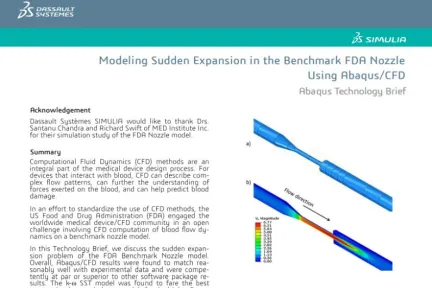
Modeling Sudden Expansion in the Benchmark FDA Nozzle Using Abaqus/CFD

In this Technology Brief, we discuss the sudden expansion problem f the FDA Benchmark Noozle model. Overall, Abaqus/CFD results were found to match reasonably well with experimental data and were competently at par or superior to other package software results. The k-ω SST model was found to fare the best among the three turbulence models for the higher Reynolds number cases.

Solution Briefs

Modeling Sudden Expansion in the Benchmark FDA Nozzle Using Abaqus/CFD
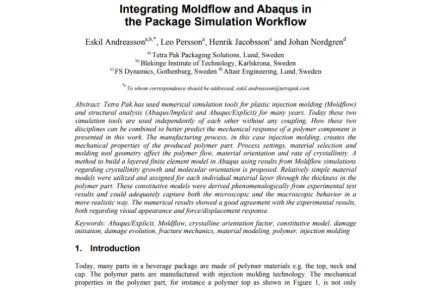
Integrating Moldflow and Abaqus in the Package Simulation Workflow

Tetra Pak has used numerical simulation tools for plastic injection molding (Moldflow) and structural analysis (Abaqus/Implicit and Abaqus/Explicit) for many years. Today these two simulation tools are used independently of each other without any coupling. How these two disciplines can be combined to better predict the mechanical response of a polymer component is presented in this work. The manufacturing process, in this case injection molding, creates the mechanical properties of the produced polymer part. Process settings, material selection and molding tool geometry affect the polymer flow, material orientation and rate of crystallinity.

Contact

Integrating Moldflow and Abaqus in the Package Simulation Workflow
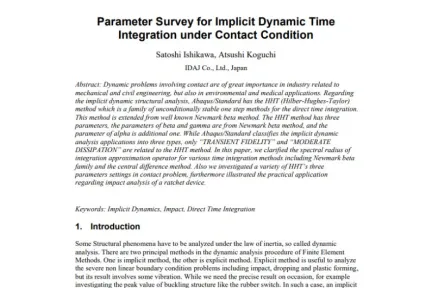
Parameter Survey for Implicit Dynamic Time Integration under Contact Condition

Dynamic problems involving contact are of great importance in industry related to mechanical and civil engineering, but also in environmental and medical applications. Regarding the implicit dynamic structural analysis, Abaqus/Standard has the HHT (Hilber-Hughes-Taylor) method which is a family of unconditionally stable one step methods for the direct time integration. This method is extended from well known Newmark beta method.

Customer Papers

Parameter Survey for Implicit Dynamic Time Integration under Contact Condition
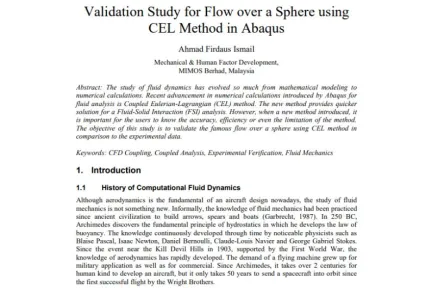
Validation Study for Flow over a Sphere using CEL Method in Abaqus

The study of fluid dynamics has evolved so much from mathematical modeling to numerical calculations. Recent advancement in numerical calculations introduced by Abaqus for fluid analysis is Coupled Eulerian-Lagrangian (CEL) method. The new method provides quicker solution for a Fluid-Solid Interaction (FSI) analysis. However, when a new method introduced, it is important for the users to know the accuracy, efficiency or even the limitation of the method. The objective of this study is to validate the famous flow over a sphere using CEL method in comparison to the experimental data.

Customer Papers

Validation Study for Flow over a Sphere using CEL Method in Abaqus
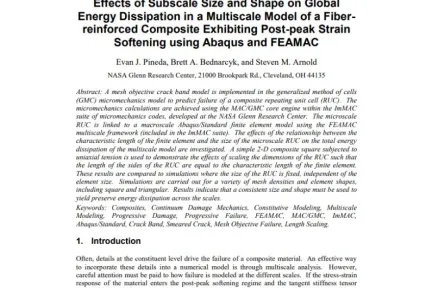
Effects of Subscale Size and Shape on Global Energy Dissipation in a Multiscale Model of a Fiberreinforced Composite Exhibiting Post-peak Strain Softening using Abaqus and FEAMAC

A mesh objective crack band model is implemented in the generalized method of cells (GMC) micromechanics model to predict failure of a composite repeating unit cell (RUC). The micromechanics calculations are achieved using the MAC/GMC core engine within the ImMAC suite of micromechanics codes, developed at the NASA Glenn Research Center. The microscale RUC is linked to a macroscale Abaqus/Standard finite element model using the FEAMAC multiscale framework (included in the ImMAC suite). The effects of the relationship between the characteristic length of the finite element and the size of the microscale RUC on the total energy dissipation of the multiscale model are investigated.

Customer Papers

Effects of Subscale Size and Shape on Global Energy Dissipation in a Multiscale Model of a Fiberreinforced Composite Exhibiting Post-peak Strain Softening using Abaqus and FEAMAC
検索条件に一致する項目が278件あります

お客様活用事例

検索条件に一致する項目が153件あります
検索条件に一致する項目が3件あります

SIMULIA 自己学習

ダッソー・システムズでは、それぞれのご都合に合わせて継続的に学習できるよう、さまざまな自己学習モジュールをご用意しています

ブログ

ダッソー・システムズの技術者が最新ニュースやイノベーションについて書いている SIMULIA ブログをご覧ください。

検索条件に一致する項目が764件あります

SIMULIA のソリューションの詳細

組織の規模の大小を問わず、シームレスなコラボレーションと持続可能なイノベーションに、当社のソリューションがどう役立つかについて、SIMULIA のエンジニアがご説明します。

始める

学生、教育機関、専門家、企業向けに、さまざまなトレーニング・コースをご提供しています。お客様に最適な SIMULIA トレーニングを受講してください。 

サポートを利用する

ソフトウェアおよびハードウェアの認証情報、ソフトウェアのダウンロード、ユーザー・ドキュメント、サポート窓口、ならびに提供サービスに関する情報はこちらから。