SIMULIA リソース・センター

SIMULIA に関する必要な情報すべてが見つかります 

検索条件に一致する項目が1509件あります
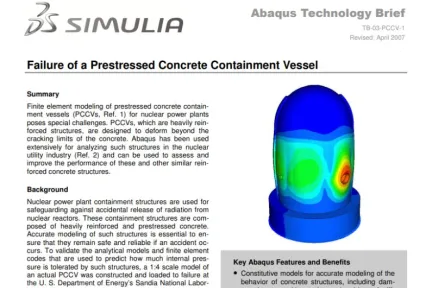
Failure of a Prestressed Concrete Containment Vessel

Finite element modeling of prestressed concrete containment vessels (PCCVs) for nuclear power plants poses special challenges. PCCVs, which are heavily reinforced structures, are designed to deform beyond the cracking limits of the concrete. Abaqus has been used extensively for analyzing such structures in the nuclear utility industry and can be used to assess and improve the performance of these and other similar reinforced concrete structures.

Solution Briefs

Failure of a Prestressed Concrete Containment Vessel
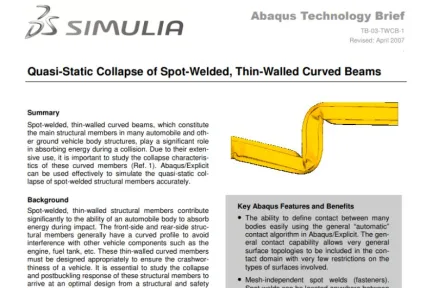
Quasi-Static Collapse of Spot-Welded, Thin-Walled Curved Beams

Spot-welded, thin-walled curved beams, which constitute the main structural members in many automobile and other ground vehicle body structures, play a significant role in absorbing energy during a collision. Due to their extensive use, it is important to study the collapse characteristics of these curved members. Abaqus/Explicit can be used effectively to simulate the quasi-static collapse of spot-welded structural members accurately.

Solution Briefs

Quasi-Static Collapse of Spot-Welded, Thin-Walled Curved Beams
XFEM Analyses of Critical Cracks in a Pressure Tap for a 40mm Gun Breech

Critical flaw size was estimated using the Extended Finite Element Method (XFEM) capabilities in the general purpose finite element program ABAQUS. Results suggest that the pressure loads were not high enough to initiate a crack or propagate cracks within the critical defect size limits of the breech for pressure loads currently used in test and evaluation. The results are consistent with the 150+ successful shots that have been completed and the 1000+ shots completed on a similar breech with similar pressure taps.

Customer Papers

XFEM Analyses of Critical Cracks in a Pressure Tap for a 40mm Gun Breech
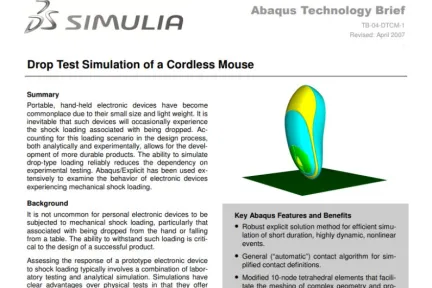
Drop Test Simulation of a Cordless Mouse

Portable, hand-held electronic devices have become commonplace due to their small size and light weight. It is inevitable that such devices will occasionally experience the shock loading associated with being dropped. Accounting for this loading scenario in the design process, both analytically and experimentally, allows for the development of more durable products. The ability to simulate drop-type loading reliably reduces the dependency on experimental testing. Abaqus/Explicit has been used extensively to examine the behavior of electronic devices experiencing mechanical shock loading.

Solution Briefs

Drop Test Simulation of a Cordless Mouse
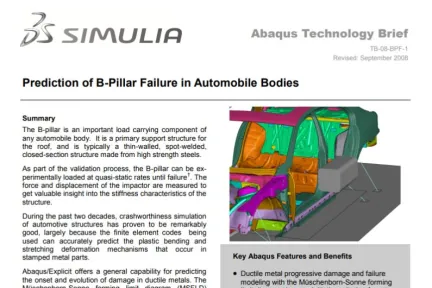
Prediction of B-Pillar Failure in Automobile Bodies

Abaqus/Explicit offers a general capability for predicting the onset and evolution of damage in ductile metals. The Müschenborn-Sonne forming limit diagram (MSFLD) damage initiation criterion allows for the prediction of necking instability in sheet metal. When combined with appropriate damage evolution criteria, sheet metal rupture initiated by necking can be captured in an Abaqus/ Explicit simulation. In this Technology Brief, the MSFLD criterion is employed to investigate the failure of a B-pillar structure. Abaqus/Explicit results are shown to match well with experimental data provided by BMW.

Solution Briefs

Prediction of B-Pillar Failure in Automobile Bodies
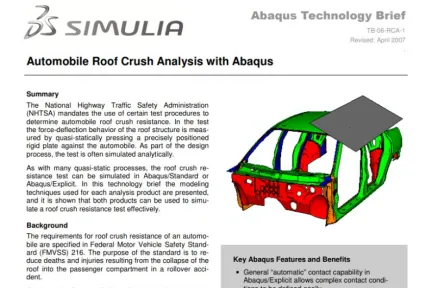
Automobile Roof Crush Analysis with Abaqus

As with many quasi-static processes, the roof crush resistance test can be simulated in Abaqus/Standard or Abaqus/Explicit. In this technology brief the modeling techniques used for each analysis product are presented, and it is shown that both products can be used to simulate a roof crush resistance test effectively.

Solution Briefs

Automobile Roof Crush Analysis with Abaqus
Iterative Design Evaluation Process in Abaqus for CATIA V5

In this Technology Brief two approaches are described to illustrate the productivity gains possible with AFC. The first uses CATIA’s Knowledgeware capability to define parametric studies that assist in making engineering decisions. With this approach, geometry and load parameters can be captured in a design table to further simplify model modifications. The second approach converts proven analysis methods into templates that can be reused to analyze design variations efficiently and with minimal effort.

Solution Briefs

Iterative Design Evaluation Process in Abaqus for CATIA V5
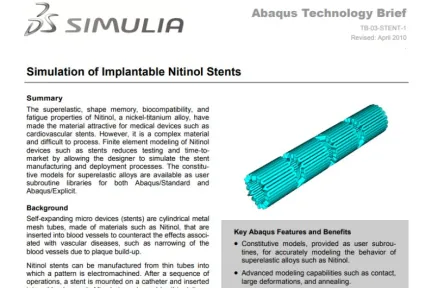
Simulation of Implantable Nitinol Stents

Self-expanding micro devices (stents) are cylindrical metal mesh tubes, made of materials such as Nitinol, that are inserted into blood vessels to counteract the effects associated with vascular diseases, such as narrowing of the blood vessels due to plaque build-up. Nitinol stents can be manufactured from thin tubes into which a pattern is electromachined. After a sequence of operations, a stent is mounted on a catheter and inserted into a blood vessel. After being released by this delivery system, the stent self-expands and exerts a radial force on the wall of the blood vessel.

Solution Briefs

Simulation of Implantable Nitinol Stents
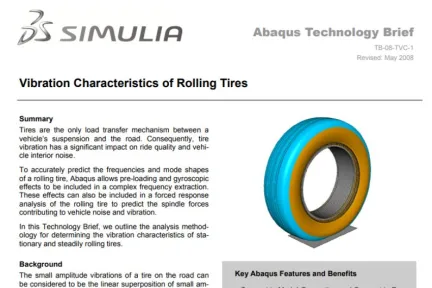
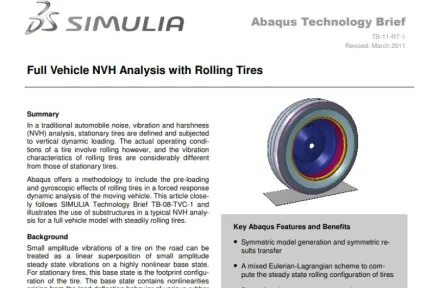
Full Vehicle NVH Analysis with Rolling Tires

Abaqus offers a methodology to include the pre-loading and gyroscopic effects of rolling tires in a forced response dynamic analysis of the moving vehicle. This article closely follows SIMULIA Technology Brief TB-08-TVC-1 and illustrates the use of substructures in a typical NVH analysis for a full vehicle model with steadily rolling tires.

Solution Briefs

Full Vehicle NVH Analysis with Rolling Tires
Lowest cost printer chassis design that would pass a series of transportation drop tests, utilizing design of experiments in conjunction with Abaqcus/ Explicit analysis.

A printer chassis provides an important function of locating and securing the relative position of all the sub-systems that makeup a printer. The customer location could be thousands of miles away from the factory and many modes of transportation are required from ship, train, trucks, forklift, to pushing across corridors, stairs and elevators. The transportation loads are the most sever the printer would see in its life time. These include impacts on all sides at 3 MPH to an 8 inch vertical drop. In today’s competitive market cost is as critical a function as performance to succeed in the market. To design the lowest cost chassis, 3 large highly stressed parts in the chassis were optimized for cost. Two parameters; sheet metal thickness, and material strength were used to minimize the chassis cost provided the combination passed each one of the six unique transportation tests. A six factor, two levels, Taguchi L12 matrix was utilized for the design of experiment (DOE). Abaqus/ Explicit analysis were used for virtual transportation testing to compute the output responses of the DOE. The design optimization exercise resulted in an addition 6% cost savings.

Customer Papers

Lowest cost printer chassis design that would pass a series of transportation drop tests, utilizing design of experiments in conjunction with Abaqcus/ Explicit analysis.
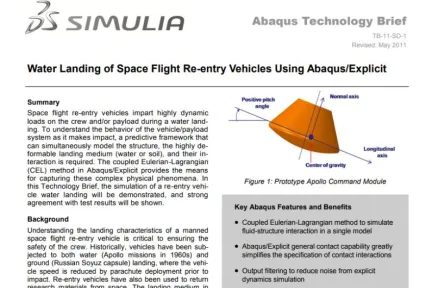
Water Landing of Space Flight Re-entry Vehicles Using AbaqusExplicit

Space flight re-entry vehicles impart highly dynamic loads on the crew and/or payload during a water landing. To understand the behavior of the vehicle/payload system as it makes impact, a predictive framework that can simultaneously model the structure, the highly deformable landing medium (water or soil), and their interaction is required. The coupled Eulerian-Lagrangian (CEL) method in Abaqus/Explicit provides the means for capturing these complex physical phenomena. In this Technology Brief, the simulation of a re-entry vehicle water landing will be demonstrated, and strong agreement with test results will be shown.

Solution Briefs

Water Landing of Space Flight Re-entry Vehicles Using AbaqusExplicit
検索条件に一致する項目が278件あります

お客様活用事例

検索条件に一致する項目が153件あります
検索条件に一致する項目が3件あります

SIMULIA 自己学習

ダッソー・システムズでは、それぞれのご都合に合わせて継続的に学習できるよう、さまざまな自己学習モジュールをご用意しています

ブログ

ダッソー・システムズの技術者が最新ニュースやイノベーションについて書いている SIMULIA ブログをご覧ください。

検索条件に一致する項目が764件あります

SIMULIA のソリューションの詳細

組織の規模の大小を問わず、シームレスなコラボレーションと持続可能なイノベーションに、当社のソリューションがどう役立つかについて、SIMULIA のエンジニアがご説明します。

始める

学生、教育機関、専門家、企業向けに、さまざまなトレーニング・コースをご提供しています。お客様に最適な SIMULIA トレーニングを受講してください。 

サポートを利用する

ソフトウェアおよびハードウェアの認証情報、ソフトウェアのダウンロード、ユーザー・ドキュメント、サポート窓口、ならびに提供サービスに関する情報はこちらから。