
University of Moncton
University of Moncton uses Virtual Twins for smart city planning in Moncton and Dieppe, balancing density, housing and biodiversity.
Customer Story
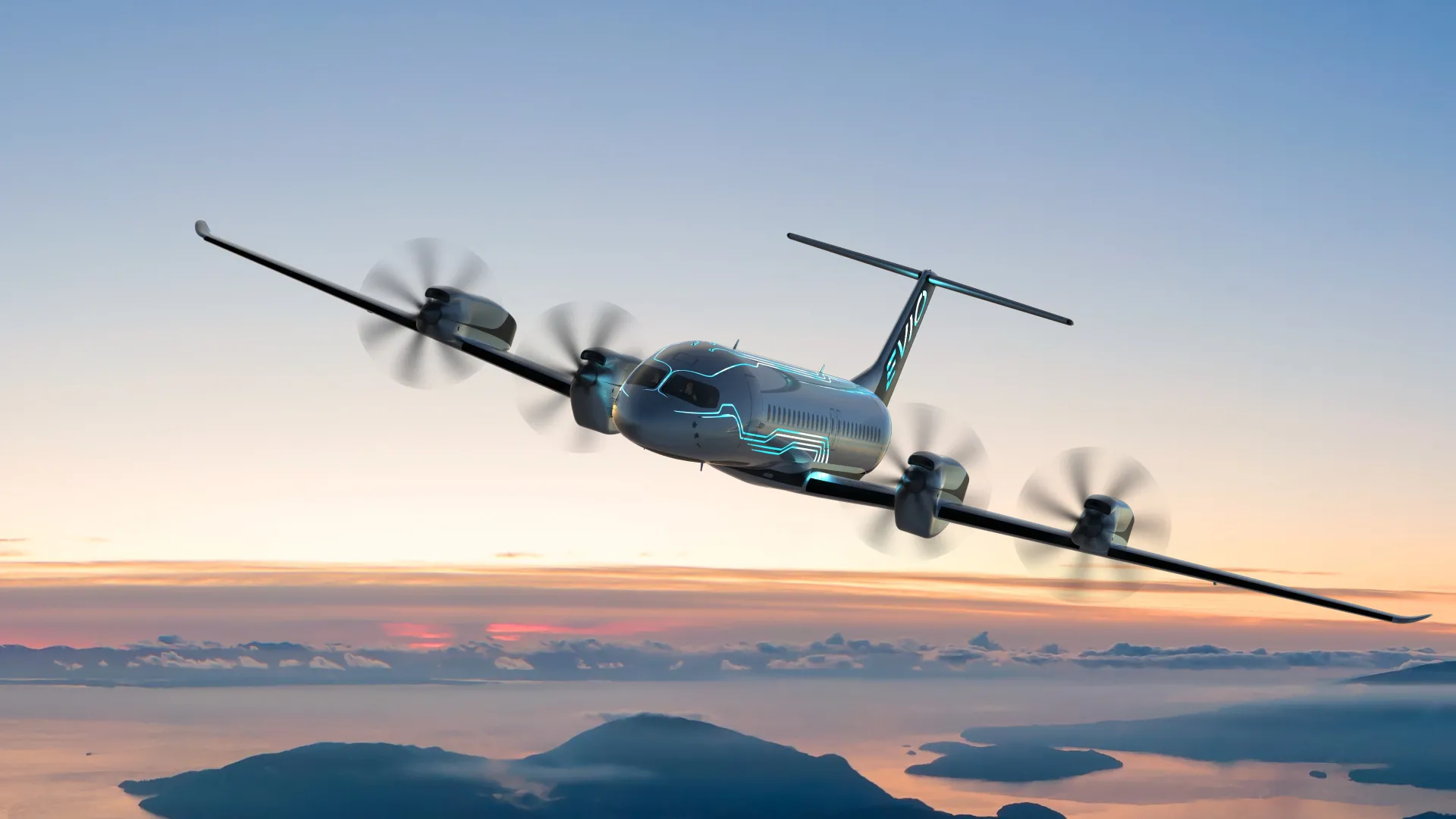
To develop a hybrid electric aircraft, EVIO chose the 3DEXPERIENCE platform on the cloud to establish a connected environment for 3D design, collaboration, product data management and VR experiences.
Retired astronaut and former International Space Station commander Chris Hadfield recently stood inside a new regional hybrid electric aircraft that is yet to be built.
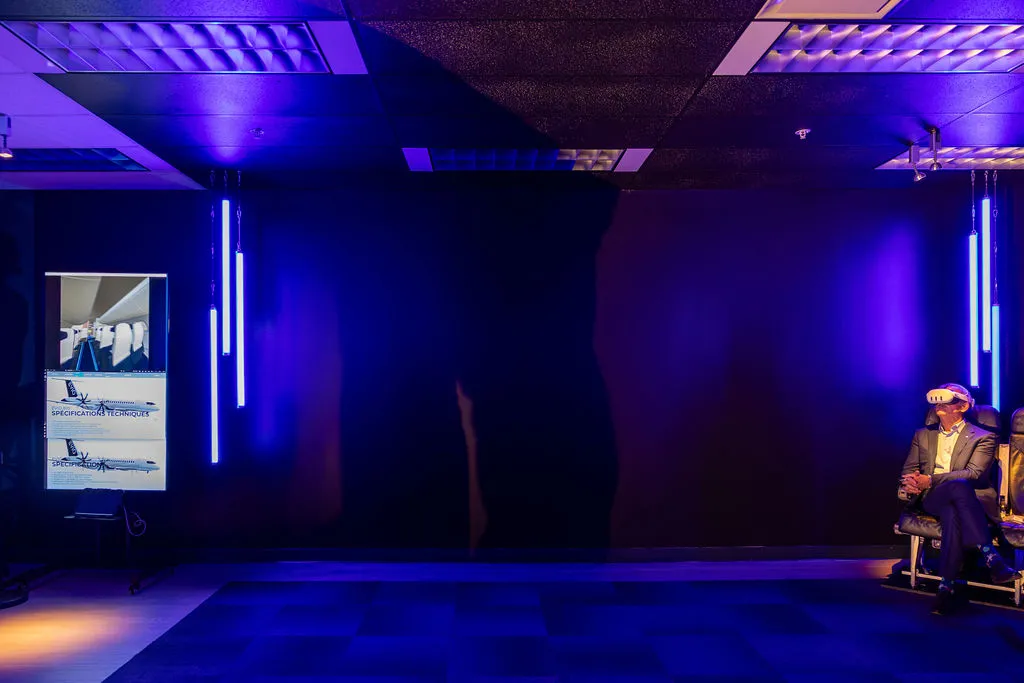
Wearing a virtual reality (VR) headset while at the Montreal office of aviation startup EVIO, he looked down the cabin aisle, examined the wing and experienced the aircraft at full scale. The structure around him was not a marketing rendering; it was a live engineering model created using Dassault Systèmes’ 3DEXPERIENCE platform on the cloud. This gave Hadfield an opportunity to fully understand EVIO’s vision and ambition.
“We’re developing the EVIO-810 – a new regional aircraft in the 76-to-80-seat category,” said Luc Van Bavel, EVIO’s co-founder and chief technology officer. “Our mission is to provide regional airlines with an airplane that delivers a significant reduction in fuel consumption and emissions.”
That goal directly addresses the tough economics facing regional aviation today. Flights of 500 km (310 miles) or less can produce nearly twice as much CO₂ per passenger-kilometer as flights over 1,000 km (621 miles), because the relatively fuel-intensive take-off and climb phases account for a greater proportion of the shorter journey. At the same time, airlines operate under constant pressure from fuel-price volatility and thin margins, relying heavily on older aircraft that have changed little in decades and give passengers a cramped and noisy onboard experience.
The EVIO-810 tackles all of these challenges. “By operating an aircraft that burns substantially less fuel, we can make operating costs more predictable and economically attractive while also improving sustainability,” Van Bavel said. “We also want to offer a level of comfort that is much closer to a larger commercial airplane, with a quieter cabin and a much better passenger experience.”
The company’s plug-in hybrid propulsion system is central to its vision. “It’s a bit like a hybrid car,” Van Bavel said. “You can charge it before leaving and on short ranges you can operate all-electric with zero emissions. At airports, we always operate in all-electric mode, which provides a significant reduction in local emissions and noise. To operate longer ranges, we start using fuel with the turbine.”
Engineering an aircraft as ambitious as the EVIO-810 is no small task – particularly for a startup. The company quickly realized that to succeed it needed to adopt industry-standard tools and processes.
“When I started, we were all saving design files into one big folder,” said Walid Assi, product lifecycle management (PLM) engineer at EVIO. “That wasn’t very effective because we were constantly worried that someone else would overwrite our work. We needed a platform that would give us better control over who was modifying what and provide full traceability of our engineering data.”
EVIO chose to take advantage of Dassault Systèmes’ 3DEXPERIENCE for Startups program, which gave the team access to an enterprise-grade environment that supports 3D design, collaboration, data management and VR experiences all in one place. The platform also will allow EVIO to easily scale as needed and expand with additional capabilities down the road.
“The 3DEXPERIENCE platform is a very attractive proposition,” Assi said. “We were already using CATIA V5 for design, and all of our engineers had experience with Dassault Systèmes’ products. Staying with that familiarity helped us a lot when it came to transitioning to the solution itself.”
Rather than an on-premise implementation, the cloud removes the burden of EVIO managing its own IT infrastructure. “As a startup, we don’t have a full-fledged IT department,” Assi said. “The cloud gives us a plug-and-play option, and everybody can connect from anywhere. That lets us focus on what we want to do – which is build the airplane. We don’t have the headache of taking care of the software itself.”
The transition was straightforward. EVIO took its existing CATIA V5 data into the platform using the built-in file-based data import (FBDI) tool, decomposing large aircraft assemblies into manageable structures while preserving all the links between them.
What the 3DEXPERIENCE platform allows us to do is open the entire airplane in less than a minute. That means we are not working in silos anymore, loading a small assembly to be able to work. Now we can load everything and work in context: we’re actually looking at where the parts connect, where the assemblies connect and where the systems connect. That means we’re avoiding problems early on – and that’s a big advantage.
For Jean-Sébastien Leclerc, Head of Structural and Design engineering at EVIO, the platform’s biggest business impact is the speed at which new engineers become productive.
“Montreal is one of the world’s leading aerospace hubs and it has a strong Dassault Systèmes user base, so having the 3DEXPERIENCE platform made a real difference in the speed of transition for engineers joining our program,” he said. “From day one, they could work in our digital mock-up (DMU) of the EVIO-810 and participate in the concept review.”
These aren’t the only speed improvements. Prior to adopting the platform, engineers would have to load and work on individual components in isolation because it took too long to load the entire assembly. That’s now changed.
“What the 3DEXPERIENCE platform allows us to do is open the entire airplane in less than a minute,” Assi said. “That means we are not working in silos anymore, loading a small assembly to be able to work. Now we can load everything and work in context: we’re actually looking at where the parts connect, where the assemblies connect and where the systems connect. That means we’re avoiding problems early on – and that’s a big advantage.”
ENOVIA has changed the day-to-day discipline of how EVIO’s engineers manage their data. Although the company’s old shared folder approach demanded constant vigilance, ENOVIA’s lifecycle functionality now gives the team clear ownership over every file.
“ENOVIA adds guardrails around our data,” Assi said. “Before, we had to check and double-check that we weren’t saving over somebody else’s work. Now, we don’t have that problem. With the lifecycle controls, we can reserve, lock or unlock a file, so we can work with greater confidence. When we open a model, we know nobody else is modifying it. When we save, we know we’re not overwriting someone else.”
The result, Assi said, is a team that collaborates more openly. “Engineers don’t hesitate anymore to tell somebody, ‘Hey, open this model and check it out.’ This is the biggest benefit of ENOVIA.”
That same transparency helps EVIO keep its ambitious development schedule on track. “Since we’re all working on the same platform, we all know what’s happening,” Assi said. “Teams are working collaboratively, so they can signal each other if they see something happening on the other side, before it becomes an issue at the milestone itself. It helps us prevent last-minute errors.”
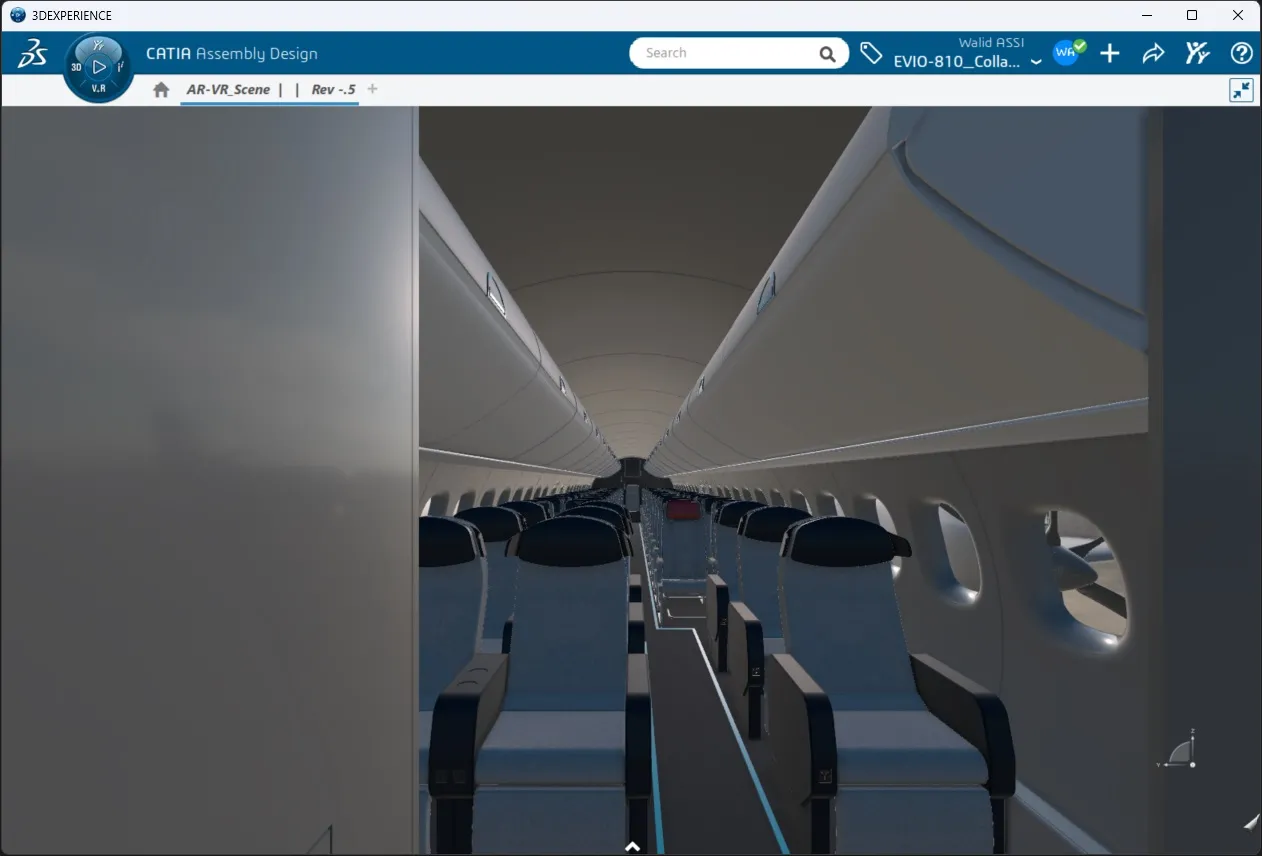
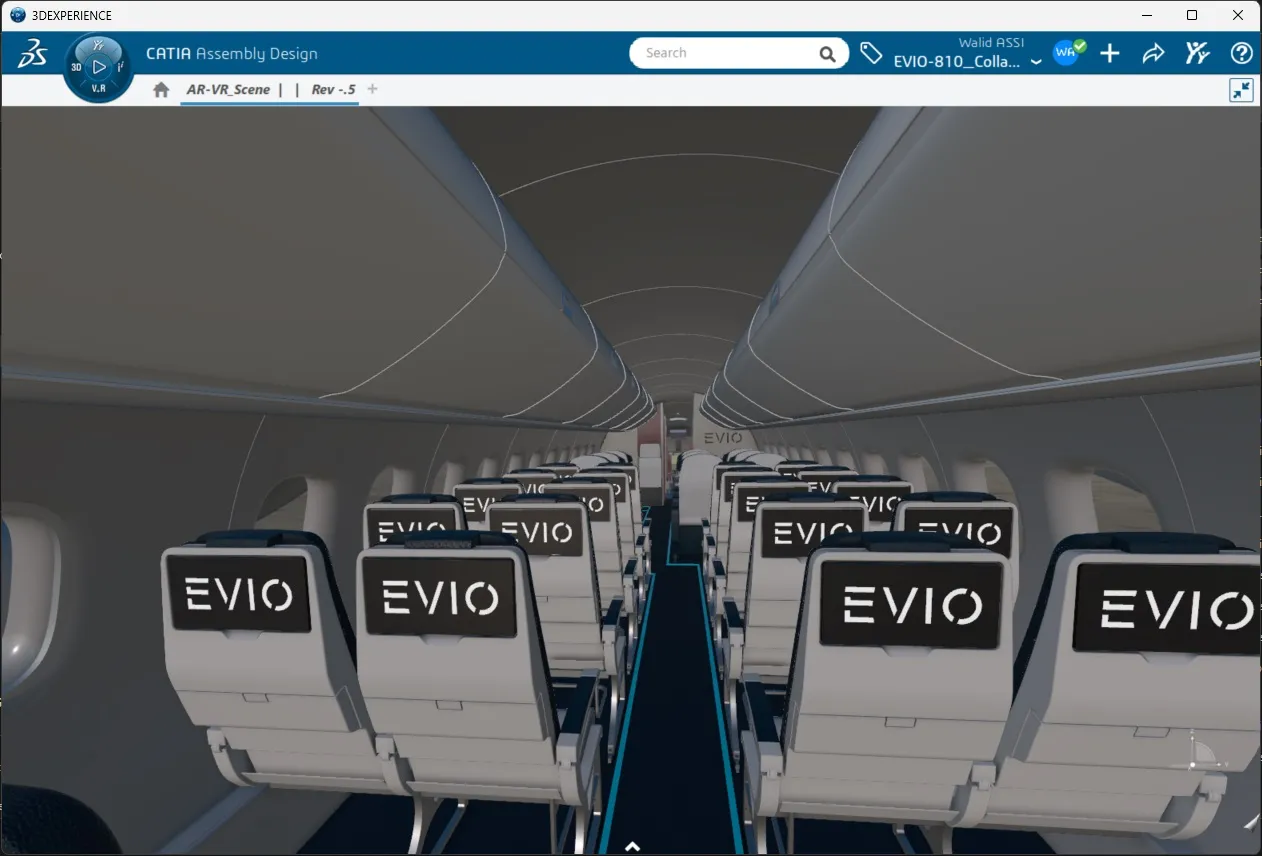
With the aircraft model now accessible through a connected digital environment, EVIO also uses the 3DEXPERIENCE platform to take collaboration beyond the desktop. By connecting its DMU to a VR experience, engineers can enter a specially equipped room, put on a headset and walk through the life-size aircraft, long before any physical prototype is created.
This allows them to evaluate everything from practical accessibility concerns, such as whether there is enough clearance between components, to more complex challenges, such as verifying how the aircraft’s hybrid propulsion system works within the context of the overall assembly.
Assi, who set up EVIO’s VR room, calls it the true differentiator of the platform. “Really, the speed of being able to move from a CAD model to quickly go into a VR room with a headset, to test out any concept, review the cabin layout, open the nacelle covers, see the batteries, see the major elements we just designed and see everything in full scale – that has been the true game changer,” he said.
The VR room also becomes EVIO’s clearest way of introducing the aircraft to people outside the design team, whether that’s a potential supplier, customer, investor, or an astronaut – like Chris Hadfield. “One of the comments we get from potential customers is that they’re amazed to see the actual engineering model,” Assi said. “We’re not showing images or just forms, we’re showing an aircraft that works, and the teams that designed it are just outside the door. That’s a huge benefit.”
With the EVIO-810 concept now defined, EVIO is directing its attention toward demonstrating the breakthrough technologies that will make its vision a reality. The primary focus is the development of its hybrid propulsion system, including new battery technology and the integration of the propulsion system into the nacelle.
As EVIO moves toward the next stages of development, it is keen to bring suppliers onto the 3DEXPERIENCE platform so that they can collaborate more effectively. “Right now, supplier collaboration mostly goes through file exchange,” Assi said. “What we want is to remove the step of sending a file back and forth. We want everybody on the same platform, with the ENOVIA guardrails, so we can all work from a single source of truth.”
Over time, EVIO also plans to establish a more comprehensive virtual twin approach, connecting the aircraft’s as-designed, as-built and as-operated information as the program progresses from concept toward production. “The virtual twin capabilities can really document and connect the dots between design, manufacturing and the other information that needs to be linked to a configuration,” Leclerc said.
And that’s just the start. Assi sees Dassault Systèmes playing an even bigger role as EVIO grows. “There’s a whole host of capabilities within the 3DEXPERIENCE platform that would support us if we want to go bigger and start manufacturing the EVIO-810,” he said. “We’re not there yet, but we know that in the long run, we can keep using this platform to get to first flight faster and get a better aircraft into the hands of regional airlines sooner.”

EVIO is developing a family of hybrid-electric regional aircraft designed to deliver superior operating economics, reduce noise and emissions, and enhance the passenger experience. Optimized for all-electric operation on short flights and hybrid operation on longer missions, the dual-class 76-seat EVIO 810 combines advanced aircraft and hybrid-electric systems to unlock new levels of performance, efficiency and mission flexibility. The technologies underpinning the EVIO 810 also have the potential to enable critical capabilities across defense and other demanding missions. Founded in 2018, EVIO operates in Canada and the United States. EVIO is supported by industry partners, including Boeing and Pratt & Whitney Canada.
For more information: https://evio.aero/
University of Moncton uses Virtual Twins for smart city planning in Moncton and Dieppe, balancing density, housing and biodiversity.
Customer Story
Discover how Marcopolo uses the 3DEXPERIENCE platform to streamline bus development, centralize product data, and speed time to market.
Customer Story
Elysian Aircraft leverages the 3DEXPERIENCE platform to innovate electric aircraft propulsion, delivering efficient and sustainable aviation solutions.
Customer Story
VAERIDION uses Dassault Systèmes’ 3DEXPERIENCE to accelerate electric aircraft design, certification, and development of its zero-emission Microliner.
Customer Story
Airbus has deployed Dassault Systèmes’ (3DS) applications to drive a global collaborative solution throughout the value chain from engineering to manufacturing...
Customer Story
Plant commissioning in a virtual environment to keep an automated fuselage assembly on track.
Customer Story
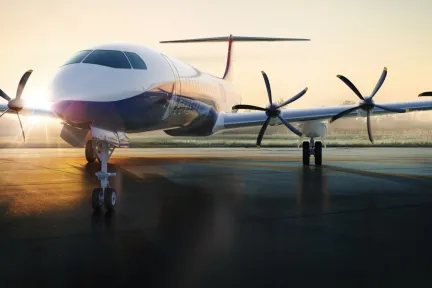
Eviation Aircraft wanted to design and build an all electric airplane for mid-range distances that is cost-effective and environmentally friendly on an aggressive time schedule by using the 3DEXPERIENCE platform on the cloud.
Customer Story
The 3DEXPERIENCE platform supports the India-based company in engineering over 100 unique intellectual property breakthroughs across robotics, aerospace and advanced materials.
Customer Story
HeliAir uses the 3DEXPERIENCE platform on the cloud to design the self-developed KOKON interior concept to help build medical emergency helicopters.
Customer Story Video