1506 Ergebnisse
ABAQUS/XFEM to study the fracture of 3D printed polymers considering layer interfaces

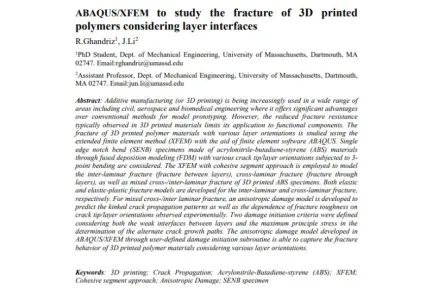
Additive manufacturing (or 3D printing) is being increasingly used in a wide range of areas including civil, aerospace and biomedical engineering where it offers significant advantages over conventional methods for model prototyping. However, the reduced fracture resistance typically observed in 3D printed materials limits its application to functional components. The fracture of 3D printed polymer materials with various layer orientations is studied using the extended finite element method (XFEM) with the aid of finite element software ABAQUS. Single edge notch bend (SENB) specimens made of acrylonitrile-butadiene-styrene (ABS) materials through fused deposition modeling (FDM) with various crack tip/layer orientations subjected to 3- point bending are considered.

Customer Papers
ABAQUS/XFEM to study the fracture of 3D printed polymers considering layer interfaces
Prediction of Cure Overheating in Thick Adhesive Bondlines for Wind Energy Applications

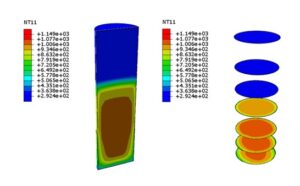
Bondline failure is a key failure mode in wind turbine blades. One of the dominant sources of failure can be the degradation of the adhesive due do the cure overheating. Substantial variation in bondline thickness can result in different thermal histories for the adhesive layer due to the exothermic curing of common adhesives. Predictive guidance on the impact of this variability in adhesive cure temperature cycle is extremely limited. A finite element model capable of tracing the thermal and conversion histories in the adhesive has been developed to address this problem. To be successful in predicting the effects of the exothermic reaction on temperature within the adhesive in cure cycle simulations, the standard heat transfer equation has been coupled with a cure kinetics model in Abaqus/CAE implementing user subroutines.

Customer Papers
Prediction of Cure Overheating in Thick Adhesive Bondlines for Wind Energy Applications
Critical Buckling Load Optimization of a Filament Wound Composite Cylindrical Underwater Structure

Filament wound composite structures have high resistance to water corrosion which makes them popular for military underwater applications besides their high strength to weight ratio. The main loading condition for an underwater structure is hydrostatic external pressure which generally causes structural instability or buckling rather than rupture of the structure. In this study, a military underwater cylindrical Glass/Epoxy filament wound structure was analyzed in terms of buckling. Abaqus/CAE and Isight tool with Response Surface Method were used. Helical winding angle and thickness of helical and hoop layers with constant total thickness were used as main variables to investigate the effects of them on the critical buckling pressure.

Customer Papers

Critical Buckling Load Optimization of a Filament Wound Composite Cylindrical Underwater Structure
Using Simulation to Identify Loads Contributing to a Structural Durability Failure of an Engine Component

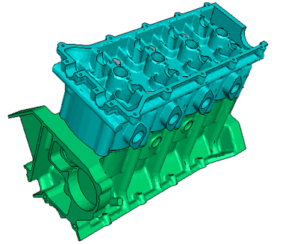
Honda engines undergo severe testing for evaluation of performance and durability. This paper focuses on a structural durability failure of a steel tube press-fit into an aluminum casting installed on an engine. While the engine is operating, the assembly experiences complex load conditions including modal excitation, high acceleration, as well as, forces and moments caused by system deformation. Traditionally, these loads cannot be measured without completely changing the system. This makes determining a root cause difficult. Therefore, True-Load was used in conjunction with measured strain data to calculate the transient behavior of the loads acting on the components and the stresses experienced by the tube. Analysis of this information allowed the loading conditions driving the failure to be identified. This provided direction for future design iterations.

Customer Papers

Using Simulation to Identify Loads Contributing to a Structural Durability Failure of an Engine Component
Design Optimization of Composite Rotor Blade of Helicopter

The composite rotor blades, by design, are intended to meet performance, stiffness, strength and fatigue requirements, taking into consideration the weight and manufacturability. The design process to achieve an optimum blade configuration is highly iterative, considering several design variables. Further, it is of paramount importance to also make a judicial tradeoff between these design variables to achieve acceptable design in the preliminary design phase. The multi-disciplinary and multi-objective nature of the blade design demands suitable optimization techniques to reduce iterations, errors, time and cost. The present study consists two phases.

Customer Papers

Design Optimization of Composite Rotor Blade of Helicopter
Developing UMAT to predict thermo-mechanical fatigue lifetime of Aluminum

The improvement of fuel efficiency and the development of high power engines have been increasing the thermal load of the engine parts. This is increasing the cases of the thermalmechanical fatigue damage. Thermo-mechanical fatigue (TMF) failure is caused by the cumulative plastic strain due to cyclic thermal loads, unlike mechanical fatigue failure. In order to predict the TMF lifetime, a nonlinear material equation including viscoelastic plasticity behavior under high temperature thermal load conditions should be constructed and appropriate tests should be conducted to obtain appropriate material parameters. And then the crack propagation model is linked to derive the lifetime prediction formulas. In this paper, an aluminum material model for TMF lifetime prediction is developed. Theoretical formulas were constructed through the process described above, and material parameters were obtained through testing. Also, the derived lifetime prediction equation was composed of ABAQUS UMAT so that it can be used for the lifetime analysis of aluminum.

Customer Papers

Developing UMAT to predict thermo-mechanical fatigue lifetime of Aluminum
Automatic 3D Crack Placement using the Python API in Abaqus CAE

This paper illustrates automated capabilities using the Python API in Abaqus/CAE to build, execute, and process complicated geometries with 3D semi-elliptical crack fronts suitable for linear-elastic analyses. These Python scripts adopt the same workflow used in Abaqus/CAE, which enables rapid debugging and post-analysis modifications through the GUI if necessary. These scripts are fully parameterized and support control over a crack’s size, its shape, its location, and its discretization, e.g., the number of elements along its front. Due to the complexity of the required meshes, these scripts produce highly detailed crack-front regions with hundreds of edges, faces, and cells. Furthermore, these scripts support post-processing of stress-intensity factors along the crack front and other quantities of interest.

Customer Papers

Automatic 3D Crack Placement using the Python API in Abaqus CAE
CFD Topology and Shape Optimization of Ford Applications using Tosca Fluid

Modern engine architectures need compact designs driven by vehicle package constraints. Furthermore, an engine should fit into several vehicle applications and parts have to be modified to match all package configurations. The optimization of the individual parts and the system by Computational Fluid Dynamics (CFD) may help to minimize or even delete these drawbacks. Meanwhile, there are several powerful optimization methods for three-dimensional flows on the market. While comparing their strengths and weaknesses, efficiency and easy handling are also important for engineers in research and product development. In this paper, a combined optimization strategy using CFD topology optimization followed by a shape optimization is presented using the software tools Tosca Fluid and STAR-CCM+.

Customer Papers

CFD Topology and Shape Optimization of Ford Applications using Tosca Fluid
Experimental Design to Characterize the Interface of Flexible Hybrid Electronics under Mixed-Mode Fracture

Flexible Hybrid Electronics (FHEs) are finding increasing applications since they overcome the limitations of rigid and non-deformable traditional electronic boards and circuits. A key parameter in FHE performance is the adhesion of printed conductive silver pastes to the flexible substrate. Prediction of the failure mechanism of the interface, under large deformations and with a considerable material mismatch, is fundamental to future design efforts. However, due to the complex nonlinear behavior of the materials and size of components, common interfacial characterization tests may not always be feasible. In this study, a biaxial loading configuration was designed to extract the mixed mode tractionseparation parameters.

Customer Papers

Experimental Design to Characterize the Interface of Flexible Hybrid Electronics under Mixed-Mode Fracture
High power mercury target design exploration using Isight

The stainless-steel target vessel directs the flow of mercury at the Spallation Neutron Source (SNS) facility in Oak Ridge National Laboratory, Tennessee, and is struck by cyclic (60hz) proton beam pulses to release neutrons for scientific experiments. The target works under various severe conditions: temperature, radiation, mercury flow, and proton beam pulse pressures. Insufficient strength and durability of the target stainless steel vessel from beam pulse and thermal cyclic loads can lead to mercury leaks and premature target life termination. Neutron production and the scientific user programs at SNS has been disrupted on several occasions due to such incidents.

Customer Papers

High power mercury target design exploration using Isight
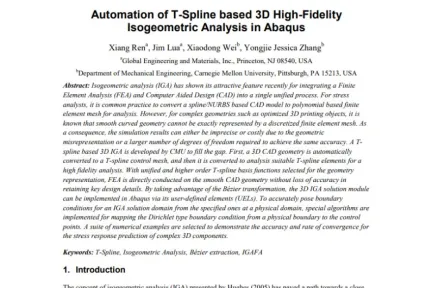
Automation of T-Spline based 3D High-Fidelity Isogeometric Analysis in Abaqus

Isogeometric analysis (IGA) has shown its attractive feature recently for integrating a Finite Element Analysis (FEA) and Computer Aided Design (CAD) into a single unified process. For stress analysts, it is common practice to convert a spline/NURBS based CAD model to polynomial based finite element mesh for analysis. However, for complex geometries such as optimized 3D printing objects, it is known that smooth curved geometry cannot be exactly represented by a discretized finite element mesh. As a consequence, the simulation results can either be imprecise or costly due to the geometric misrepresentation or a larger number of degrees of freedom required to achieve the same accuracy. A Tspline based 3D IGA is developed by CMU to fill the gap.

Customer Papers

Automation of T-Spline based 3D High-Fidelity Isogeometric Analysis in Abaqus
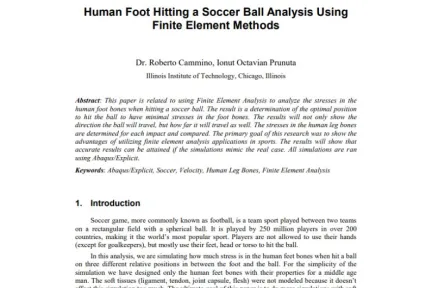
Human Foot Hitting a Soccer Ball Analysis Using Finite Element Methods

This paper is related to using Finite Element Analysis to analyze the stresses in the human foot bones when hitting a soccer ball. The result is a determination of the optimal position to hit the ball to have minimal stresses in the foot bones. The results will not only show the direction the ball will travel, but how far it will travel as well. The stresses in the human leg bones are determined for each impact and compared. The primary goal of this research was to show the advantages of utilizing finite element analysis applications in sports. The results will show that accurate results can be attained if the simulations mimic the real case. All simulations are ran using Abaqus/Explicit.

Customer Papers

Human Foot Hitting a Soccer Ball Analysis Using Finite Element Methods
260 Ergebnisse

Kundengeschichten

145 Ergebnisse
2 Ergebnisse

SIMULIA Selbstlernprogramm

Wir bieten Hunderte von Selbstlernmodulen an, damit jeder nach seinen eigenen Vorstellungen lernen kann

Blogs

Lesen Sie die neuesten Nachrichten und Innovationen unserer Experten auf dem SIMULIA Blog.

696 Ergebnisse

Vernetzen Sie sich mit SIMULIA

Erfahren Sie, was SIMULIA für Sie tun kann

Lassen Sie sich von unseren SIMULIA Experten zeigen, wie unsere Lösungen eine nahtlose Zusammenarbeit und nachhaltige Innovation in Unternehmen jeder Größe ermöglichen.

Erste Schritte

Wir bieten Kurse und Schulungen für Studierende, Hochschulen, Fachleute und Unternehmen an. Finden Sie die passende SIMULIA Schulung. 

Hilfe anfordern

Hier finden Sie Informationen zu Software- und Hardware-Zertifizierungen, Software-Downloads, Anwenderdokumentation, Support-Kontakten und Serviceangeboten