
Planetary Gear System Gear Whine
Planetary Gear System Gear Whine (Transmission/Differential)
E-seminars
Finden Sie alles, was Sie über SIMULIA brauchen
Planetary Gear System Gear Whine (Transmission/Differential)
E-seminars
Simulation of railway track maintenance trains at MATISA
E-seminars
In aircraft bleed air system ducts, cracks may exist or initiate from manufacturing defects in areas of high stress concentration in particular at welds. The initial minor cracks may grow into two possible failures: either the crack grows steadily through the wall to form a stable “through-crack” (leak-before-break), or it becomes unstable before or after it has reached the opposite surface of the duct wall and spreads rapidly over a large portion of the duct (break-before-leak), depending on the pressurized hot-air load and the toughness of material. For the safe design of bleed air system ducts and assessment of ducts with minor cracks found in the quality inspection, it is required to understand and predict the crack behavior and leak-before-break leakage rate.
Customer Papers
Model -Aided Design of a Hydraulic Pitch Actuation System
E-seminars
Impact of Elasticity on the Transmission Behaviour of Thin Ring Gears
E-seminars
Strength and Endurance Predictions of Drivetrains and Rotor Blades using Abaqus
E-seminars
The firing process of ceramic products under a specific heat curve is generally divided into three different phases: thermal expansion, sintering, and thermal contraction phases. These non-mechanical deformations are assumed to be unrelated, and the mechanical ones are assumed to be represented by the viscoplastic constitutive model. The key issue is how to determine sintering strains by calibrating the employed function forms of the densification rate with the data obtained from the stairway thermal cycle (STC) test. In addition, the presentations of the dependencies of the elastic and creep properties on both temperature and density are of importance to accurately predict the overall deformation of ceramic products.
Customer Papers
Dynamic simulation of the inflation gas of a tire under operational conditions
E-seminars
4th Wind And Drivetrain Conference Wind and Drivetrain Update
E-seminars
Tagungsprogramm/Event Program European SIMULIA Multibody Simulation UGM Deutsches SIMULIA-Anwendertreffen/German RUM European SIMULIA Durability User Group Meeting
E-seminars
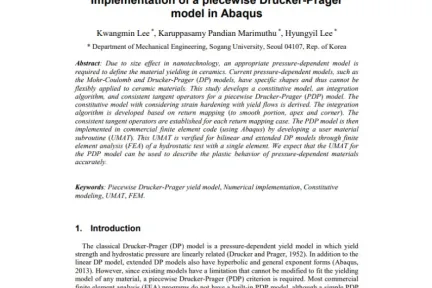
Due to size effect in nanotechnology, an appropriate pressure-dependent model is required to define the material yielding in ceramics. Current pressure-dependent models, such as the Mohr-Coulomb and Drucker-Prager (DP) models, have specific shapes and thus cannot be flexibly applied to ceramic materials. This study develops a constitutive model, an integration algorithm, and consistent tangent operators for a piecewise Drucker-Prager (PDP) model. The constitutive model with considering strain hardening with yield flows is derived. The integration algorithm is developed based on return mapping (to smooth portion, apex and corner). The consistent tangent operators are established for each return mapping case.
Customer Papers
How Multibody-System Simulation Models can Support the Design of Wind Turbines
E-seminars
Wir bieten Hunderte von Selbstlernmodulen an, damit jeder nach seinen eigenen Vorstellungen lernen kann
Lesen Sie die neuesten Nachrichten und Innovationen unserer Experten auf dem SIMULIA Blog.
Below is an excerpt from a recent interview with Grace Lau, an...
Article
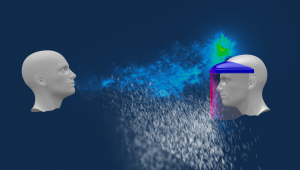
This is a forward looking post, featuring some of the new things...
Article
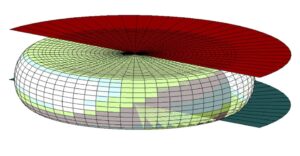
NAFEMS’ biannual Americas Conference CAASE20 should have been taking place in Indianapolis...
Article
Reference IPE: Brake System Engineering A couple of years ago, I was...
Article
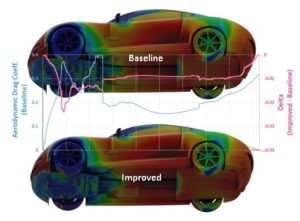
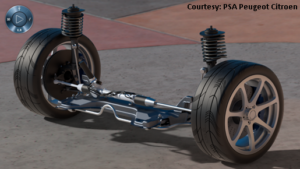
Reference IPE: Chassis and Suspension Strength and Durability Problem Statement: Model build...
Article
Recently, SIMULIA introduced the 2020 SIMULIA Champions, the inaugural team of brand...
Article
During the current situation in which more and more live and onsite...
Article
Neat and Clean Rims It was a sunny Sunday. After lunch, I...
Article
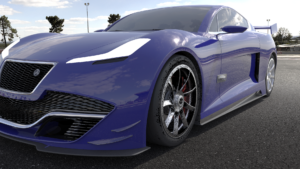
Imagine creating a product and testing out every single feature and nuance...
Article
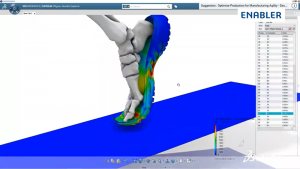
Brake System Engineering Helps with Brake Squeal Picture this: It’s midnight and...
Article
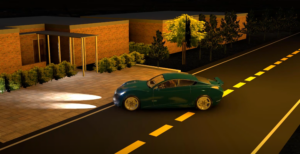
With such a large number of manufacturers and models in the automotive...
Article
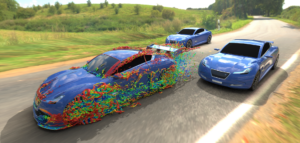
This case study was originally published on the Dassault Systèmes website. You...
Article
Lassen Sie sich von unseren SIMULIA Experten zeigen, wie unsere Lösungen eine nahtlose Zusammenarbeit und nachhaltige Innovation in Unternehmen jeder Größe ermöglichen.
Wir bieten Kurse und Schulungen für Studierende, Hochschulen, Fachleute und Unternehmen an. Finden Sie die passende SIMULIA Schulung.
Hier finden Sie Informationen zu Software- und Hardware-Zertifizierungen, Software-Downloads, Anwenderdokumentation, Support-Kontakten und Serviceangeboten