有 1506 个结果
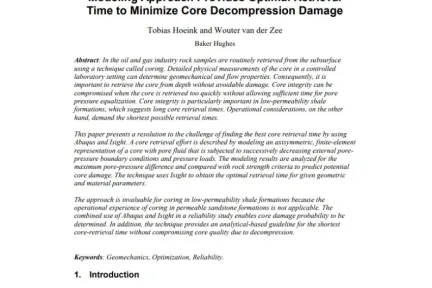
Modeling Approach Provides Optimal Retrieval Time to Minimize Core Decompression Damage

This paper presents a resolution to the challenge of finding the best core retrieval time by using Abaqus and Isight. A core retrieval effort is described by modeling an axisymmetric, finite-element representation of a core with pore fluid that is subjected to successively decreasing external porepressure boundary conditions and pressure loads. The modeling results are analyzed for the maximum pore-pressure difference and compared with rock strength criteria to predict potential core damage. The technique uses Isight to obtain the optimal retrieval time for given geometric and material parameters.

Customer Papers
Modeling Approach Provides Optimal Retrieval Time to Minimize Core Decompression Damage
Numerical Simulation of Nugget Formation in Spot Welding

This paper provides a finite element model to predict the nugget development during resistance spot welding of steel sheets. The model employs the coupled thermal-electricalmechanical analysis capability of Abaqus. The contact area and the interface pressure distribution are determined from a thermal-mechanical coupling in the analysis. The knowledge of interface pressure allows for accurate prediction of interfacial heat and electrical resistance, which have a dominant role in Joule heat generation. Temperature-dependent material properties for the coupled analysis are used. The significant parameters in the spot-welding process are current magnitude and frequency, welding time, sheet material and thickness, geometry of electrodes, and electrode force.

Customer Papers

Numerical Simulation of Nugget Formation in Spot Welding
Abaqus/Standard-based quantification of human cardiac mechanical properties

Computational modeling can provide critical insight into existing and potential new surgical procedures, medical or minimally-invasive treatments for heart failure, one of the leading causes of deaths in the world that has reached epidemic proportions. In this paper, we present our Abaqus/Standard-based pipeline to create subject-specific left ventricular models. We first review our generic left ventricular model, and then the personalization process based on magnetic resonance images. Identification of subject-specific cardiac material properties is done by coupling Abaqus/Standard to the python optimization library NL-Opt. Compared to previous studies from our group, the emphasis is here on the fully implicit solving of the model, and the two-parameter optimization of the passive cardiac material properties.

Customer Papers

Abaqus/Standard-based quantification of human cardiac mechanical properties
Geomechanical Optimization of Underground Gas Storage Operation

The paper presents the workflow used to assess fault slip risk during the UGS operation. The workflow starts with the construction of a 3D finite element model of the complex geology using Abaqus and is followed by coupling it to a reservoir flow model of the field. The results show that a strong pressure gradient in the field is one of the factors which impact the fault stability. Therefore, a balanced reservoir model is developed to control pressure on both sides of the fault. This model minimizes the risk of fault re-activation. A Monte Carlo simulation on the fault slip stability is performed to quantify the reliability of the prediction.

Customer Papers

Geomechanical Optimization of Underground Gas Storage Operation
Subsea Flowline-PLET-Jumper Integrated Abaqus Model

Oil and gas field development is moving into ever deeper waters to meet the world’s growing demand for energy. Subsea flowlines, jumpers and pipeline end terminals (PLETs) are the key components for a reliable and cost-effective subsea field development. Usually, the subsea flowline, jumper and PLET are designed and analyzed separately by different engineering groups using simplified end boundary conditions, and the interface loads from the flowline / jumper to PLET are obtained from de-coupled finite element (FE) models.This paper presents a comprehensive Abaqus model to more accurately analyze the subsea system collectively.

Customer Papers

Subsea Flowline-PLET-Jumper Integrated Abaqus Model
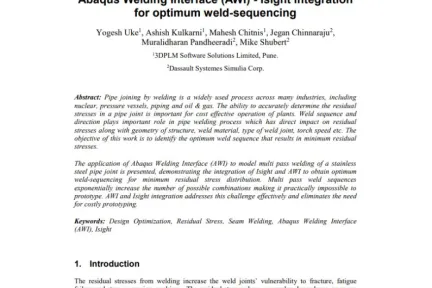
Abaqus Welding Interface - Isight integration for optimum weld-sequencing

Pipe joining by welding is a widely used process across many industries, including nuclear, pressure vessels, piping and oil & gas. The ability to accurately determine the residual stresses in a pipe joint is important for cost effective operation of plants. Weld sequence and direction plays important role in pipe welding process which has direct impact on residual stresses along with geometry of structure, weld material, type of weld joint, torch speed etc. The objective of this work is to identify the optimum weld sequence that results in minimum residual stresses. The application of Abaqus Welding Interface (AWI) to model multi pass welding of a stainless steel pipe joint is presented, demonstrating the integration of Isight and AWI to obtain optimum weld-sequencing for minimum residual stress distribution.

Customer Papers

Abaqus Welding Interface - Isight integration for optimum weld-sequencing
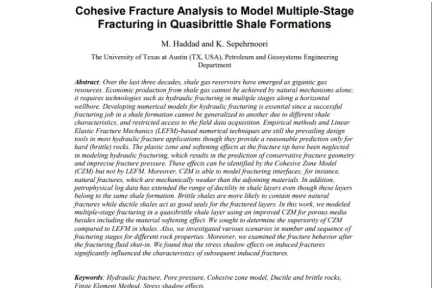
Cohesive Fracture Analysis to Model Multiple-Stage Fracturing in Quasibrittle Shale Formations

Over the last three decades, shale gas reservoirs have emerged as gigantic gas resources. Economic production from shale gas cannot be achieved by natural mechanisms alone; it requires technologies such as hydraulic fracturing in multiple stages along a horizontal wellbore. Developing numerical models for hydraulic fracturing is essential since a successful fracturing job in a shale formation cannot be generalized to another due to different shale characteristics, and restricted access to the field data acquisition. Empirical methods and Linear Elastic Fracture Mechanics (LEFM)-based numerical techniques are still the prevailing design tools in most hydraulic fracture applications though they provide a reasonable prediction only for hard (brittle) rocks.

Customer Papers

Cohesive Fracture Analysis to Model Multiple-Stage Fracturing in Quasibrittle Shale Formations
有 246 个结果

客户成功故事

有 150 个结果
有 6 个结果

SIMULIA 自学

我们提供数百个自学模块,以便您能够在方便的时间不断学习

博客

欢迎阅读 SIMULIA 博客,了解最新报道以及我们专家的最新创新。

有 694 个结果

了解 SIMULIA 可以为您做些什么

与 SIMULIA 专家交谈,了解我们的解决方案如何在各种规模的企业中实现无缝协作和可持续创新。

启动开发

课程面向学生、学术界、专业人士和企业开放。查找适合您的 SIMULIA 培训。

获得帮助

查找有关软硬件认证、软件下载、用户文档、支持联系人和服务项目的信息