有 1506 个结果
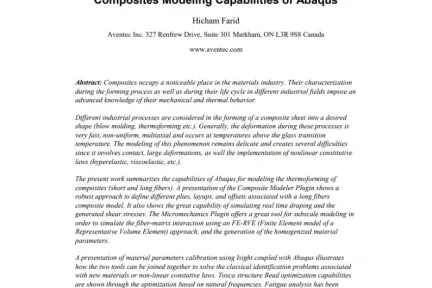
Composites Modeling Capabilities of Abaqus

Composites occupy a noticeable place in the materials industry. Their characterization during the forming process as well as during their life cycle in different industrial fields impose an advanced knowledge of their mechanical and thermal behavior. A presentation of material parameters calibration using Isight coupled with Abaqus illustrates how the two tools can be joined together to solve the classical identification problems associated with new materials or non-linear constative laws. Tosca structure Bead optimization capabilities are shown through the optimization based on natural frequencies. Fatigue analysis has been performed using Fe-safe and shows the fatigue life contours.

Customer Papers
Composites Modeling Capabilities of Abaqus
Process Modeling and Validation for Metal Big Area Additive Manufacturing

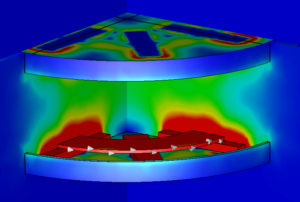
Metal Big Area Additive Manufacturing (mBAAM) is a new additive manufacturing (AM) technology based on the metal arc welding. A continuously fed metal wire is melted by an electric arc that forms between the wire and the substrate, and deposited in the form of a bead of molten metal along the predetermined path. Objects are manufactured one layer at a time starting from the base plate. The final properties of the manufactured object are dependent on its geometry and the metal deposition path, in addition to depending on the basic welding process parameters. Computational modeling can be used to accelerate the development of the mBAAM technology as well as a design and optimization tool for the actual manufacturing process.

Customer Papers
Process Modeling and Validation for Metal Big Area Additive Manufacturing
Bi-directionally Coupled Multi-Physics Analysis on Fuel Tank

A motorcycle fuel tank is regarded as important safety-related part containing flammable fluids. It may lead to life threatening situation if the fluid leaks. Thus apart from general dynamic simulation, the fuel tank should be subjected to lateral impact test. The physics of fluid-structure impact are complex, and modeling of such events requires proper understanding of both fluid dynamics and structural mechanics. The fluid-structure interaction was achieved through arbitrary Lagrangian-Eulerian (ALE) approach in Abaqus. A good correlation was achieved between the deformation of fuel tank in testing and simulation. The focus was to verify whether the fuel tank ruptures under the impact or due to contact with surrounding frame parts.

Customer Papers
Bi-directionally Coupled Multi-Physics Analysis on Fuel Tank
Parametric Study to Evaluate the Effect of Strut Geometry on PLLA Coronary Stent Recoil

Bioresorbable poly(L-lactic acid) (PLLA) stents present a clinically attractive treatment for coronary heart disease, providing a temporary scaffold that resorbs once the artery has healed. Polymeric stents are often mechanically inferior to their permanent metallic counterparts. However, their mechanical properties can be tailored through stretch-blow molding (SBM); a process that induces crystallinity and molecular orientation, subsequently altering the mechanical response of the polymer. This study aims to quantify the variation in mechanical properties of PLLA as a result of the SBM procedure and investigate the functionality of a stent constructed from this polymer.

Customer Papers
Parametric Study to Evaluate the Effect of Strut Geometry on PLLA Coronary Stent Recoil
Modelling of Accurate and Fast Heat Transfer Analysis using FILM Subroutine

In typical engineering applications, mixed convection is simulated using an assumed convection Heat Transfer Coefficient (HTC); but in reality, the HTC depends on various parameters like the orientation of geometry, the flow regimes, the temperature of the body, and the properties of the fluid. This paper describes in detail how to calculate the temperature dependent HTC using FILM subroutine and the simulation results comparison with conjugate heat transfer analysis carried out in Abaqus.

Customer Papers

Modelling of Accurate and Fast Heat Transfer Analysis using FILM Subroutine
State of the Art Hytrel material modeling development for the design of Jounce Bumper

This paper describes the behavior and subsequent constitutive modelling of a Hytrel thermoplastic elastomer (TPC-ET) for a so-called Jounce bumper, which is a part of the vehicle’s shock absorber system. This component is subjected to large deformations (up to 100% strain) with significant permanent set and loss of stiffness. The objective of the analysis is to predict the component behavior after cyclic loading to obtain the load-displacement response curve of the Jounce bumper in operational conditions. The possibilities and limitations of the hyper-elastic model, including permanent-set and Mullins’ effect are discussed and numerical results compared to the test data from an actual component.

Customer Papers

State of the Art Hytrel material modeling development for the design of Jounce Bumper
Modelling Rubber Bushings Using the Parallel Rheological Framework

Bushings are anti‐vibration components used in vehicle suspension systems. They are typically made of rubber between two concentric metallic cylinders. Their analysis requires characterising their complex impedance (dynamic stiffness and phase angle). Their behaviour is often difficult to predict without testing a prototype. The rubber undergoes large strains, usually involving strain stiffening and Mullins effect, time dependency and, possibly, plasticity. Thus the behaviour depends on the loading frequency and amplitude, as well as the preload. To tackle the problem a methodology has been developed that combines Abaqus and Isight.

Customer Papers

Modelling Rubber Bushings Using the Parallel Rheological Framework
Example Nonparametric Optimization Cases for Additive Manufacturing Using Tosca and Abaqus

Two example nonparametric optimization cases for AM using TOSCA and ABAQUS are presented. For the first case, we optimized a disc brake caliper, where loading conditions were driven by the master cylinder, the contact areas of the disc rotor, and the envelope limitations within the wheel. The objective function, design constraints, and the targeted design response drove the outer topology of the caliper casting. TOSCA’s topology optimization established the primary geometry, and subsequent validation of the parametric reconstruction was performed in ABAQUS. The resulting optimized geometry removed 62% the caliper bridge volume from areas of low stress and replaced it (as needed) in high stress areas.

Customer Papers

Example Nonparametric Optimization Cases for Additive Manufacturing Using Tosca and Abaqus
Designing Cylinder Head Gaskets for New Generation Powertrains

The past decade has seen transformative changes in internal combustion engine technology. Revolutionary technological advances of powertrains include the replacement of traditional gasoline internal combustion engines with smaller displacement engines, the use of turbocharging to make smaller displacement engines more powerful and efficient, and the use of lightweight materials in both vehicle bodies and engines. Furthermore, the federal government’s CAFE standards mandate that OEMs develop more fuel-efficient vehicles with lower emissions.

Customer Papers

Designing Cylinder Head Gaskets for New Generation Powertrains
Fatigue Life Prediction Techniques for Polymers and Polymer Matrix Composites

To include the self-heating effect into the fatigue computation, information regarding hysteresis energy is required. As shown in Fig. 1, the hysteresis energy can be calculated by subtracting strain energies during the loading WL and unloading WU event. The calculated hysteresis energy includes information regarding both plastic deformation together with damage induced dissipations.

Customer Papers

Fatigue Life Prediction Techniques for Polymers and Polymer Matrix Composites
FlowVision & Abaqus 2-Way Strongly Coupled FSI Simulation of Automobile Tire Aquaplaning

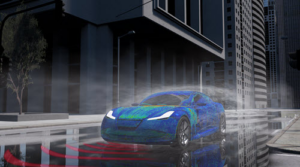
Aquaplaning of automobile tires simultaneously incorporates various physical phenomena some of which are challenging to model with computer-aided simulation tools. Among those are complex patterned topology and rotational movement of tire, small clearance between ground and tire, free surface flow of water and air and inevitably the elastic nature of tire body and effect of its deformations on fluid flow characteristics.In order to overcome these challenges, Abaqus FE software from SIMULIA and FlowVision CFD package from Capvidia are strongly coupled for bidirectional fluid structure interaction (FSI) co-simulation. This approach is applied to a 205/55/R16 sized tire and same conditions are realized in experimental environment for comparison purposes.

Customer Papers

FlowVision & Abaqus 2-Way Strongly Coupled FSI Simulation of Automobile Tire Aquaplaning
有 246 个结果

客户成功故事

有 150 个结果
有 6 个结果

SIMULIA 自学

我们提供数百个自学模块,以便您能够在方便的时间不断学习

博客

欢迎阅读 SIMULIA 博客,了解最新报道以及我们专家的最新创新。

有 694 个结果

了解 SIMULIA 可以为您做些什么

与 SIMULIA 专家交谈,了解我们的解决方案如何在各种规模的企业中实现无缝协作和可持续创新。

启动开发

课程面向学生、学术界、专业人士和企业开放。查找适合您的 SIMULIA 培训。

获得帮助

查找有关软硬件认证、软件下载、用户文档、支持联系人和服务项目的信息