Facing Sustainable Packaging Challenges
A global manufacturer used simulation to transform its packaging. Recycled content jumped from 10% to 76%, with 18% less material used.
How One Industry Leader Met the Challenges of Sustainable Packaging
When a major consumer goods organization wanted to incorporate more PCR materials into its packaging, Dassault Systèmes made it happen with the power of simulation.
This case study focuses on the estimated contribution to the objectives of Climate Change Mitigation and Transition into a Circular Economy.
Prioritizing Circular Packaging to Meet Sustainability Goals
Developing sustainable products means keeping emissions in check. In the packaging industry, this is no small challenge.
For one global organization, this translates to reducing the environmental impact of millions of products while maintaining high-performance standards and meeting consumer demands.
Clearly, its commitment to reducing plastic usage and increasing the integration of PCR (post-consumer recycled) materials into packaging required a transformative approach.
With plastic pollution escalating as a worldwide concern, the question looms large: How can packaging go beyond reducing waste to delight consumers, minimize material usage and support the principles of a circular economy?
By adopting sustainable practices and streamlining product development processes, the organization has advanced closer to its target of creating sustainable packaging solutions.
Uncover how Dassault Systèmes’ innovative solutions are shaping a more resilient future for packaging product development while minimizing resource consumption.
About the Customer
Use Case: Deployment of SIMULIA on the 3DEXPERIENCE® platform to improve the environmental footprint of product packaging by incorporating PCR materials over plastic, thinning out packaging for weight reduction and maximizing resource efficiency.
Industry
Consumer goods manufacturer
Company size
102,000 employees
Location
Presence in 185+ countries worldwide
The Challenge
The customer’s key challenges stemmed directly from its:
Business needs
Manage design-material optimization to streamline production, ensuring packaging can be produced in billions of units without compromising performance or reliability.
- Operational requirements
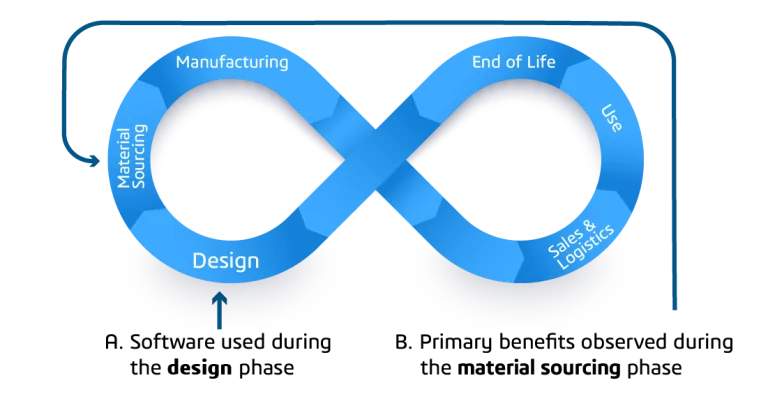
- Software used during the design phase
- Primary benefits observed during the material sourcing phase

The Solution
- The need to increasingly employ recycled plastic in packaging while maintaining product performance and consumer appeal
- Accelerate the transition toward a circular economy
The Outcome
By leveraging SIMULIA on the 3DEXPERIENCE platform, packaging designs were successfully optimized to increase the proportion of PCR materials, make more lightweight packaging and minimize overall material use — all while ensuring peak product performance. In turn, these improvements accelerate the transition to a circular economy.
This advanced modeling and simulation approach streamlined the design process, enabling faster iteration and testing while balancing stakeholder requirements. The ability to run sensitivity studies and evaluate design robustness ensured seamless integration of PCR materials, supporting mass production without compromising performance or reliability.
Throughout this packaging effort, SIMULIA was instrumental in capturing and managing clear, quantified requirements within the platform, integrating them right from the design stage. This capability enabled precise simulations, making it more efficient to design, test and optimize sustainable and more circular packaging solutions.
Real-time collaboration and improved visibility on the 3DEXPERIENCE platform enabled informed, data-driven decisions throughout the production process, helping achieve circularity and sustainability goals more efficiently.
The End Result
Sustainability is huge for us. It’s at the core of our company vision and purpose, and packaging is a big part of that. Plastic reduction is super important for that agenda and Dassault Systèmes is helping us progressively optimize our designs so we can make sure we’re minimizing material usage.
Methods
The avoided emission estimation was estimated following the:
- EU Taxonomy (Regulation Guideline), ISO 14067, 11044 and Guidance of WBCSD Net Zero Initiative Guidelines.
- Methodology based on the comparison of two scenarios for one given functional unit (ISO 14067:2018 and ISO14064-2:2019).
- 3DS methodology has been certified by an independent third party and elaborated in compliance with the EU Taxonomy (Regulation Guideline), ISO 14067, 11044 and Guidance of WBCSD Net Zero Initiative Guidelines. The end result expressed in tCO2e remains an estimation.
Measuring the Sustainability Benefits of Our Solutions
Discover how we accurately quantify the sustainability benefits of our solutions for customers, using a certified methodology. Through real-world use cases, see how we support organizations in their sustainability transition, delivering tangible, measurable results.
Frequently Asked Questions
Sources
1Each of these case studies is a past or current project for which emissions avoided or reduced have been estimated following EU Taxonomy (Regulation Guideline), ISO 14067, 11044 and Guidance of WBCSD Net Zero Initiative Guidelines. The 3DS approach and these calculations, along with the allocated contribution of the software, have been certified by an independent third party. External View URD 2023, Chapter 2.
Related Content
Regulatory Compliance
Drive profitability and meet consumer demands while ensuring regulatory compliance with the 3DEXPERIENCE® platform.
Design Profitable and Sustainable Packaging
Innovate every step of your sustainable packaging journey, driving profitability with an end-to-end strategy, powered by the 3DEXPERIENCE® platform.
Circularity in Action
It’s time for concerted action. Here’s how to make the circular economy achievable, scalable and profitable.
Circular Plastics Economy
A closer look at how circular plastics can accelerate innovation and drive a more sustainable future without compromising the bottom line.