SIMULIA リソース・センター

SIMULIA に関する必要な情報すべてが見つかります 

検索条件に一致する項目が1509件あります
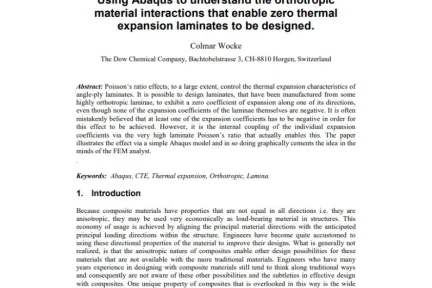
Using Abaqus to understand the orthotropic material interactions that enable zero thermal expansion laminates to be designed.

Poisson’s ratio effects, to a large extent, control the thermal expansion characteristics of angle-ply laminates. It is possible to design laminates, that have been manufactured from some highly orthotropic laminae, to exhibit a zero coefficient of expansion along one of its directions, even though none of the expansion coefficients of the laminae themselves are negative. It is often mistakenly believed that at least one of the expansion coefficients has to be negative in order for this effect to be achieved. However, it is the internal coupling of the individual expansion coefficients via the very high laminate Poisson’s ratio that actually enables this. The paper illustrates the effect via a simple Abaqus model and in so doing graphically cements the idea in the minds of the FEM analyst.

Customer Papers
Using Abaqus to understand the orthotropic material interactions that enable zero thermal expansion laminates to be designed.
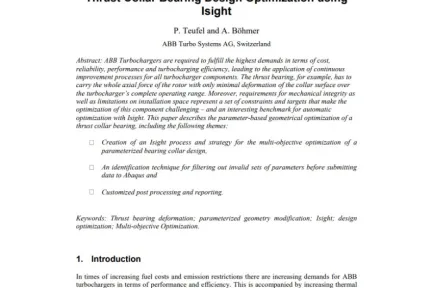
Thrust Collar Bearing Design Optimization using Isight

ABB Turbochargers are required to fulfill the highest demands in terms of cost, reliability, performance and turbocharging efficiency, leading to the application of continuous improvement processes for all turbocharger components. The thrust bearing, for example, has to carry the whole axial force of the rotor with only minimal deformation of the collar surface over the turbocharger’s complete operating range. Moreover, requirements for mechanical integrity as well as limitations on installation space represent a set of constraints and targets that make the optimization of this component challenging – and an interesting benchmark for automatic optimization with Isight. This paper describes the parameter-based geometrical optimization of a thrust collar bearing.

Customer Papers

Thrust Collar Bearing Design Optimization using Isight
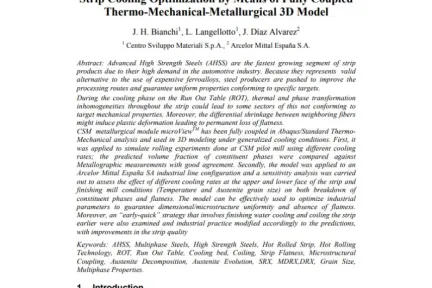
Strip Cooling Optimization by Means of Fully Coupled Thermo-Mechanical-Metallurgical 3D Model

Advanced High Strength Steels (AHSS) are the fastest growing segment of strip products due to their high demand in the automotive industry. Because they represents valid alternative to the use of expensive ferroalloys, steel producers are pushed to improve the processing routes and guarantee uniform properties conforming to specific targets. During the cooling phase on the Run Out Table (ROT), thermal and phase transformation inhomogeneities throughout the strip could lead to some sectors of this not conforming to target mechanical properties. Moreover, the differential shrinkage between neighboring fibers might induce plastic deformation leading to permanent loss of flatness.

Customer Papers

Strip Cooling Optimization by Means of Fully Coupled Thermo-Mechanical-Metallurgical 3D Model
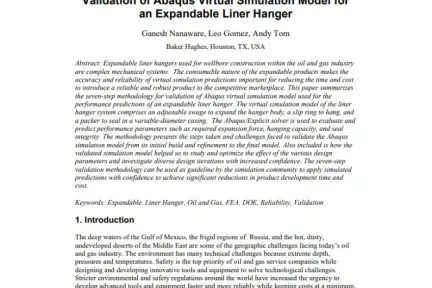
Validation of Abaqus Virtual Simulation Model for an Expandable Liner Hanger

Expandable liner hangers used for wellbore construction within the oil and gas industry are complex mechanical systems. The consumable nature of the expandable products makes the accuracy and reliability of virtual simulation predictions important for reducing the time and cost to introduce a reliable and robust product to the competitive marketplace. This paper summarizes the seven-step methodology for validation of Abaqus virtual simulation model used for the performance predictions of an expandable liner hanger.

Customer Papers

Validation of Abaqus Virtual Simulation Model for an Expandable Liner Hanger
Chart Tracer Tool in Antenna Magus

The Chart Tracer tool forms part of the Data Conversion collection in the Antenna Magus Toolbox. It may be used to digitize data from images of Cartesian or Polar plots with linear or log-scale axes. Images in this document may differ from those on your computer if you are using a different version.

Tech Notes

Chart Tracer Tool in Antenna Magus
ABAQUS KNEE SIMULATOR

The Abaqus Knee Simulator is a validated computational modeling tool for performing basic to advanced knee implant analyses and simulations. This tool offers five fast and easy-to-setup workflows which reduce your reliance on time-consuming trials and expensive lab equipment, while still meeting regulatory requirements.

Brochures

ABAQUS KNEE SIMULATOR
Numerical Evaluation of Key Performance of Railroad Concrete Crossties

In recent years, concrete rail ties have received additional scrutiny with respect to their design criteria, manufacturing processes, in track performance and failure modes, owing to a number of railway track deterioration/failure events resulting from premature concrete tie failure. This paper employs a finite element analysis (FEA) framework to examine the key performance of pretensioned concrete crossties, including the pretension-released surface strain profile/transfer length, splitting/bursting propensity due to prestress transfer, and flexural loading and displacement capacities in rail seat positive and center negative bending modes.

Brochures

Numerical Evaluation of Key Performance of Railroad Concrete Crossties
Plugin for Tunneling and Geotechnical Analysis in Abaqus

Abaqus has one the best solutions for tunneling and geotechnical analysis due to the great non-linear capability. The Abaqus/CAE interface is not so friendly to define a tunneling analysis. It has a lot of steps and uses Model Change to remove and add elements, to simulate excavation a construction step). It’s also difficult to change material properties during analysis. For non Abaqus users could be very hard to define a model. This paper shows a plug-in for Abaqus/CAE that helps the user to define a tunneling, excavation and temporary structures, with support facility and other geotechnical analysis. The paper explores the steps to define a geotechnical analysis and Abaqus/CAE capabilities. It also includes two examples of the plugin usage: a tunnel and a retaining wall.

Customer Papers

Plugin for Tunneling and Geotechnical Analysis in Abaqus
Static and dynamic simulations for automotive interiors components using ABAQUS

Over the last years the car manufacturers have been working intensively to improve the quality of the interiors since it is extremely important to the customer’s perception of the car. The numerical simulation can help the development of the interiors components design in order to guarantee better structural performances and to increase the quality of the products and therefore it is important to develop new calculation methodologies. In this paper, we will present two methodologies developed to improve the quality and efficiency of dashboards.

Customer Papers

Static and dynamic simulations for automotive interiors components using ABAQUS
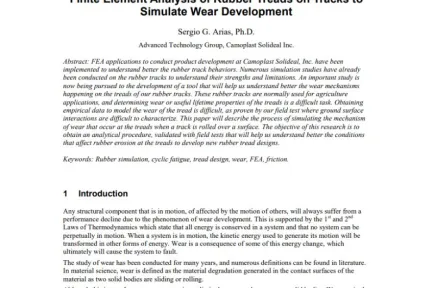
Finite Element Analysis of Rubber Treads on Tracks to Simulate Wear Development

FEA applications to conduct product development at Camoplast Solideal, Inc. have been implemented to understand better the rubber track behaviors. Numerous simulation studies have already been conducted on the rubber tracks to understand their strengths and limitations. An important study is now being pursued to the development of a tool that will help us understand better the wear mechanisms happening on the treads of our rubber tracks. This paper will describe the process of simulating the mechanism of wear that occur at the treads when a track is rolled over a surface.

Customer Papers

Finite Element Analysis of Rubber Treads on Tracks to Simulate Wear Development
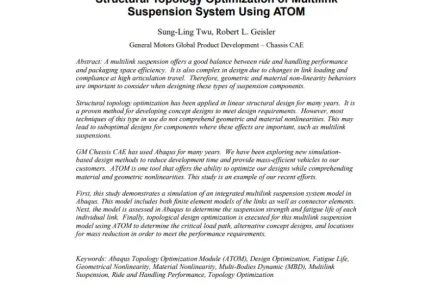
Structural Topology Optimization of Multilink Suspension System Using ATOM

A multilink suspension offers a good balance between ride and handling performance and packaging space efficiency. It is also complex in design due to changes in link loading and compliance at high articulation travel. Therefore, geometric and material non-linearity behaviors are important to consider when designing these types of suspension components. Structural topology optimization has been applied in linear structural design for many years. It is a proven method for developing concept designs to meet design requirements. However, most techniques of this type in use do not comprehend geometric and material nonlinearities. This may lead to suboptimal designs for components where these effects are important, such as multilink suspensions.

Customer Papers

Structural Topology Optimization of Multilink Suspension System Using ATOM
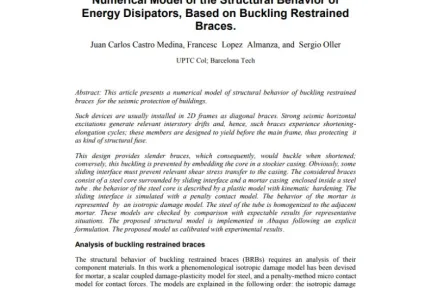
Numerical Model of the Structural Behavior of Energy Disipators, Based on Buckling Restrained Braces.

This article presents a numerical model of structural behavior of buckling restrained braces for the seismic protection of buildings. Such devices are usually installed in 2D frames as diagonal braces. Strong seismic horizontal excitations generate relevant interstory drifts and, hence, such braces experience shorteningelongation cycles; these members are designed to yield before the main frame, thus protecting it as kind of structural fuse.

Customer Papers

Numerical Model of the Structural Behavior of Energy Disipators, Based on Buckling Restrained Braces.
検索条件に一致する項目が278件あります

お客様活用事例

検索条件に一致する項目が153件あります
検索条件に一致する項目が3件あります

SIMULIA 自己学習

ダッソー・システムズでは、それぞれのご都合に合わせて継続的に学習できるよう、さまざまな自己学習モジュールをご用意しています

ブログ

ダッソー・システムズの技術者が最新ニュースやイノベーションについて書いている SIMULIA ブログをご覧ください。

検索条件に一致する項目が764件あります

SIMULIA のソリューションの詳細

組織の規模の大小を問わず、シームレスなコラボレーションと持続可能なイノベーションに、当社のソリューションがどう役立つかについて、SIMULIA のエンジニアがご説明します。

始める

学生、教育機関、専門家、企業向けに、さまざまなトレーニング・コースをご提供しています。お客様に最適な SIMULIA トレーニングを受講してください。 

サポートを利用する

ソフトウェアおよびハードウェアの認証情報、ソフトウェアのダウンロード、ユーザー・ドキュメント、サポート窓口、ならびに提供サービスに関する情報はこちらから。