
Contact SIMULIA Sales
Take the first step towards a more powerful and cost-effective simulation solution.
Contact

SIMULIA に関する必要な情報すべてが見つかります
Take the first step towards a more powerful and cost-effective simulation solution.
Contact
Accurate results using unified modeling and simulation for industrial equipment
EBooks


How a Modeling and Simulation (MODSIM) approach can save time and cost.
White Papers
Industry experts use MODSIM to streamline product design by breaking down silos, validating designs early, optimizing parts, and fostering better collaboration.
EBooks

The primary objective of the present study is to investigate the impact of the recirculating flow that develops inside a closed, hemi-anechoic test chamber on the noise generation mechanisms of a drone rotor operated under static thrust conditions. To that end, Lattice-Boltzmann simulations are conducted for both an idealized, semi-infinite free-field and a confined, hemianechoic domain that models the test chamber, with the latter validated against experimental measurements. Comparison between simulations reveals a significant increase in rotor noisedue to confinement, up to 5 dBA in overall sound pressure level depending on microphone location, with negligible impact on aerodynamic performance. Blade-strip and beam-forming source identification techniques are utilized to determine those sound-generation mechanisms responsible for the increase in rotor noise. Leading-edge interactions between the vortical structures convected by the recirculating flow and the rotor’s blades are demonstrated to be directly responsible for the generation of unsteady loads that lead to significantly higher bladepassing frequency harmonic peaks. A small enhancement of the high-frequency self-noise contribution is also observed, whereas blade-tip vortex dynamics are largely unaffected by confinement so that the contribution of blade-vortex interaction noise is negligible.
Tech Notes
This paper describes computational work ows for the evaluation of the acoustic environmental impact of vertical take-o and landing vehicles. An operational scenario of a vehicle undertaking an approach maneuver over a at terrain is considered. The aeroacoustic sources are predicted by using the high-fidelity CFD solver SIMULIA PowerFLOW based on the Lattice-Boltzmann/very-large-eddy-simulation method. An integral approach based on the Ffowcs-Williams and Hawkings analogy is used to compute the noise on a hemisphere centered around the vehicle. Finally, the on-ground noise footprint is computed by using the hemisphere noise extrapolation approach. In view of future trajectory/maneuver optimization studies, different trimmed trajectories are considered in order to show the effect of both the aero-mechanical setting of the vehicle and its instantaneous position on the perceived noise levels along a fly-over event. Trajectories are described by a time sequence of waypoints, vehicle pitch angle, tilt angles of the propulsion units and rotational speed of the rotors.
Tech Notes
The present work describes a numerical reproduction of the 22-in source diagnostic test fan rig of the NASA Glenn Research Center. Numerical flow simulations are performed for three different rotor/stator configurations and one rotational speed, representative of an approach operating condition, by using the lattice-Boltzmann solver PowerFLOW. The full stage and nacelle geometries are considered, and results are compared to available measurements. Tripping the rotor blades results in a slightly more accurate noise prediction as a consequence of amore accurate prediction of the velocity fluctuations in the rotor wake over the whole blade span. Fourier circumferential analyses are performed for an intake and a bypass duct section with the intent of explaining the origin of some tonal noise components and comparing the present results to available literature results. Finally, the effects of adding an acoustic treatment in the intake is shown by directly resolving the unsteady flowfield in a single-degree-offreedom honeycomb layer.
Tech Notes
The current paper describes a computational work ow for the prediction of the acoustic impact of vertical take-o and landing vehicles hovering over an crowded, urban area. The aeroacoustic sources are predicted by using the high-fidelity CFD solver SIMULIA PowerFLOW 6-2019 based on a Lattice-Boltzmann/Very-Large-Eddy-Simulation method. The acoustic propagation in quiescent air is extracted directly from the CFD simulation performed in a domain encompassing both the vehicle and the nearby urban city block. The effects of sound scattering due to the presence of several buildings is analyzed by comparing the noise levels on the surface of the buildings with levels extracted on the same surface from another solution performed without buildings. The potentiality of this technology in the optimization of a ight corridor is highlighted.
Tech Notes
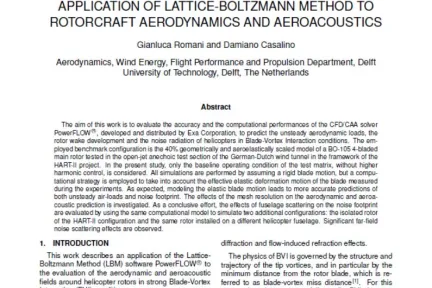
This work describes an application of the Lattice-Boltzmann Method (LBM) software PowerFLOW R to the evaluation of the aerodynamic and aeroacoustic fields around helicopter rotors in strong Blade-Vortex Interaction (BVI) conditions.
Tech Notes
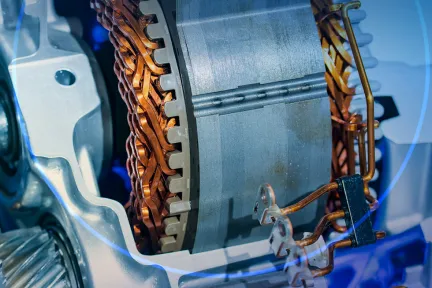
Manatee offers a collaborative simulation and analysis environment designed to quickly and accurately optimize vibro-acoustic performances of electrical systems under electromagnetic excitations. Its user-friendly interface has been developed for electrical, mechanical, acoustic and NVH test engineers.
Brochures
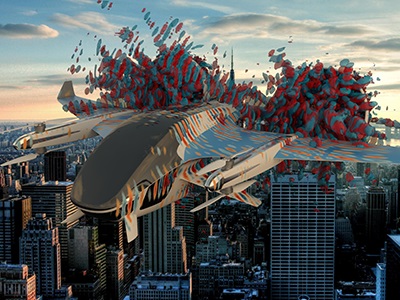
Discover how to digitalize the R&D of a new flying vehicle to reduce its time to market and increase certification confidence.
E-seminar
Watch the replay of the fourth episode in our MODSIM Series
E-seminar

Watch the replay of the second episode in our MODSIM Series
E-seminar
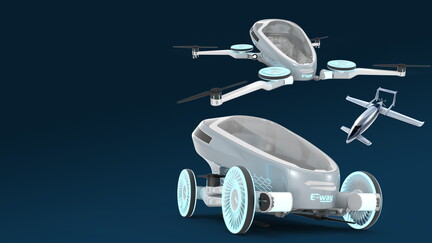
Watch the replay for the first episode in our MODSIM Series
E-seminar

Watch the replay for the third episode in our MODSIM Series
E-seminar
日頃Abaqusをお使いのお客様に、知っておくと便利な機能を紹介いたします。主にAbaqus FAQsからの抜粋です。2018年のSIMULIA解析テクノロジーセミナーの同タイトルのセッションの続編となります。
E-seminar

Multiple studies have shown that more than half of all the errors in systems development originate from missing, ambiguous, or incorrect requirements. The cost of fixing these errors increases exponentially after the system is in development or implementation, therefore it is important to try to catch these errors during the Requirements Development phase. This session will present how 3DEXPERIENCE platform enables Requirements Engineering by bringing together the iterative & interleaving activities of Requirements Development and Requirements Management facilitated by integrated Requirements Planning and Requirements Traceability. Furthermore, the session will illustrate the rigor that can be built in the Requirements Development process leveraging the integrated model-based capabilities from No Magic and Requirements in Loop simulation from Argosim to combat the problem of Requirements errors.
E-seminar

The future of conceptual engineering across multiple industries necessitates the need for tools, which effectively capture the requirements at a fundamental level and provide an efficient platform, to not only convert these to 3D geometry but also allow concurrent validation of these concepts. During this session, we will look at success stories from your industry, where a strong simulation-driven concept design, has been very effective to speed up innovation.
E-seminar
The latest releases of XFlow is now available. Watch the replay to learn about the key new features that will be available in XFlow R2021x.
E-seminar

This e-seminar presents a workflow for fatigue calculations of linear flexible structures that are embedded in multibody systems.
E-seminar

Explore appropriate tools available in SIMULIA CST Studio Suite for bandpass filter design.
E-seminar

Discover this e-seminar replay and get key insight on how modeling and simulation can help you accelerate the industrialization of high-performance batteries.
E-seminar
ダッソー・システムズでは、それぞれのご都合に合わせて継続的に学習できるよう、さまざまな自己学習モジュールをご用意しています
ダッソー・システムズの技術者が最新ニュースやイノベーションについて書いている SIMULIA ブログをご覧ください。
An interview with SIMULIA’s Huidi Ji, a software engineer who specializes in simulating composite materials.
Article
In this new blog series, we hear directly from individual SIMULIA Champions about their own personal simulation story. This post from John Sawyer of Atkins Engineering is a continuation in the series, where he talks about how his love of horse riding is similar to problems he faces in his engineering career. John also tells us how much he enjoys being a SIMULIA Champion because of the sense of community and how it brings engineers together to solve problems.
Article
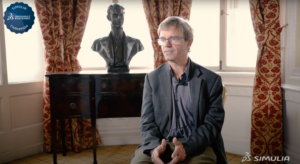
SIMULIA’s own Damiano Casalino was recently awarded the Council of European Aerospace Societies’ 2023 CEAS Aeroacoustics award. This is presented to those who have made outstanding contributions in the field of aeroacoustics.Damiano is an expert in aeroacoustics with his work at SIMULIA relating to PowerFLOW and OptydB. He is also a full-time professor and chair of aeroacoustics at Delft University of Technology (one of the most important aerospace faculties of the world) and on the Stanford list of the 2% most impacting scientists. We caught up with Damiano to find out more about his career and passion for engineering.
Article
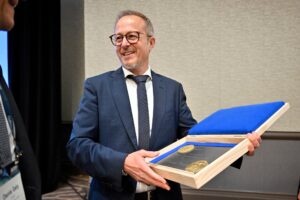
SIMULIA is excited to work with leaders across different industries as they leverage modeling and simulation (MODSIM) capabilities to shorten design loops and accelerate innovation. Our MODSIM Pioneers series highlights some outstanding contributors leading transformations in their industries. Below, we hear from Pascal Remusan, General Manager of Methods & Tools for Numerical Simulation of Renault Group, who we caught up with following his presentation at the 3DEXPERIENCE Modeling & Simulation Conference 2022.
Article

3DEXPERIENCEプラットフォームを用いてパイプライン周りの渦励起(VIV)といった連成シミュレーションを実行いただけます。流体シミュレーションはFMKロール、非線形構造シミュレーションはSYEロールでご実施いただけます。
新聞その他記事
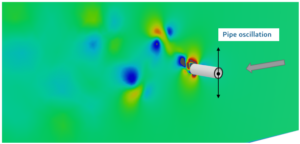
熱流体システム設計ではデザイナーやエンジニアが3Dモデルを作成し、それをCAE専任者に渡してCFD (Computational Fluid Dynamics) 解析とシミュレーションを行うのが一般的な流れです。この作業に数ヶ月を要し、その後更に物理的なテストを実施することもあります。Fluid Dynamics Engineerは革新的な設計コンセプトを探求しつつ設計改善のため日常的に熱流体の計算を行うエンジニアを対象としています。
新聞その他記事
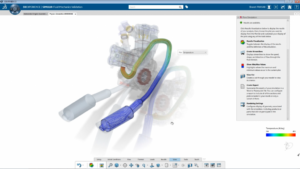
この記事は3DEXPERIENCEプラットフォーム上のシミュレーションと、3DEXPERIENCEプラットフォーム上にあるロール紹介のシリーズのひとつです。今回はFluid Dynamics Engineerロールに焦点を当て、普段から熱流体シミュレーションを行うエンジニアの方に、設計変更をして革新的な設計コンセプトを探求いただくのにお役立ていただければ幸いです。
新聞その他記事
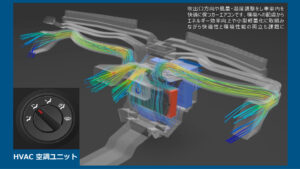
A Conversation with Dassault Systèmes’ Ross McLendon.
Article
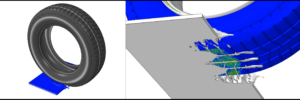
This highly integrated MODSIM workflow brings associativity between a parametric CAD and high fidelity multiphysics simulation for the better understanding of tires.
Article

Learn how fun error norms can be with SIMULIA! Specifically the error norms used in the 3DEXPERIENCE Calibration App.
Article
By Carlos Vicente and Pierre Monteil in collaboration with Exens Solutions.
Article

Learn how to leverage 3DEXPERIENCE platform web-based dashboards to democratize electromagnetic performance of complex systems.
Article

組織の規模の大小を問わず、シームレスなコラボレーションと持続可能なイノベーションに、当社のソリューションがどう役立つかについて、SIMULIA のエンジニアがご説明します。
学生、教育機関、専門家、企業向けに、さまざまなトレーニング・コースをご提供しています。お客様に最適な SIMULIA トレーニングを受講してください。
ソフトウェアおよびハードウェアの認証情報、ソフトウェアのダウンロード、ユーザー・ドキュメント、サポート窓口、ならびに提供サービスに関する情報はこちらから。