Hay 1497 resultados
An Evaluation of the Pro/ENGINEER Associative Interface for Abaqus/CAE

As design cycle times are shortened, engineers continue to find ways to be more productive. Generally, one tries to leverage software tools to get solutions faster. This productivity improvement is possible through continued software advancements, such as the Pro/ENGINEER to Abaqus/CAE Associative Import, via an Elysium Neutral (Assembly) File. Engineers can iterate from CAD to FEA while retaining applied loads and boundary conditions. This paper will discuss use of the associative import features with design changes (such as thickness change, split surfaces, or holes). The pros and cons in using the tool will be tabulated. The reader will see that using the associative import can reduce design iterations from weeks to days.

Customer Papers

An Evaluation of the Pro/ENGINEER Associative Interface for Abaqus/CAE
Thermostructural Analysis of an Experimental Re-entry Vehicle

Finite Element (FE) analysis of the Thermal Protection System (TPS) of the European eXPerimental Re-entry Testbed (EXPERT) is presented in this work. The atmospheric re-entry vehicle is subjected to thermal and mechanical loads during its different flight phases, i.e., accelerations, random vibrations, acoustic and shock loads during launch phase, aerodynamic heating and aerodynamic forces during the re-entry phase, and impact shock at the ground impact. Thermal and structural FE models are created to predict the thermal and thermomechanical performances of the EXPERT TPS. Geometrical and material non-linearities are accounted for in the FE analyses. The FE analyses results are used for the EXPERT TPS design verification and improvement.

Customer Papers

Thermostructural Analysis of an Experimental Re-entry Vehicle
Modeling of Flexible Adhesive Joints in Automotive Crash Simulations: Calibration and Application of Cohesive Elements

The simulation of crashworthiness plays an important role in the design process of today’s automotive industry. Recently, efforts have been made to consider the effects of adhesive joints in the simulations. Flexible adhesive bonds typically have a thickness of one to five millimeters. Therefore, a detailed three-dimensional representation of the adhesive layer is infeasible in industrial crash simulations. For quasi-static loading conditions the submodeling technique is one possible solution to this problem. But if the influence of the fracture process on the deformation behavior of the structure is of interest like in crash simulations, then submodeling is insufficient.

Customer Papers

Modeling of Flexible Adhesive Joints in Automotive Crash Simulations: Calibration and Application of Cohesive Elements
Projected contact area method and its application to rolling tire simulation

It is well known that the friction coefficient of rubber-like materials is a function of normal contact pressure, sliding velocity and temperature. In this reason, the exact calculation of normal contact pressure is very important when the rubber frictional forces are computed under a pressure dependent frictional model. Nevertheless, in many finite element codes including ABAQUS have been observed not to exactly calculate the nodal contact area and pressure at contact surface edges and corners. To overcome this problem, PCAM is proposed and implemented via ABAQUS user subroutine VFRIC

Customer Papers

Projected contact area method and its application to rolling tire simulation
X-FEM for Abaqus Toolkit for Automated Crack Onset and Growth Simulations

A software tool for automated crack onset and growth simulations based on the eXtended Finite Element Method (X-FEM) has been developed. For the first time, this tool is able to simulate arbitrary crack growth and composite delamination without remeshing. The automated tool is integrated with Abaqus/Standard and Abaqus/CAE via the customization interfaces. It seamlessly works with the Commercial, Off-The-Shelf (COTS) Abaqus suite. The levelset method coupled with X-FEM is used to enrich the displacement field with jump and asymptotic near-tip solutions and track the crack geometry as it grows. A penalty-based formulation is developed within the UEL framework to simulate crack closure and frictional contact.

Customer Papers

X-FEM for Abaqus Toolkit for Automated Crack Onset and Growth Simulations
Modeling the Creep Behavior of Torsional Springs

A finite element model is developed to investigate the instantaneous as well as long-term (time-dependant) structural response of a pre-loaded torsional spring. Torsional springs belong to a class of spiral springs that are commonly made out of Elgiloy - an alloy of Cobalt, Chromium, Nickel and Iron. Elgiloy has very high yield strength, and is commonly used as a spring material in clocks. The research involves development of a detailed component-level model, using Abaqus/Standard, to investigate the instantaneous static moment-rotation response, and the longterm stress relaxation response of the spring system, along with, understanding the sensitivity of this response on the various design parameters.

Customer Papers

Modeling the Creep Behavior of Torsional Springs
Load Transfer Analysis of SDS Wood Screw Connection in Multi-Ply Girder Trusses

ABAQUS/Explicit, combining with general contact, connector elements, distributedmemory processing (DMP), and digital signal processing (DSP) techniques, has a unique strength in solving some of the large quasi-static problems which involve large number of sliding contact pairs, highly nonlinear structural behavior. In this paper, a case is presented to show the successful application of ABAQUS/Explicit to solve the real-world problem in multi-ply girder truss load distribution testing. The model predicted ply-to-ply load transfer rates agree well with the test results. The calibrated model can be used for taking the place of some expensive lab tests, and it can be also used for evaluation of many design variations more efficiently.

Customer Papers

Load Transfer Analysis of SDS Wood Screw Connection in Multi-Ply Girder Trusses
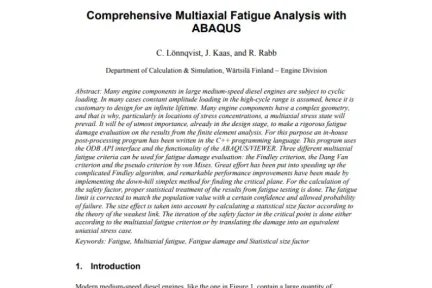
Comprehensive Multiaxial Fatigue Analysis with ABAQUS

Many engine components in large medium-speed diesel engines are subject to cyclic loading. In many cases constant amplitude loading in the high-cycle range is assumed, hence it is customary to design for an infinite lifetime. Many engine components have a complex geometry, and that is why, particularly in locations of stress concentrations, a multiaxial stress state will prevail. It will be of utmost importance, already in the design stage, to make a rigorous fatigue damage evaluation on the results from the finite element analysis. For this purpose an in-house post-processing program has been written in the C++ programming language.

Customer Papers

Comprehensive Multiaxial Fatigue Analysis with ABAQUS
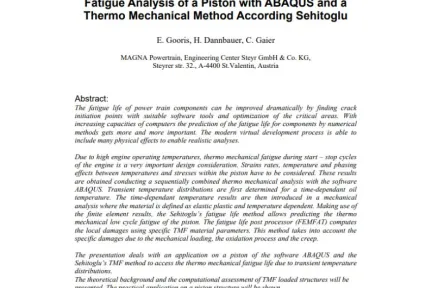
Fatigue Analysis of a Piston with ABAQUS and a Thermo Mechanical Method According Sehitoglu

The fatigue life of power train components can be improved dramatically by finding crack initiation points with suitable software tools and optimization of the critical areas. With increasing capacities of computers the prediction of the fatigue life for components by numerical methods gets more and more important. The modern virtual development process is able to include many physical effects to enable realistic analyses. The presentation deals with an application on a piston of the software ABAQUS and the Sehitoglu’s TMF method to access the thermo mechanical fatigue life due to transient temperature distributions.

Customer Papers

Fatigue Analysis of a Piston with ABAQUS and a Thermo Mechanical Method According Sehitoglu
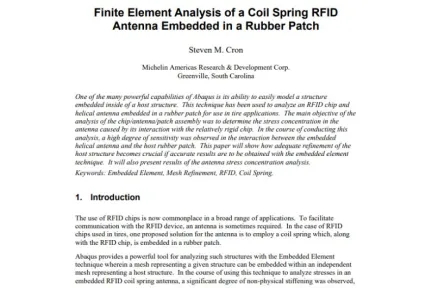
Finite Element Analysis of a Coil Spring RFID Antenna Embedded in a Rubber Patch

One of the many powerful capabilities of Abaqus is its ability to easily model a structure embedded inside of a host structure. This technique has been used to analyze an RFID chip and helical antenna embedded in a rubber patch for use in tire applications. The main objective of the analysis of the chip/antenna/patch assembly was to determine the stress concentration in the antenna caused by its interaction with the relatively rigid chip. In the course of conducting this analysis, a high degree of sensitivity was observed in the interaction between the embedded helical antenna and the host rubber patch. This paper will show how adequate refinement of the host structure becomes crucial if accurate results are to be obtained with the embedded element technique.

Customer Papers

Finite Element Analysis of a Coil Spring RFID Antenna Embedded in a Rubber Patch
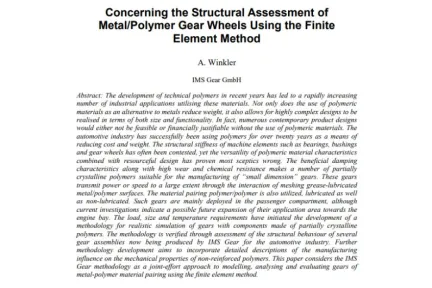
Concerning the Structural Assessment of MetalPolymer Gear Wheels Using the Finite Element Method

The development of technical polymers in recent years has led to a rapidly increasing number of industrial applications utilising these materials. Not only does the use of polymeric materials as an alternative to metals reduce weight, it also allows for highly complex designs to be realised in terms of both size and functionality. In fact, numerous contemporary product designs would either not be feasible or financially justifiable without the use of polymeric materials. The automotive industry has successfully been using polymers for over twenty years as a means of reducing cost and weight.

Customer Papers

Concerning the Structural Assessment of MetalPolymer Gear Wheels Using the Finite Element Method
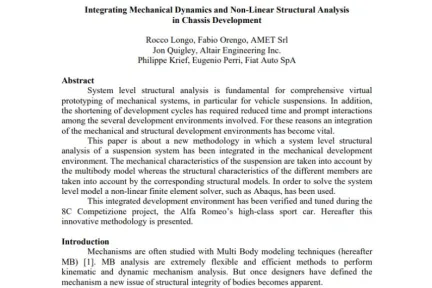
Integrating Mechanical Dynamics and Non-Linear Structural Analysis in Chassis Development

This paper is about a new methodology in which a system level structural analysis of a suspension system has been integrated in the mechanical development environment. The mechanical characteristics of the suspension are taken into account by the multibody model whereas the structural characteristics of the different members are taken into account by the corresponding structural models. In order to solve the system level model a non-linear finite element solver, such as Abaqus, has been used. This integrated development environment has been verified and tuned during the 8C Competizione project, the Alfa Romeo’s high-class sport car. Hereafter this innovative methodology is presented.

Customer Papers

Integrating Mechanical Dynamics and Non-Linear Structural Analysis in Chassis Development
Hay 247 resultados

Testimonios de clientes

Hay 132 resultados
Hay 3 resultados

Autoaprendizaje de SIMULIA

Ofrecemos cientos de módulos de autoaprendizaje para que pueda seguir aprendiendo a su ritmo

Blogs

Lea el blog de SIMULIA sobre las últimas noticias e innovaciones de nuestros expertos.

Hay 696 resultados

Descubra lo que SIMULIA puede hacer por usted

Hable con un experto de SIMULIA para descubrir cómo nuestras soluciones permiten colaborar sin problemas e innovar de manera sostenible en organizaciones de todos los tamaños.

Póngase en marcha

Los cursos y las clases están disponibles para estudiantes, instituciones académicas, profesionales y empresas. Encuentre la formación de SIMULIA adecuada para usted. 

Obtener ayuda

Encuentre información sobre certificación de software y hardware, descargas de software, documentación del usuario, contacto con soporte y oferta de servicios