Hay 1497 resultados
Three Dimensional Numerical Modelling of Foundation Systems for Offshore Wind Energy Plants

Offshore wind energy plants promise to become an important source of energy in the near future. It is expected that within 10 years, wind parks with a total capacity of thousands of megawatts will be installed in European seas. The foundation of such offshore wind energy plants plays an important role in the stability of these structures. High demands have to be made concerning foundation design and construction methods to find economical and technically optimal solutions. Two foundation concepts which can be used in this field are the monopile and the tripod.

Customer Papers
Three Dimensional Numerical Modelling of Foundation Systems for Offshore Wind Energy Plants
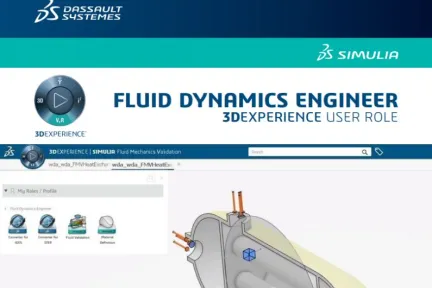
FLUID DYNAMICS ENGINEER 3DEXPERIENCE USER ROLE

Fluid Dynamics Engineer provides designers and design engineers with the ability to validate fluid performance for internal and external flows. The users can make use of the obtained results to optimize their designs for flow distribution, thermal performance, pressure loss and turbulence. Computational Fluid Dynamics (CFD) technology is employed during the product design process with minimal knowledge of CFD principles and applications.

Brochures

FLUID DYNAMICS ENGINEER 3DEXPERIENCE USER ROLE
Simulation of Descaling during Continuous Hot Rolling

Oxidation of the steel surface is always present during hot rolling and the oxide has to be eliminated before deformation to avoid imprinting and damaging the surface. It is normal practice to use high pressure water jets (descaling) to break and remove the oxide layer formed at different stages. The design of the descaling stations is carried out by trail and error without a systematic way to confirm the benefits of a given design. A model was developed using the commercial software ABAQUSTM/Standard in order to evaluate the mechanical integrity of the secondary oxide found on low carbon steel during hot rolling.

Customer Papers

Simulation of Descaling during Continuous Hot Rolling
Realistic micromechanical modeling and simulation of boron modified titanium alloys

Finite element simulations of micro-mechanical response are performed on real and computer simulated microstructures of boron modified titanium alloys containing in-situ formed Titanium Boride (TiB) phase. The microstructure model incorporates realistic particle TiB whisker morphologies/shapes and anisotropic whisker orientations. Surface-to-surface contact with finite sliding is used to model the interaction between the Vickers indenter and the sample. The computed constitutive equations are then used in 2-D and 3-D microstructural models with realistic phase morphologies/spatial distribution to simulate the global elastic-plastic mechanical response of the composite. The results are compared with the experimental data.

Customer Papers

Realistic micromechanical modeling and simulation of boron modified titanium alloys
Fatigue Damage Analysis of an Elastomeric Tank Track Component

The backerpad on the Abrams tank track system is an elastomeric cushion that protects the track and has direct contact with the tank’s wheels. The backerpad’s service life is limited by harsh operating conditions, and system designers are challenged to extend that limit. Accordingly, an analysis is demonstrated here of an experimental backerpad’s fatigue performance under the action of a tank roadwheel repeatedly rolling over the pad. First, the elastomer is characterized via tests that define its fatigue behavior. Next, the multiaxial, variable amplitude duty cycle of the pad through a representative rollover event is computed in ABAQUS/Explicit. Finally, the material characterization and duty cycle are analyzed via the fe-safe/Rubber fatigue life solver to estimate damage accumulation in each finite element of the model.

Customer Papers

Fatigue Damage Analysis of an Elastomeric Tank Track Component
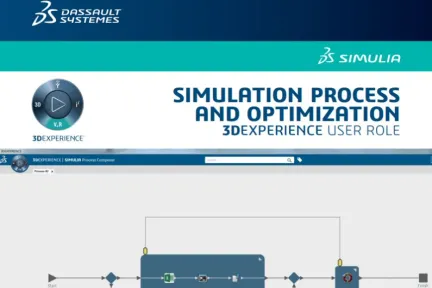
SIMULATION PROCESS AND OPTIMIZATION 3DEXPERIENCE USER ROLE

Simulation Process & Optimization provides a framework for engineering teams to integrate all of the tools they use into re-usable, deployable processes. This reduces time-consuming and error prone tasks to improve productivity and consistency while enabling design exploration studies to find better designs and democratization to expand the user-base for simulation. Lastly, capturing these processes in 3DEXPERIENCE provides the traceability organizations need when making critical business decisions.

Brochures

SIMULATION PROCESS AND OPTIMIZATION 3DEXPERIENCE USER ROLE
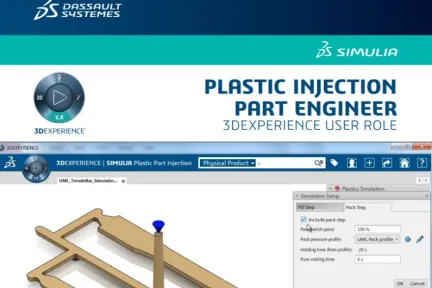
PLASTIC INJECTION PART ENGINEER 3DEXPERIENCE USER ROLE

Plastic Injection Part Engineer brings easy-to-use injection molding simulation directly to the designers of plastic parts and injection molds. It simulates how melted plastic flows during the injection molding process to predict manufacturing-related defects on plastic parts. You can quickly evaluate manufacturability while you design, to eliminate costly part redesign, improve part quality, and accelerate time to market. Plastic part designers and product developers can analyze and modify designs at the same time as optimizing for form, fit, and function.

Brochures

PLASTIC INJECTION PART ENGINEER 3DEXPERIENCE USER ROLE
Modelling of Large Open Pit Stability Using ABAQUS

The Largest, Deep Open Pits are steadily approaching depths of a kilometre. The complexity of the mining process and damage phenomena for these pits are amongst the most challenging applications of finite element simulation. Although significant advances have been made in the many areas related to mechanics of pit slopes, computer resources have limited the use of numerical modelling for open pit problems to two-dimensions or overly simplified 3d models.

Customer Papers

Modelling of Large Open Pit Stability Using ABAQUS
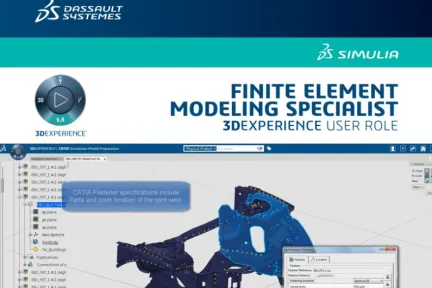
FINITE ELEMENT MODELING SPECIALIST 3DEXPERIENCE USER ROLE

The Finite Element Modeling Specialist role specializes in the creation and/or management of large and complex finite element assemblies requiring automated modeling techniques and the collaborative efforts of several engineering teams. Finite Element Modeling Specialist allows Specialist users to define procedures through a scripting language, thus capturing the company’s modeling standards and best-practices, which can be shared with other users across the enterprise on the 3DEXPERIENCE Platform.

Brochures

FINITE ELEMENT MODELING SPECIALIST 3DEXPERIENCE USER ROLE
A geomechanical reservoir modeling tool

A link between the geological software Irap RMS and ABAQUS is established using ABAQUS scripting interface in order to have; automated generation of geomechanical reservoir simulation models, to better account for geomechanical effects in the reservoir simulation and 4D feasibility studies. The link consists of a set of Python scripts that rebuild the reservoir geometry in ABAQUS/CAE: the tool may connect corresponding hanging wall and foot wall grid blocks in order to generate an unfaulted global model, the tool may open up the grid along the fault surfaces and introduce the geometry of the fault fill material, It adds the geometry of the over-, side- and under-burden. In other words all developments are geometry based which is believed to be a unique feature of the tool.

Customer Papers

A geomechanical reservoir modeling tool
RESULTS DATA ANALYST 3DEXPERIENCE USER ROLE

Whether data is generated from simulation or physical test, customers continue to generate large amount of data that requires Results Analytics to post-process, visualize, and analyze trade-offs. Users can now unlock their data to collaboratively answer common questions, such as “What if?” or “What is my best option?” while retaining decision history and reference material in one place.

Brochures

RESULTS DATA ANALYST 3DEXPERIENCE USER ROLE
Using ABAQUS with 3D imaging techniques for material characterization

Image-based meshing is opening up exciting new possibilities for the application of computational continuum mechanics methods (e.g. CFD and FEA) to material characterization based on micro-structural scan data. An innovative mesh generation technique has been developed which converts 3D scanner data (such as from microCT or X-ray tomography) directly into meshes suitable for use in FE and CFD simulations. The ease and robustness with which simulation models can be generated have opening up exciting new avenues in materials research, particularly in materials characterization and non destructive testing.

Customer Papers

Using ABAQUS with 3D imaging techniques for material characterization
Hay 247 resultados

Testimonios de clientes

Hay 132 resultados
Hay 3 resultados

Autoaprendizaje de SIMULIA

Ofrecemos cientos de módulos de autoaprendizaje para que pueda seguir aprendiendo a su ritmo

Blogs

Lea el blog de SIMULIA sobre las últimas noticias e innovaciones de nuestros expertos.

Hay 696 resultados

Descubra lo que SIMULIA puede hacer por usted

Hable con un experto de SIMULIA para descubrir cómo nuestras soluciones permiten colaborar sin problemas e innovar de manera sostenible en organizaciones de todos los tamaños.

Póngase en marcha

Los cursos y las clases están disponibles para estudiantes, instituciones académicas, profesionales y empresas. Encuentre la formación de SIMULIA adecuada para usted. 

Obtener ayuda

Encuentre información sobre certificación de software y hardware, descargas de software, documentación del usuario, contacto con soporte y oferta de servicios