Hay 1497 resultados
Solution of Inverse Problem of Elastic-Plastic Deformation using Isight and Abaqus

As a rule, compression spring shapes are designed to conform to the required compression force using general theories. Under some conditions, lateral forces on the springs can be an issue. Lateral forces are greatly affected by contact conditions between springs and structures and the spring’s self-contact. Numerical calculations to determine the spring shape must take these factors into consideration. However, the manufacturing method causes a high degree of plastic deformation by a process called “prestressing” which means that the final shape of the spring is different from the coiled metal piece required for manufacturing.

Customer Papers
Solution of Inverse Problem of Elastic-Plastic Deformation using Isight and Abaqus
Using the Failure Assessment Diagram Method with Fatigue Crack Growth to Determine Leak-beforeRupture

To evaluate if a crack may cause structural failure, the failure assessment diagram (FAD) method uses two ratios: brittle fracture and plastic collapse. The objective of this paper is to use Abaqus/Standard to compute elastic-plastic J-integral results along the crack front. These results are then used to calculate the plastic collapse crack reference stress, especially for cases when the reference stress solution is not available for a structural component.

Customer Papers

Using the Failure Assessment Diagram Method with Fatigue Crack Growth to Determine Leak-beforeRupture
Modeling and Simulation of the Firing Cycle for an Automatic Small Arm

The presented work intends to illustrate how Beretta approaches the study of automatic small arms’ firing cycles, from the launch of firing pin to locking mechanism being subjected to the gas pulse, to the recoiling of the moving parts operating the extraction and ejection of the spent cartridge case, and finally the feeding of a fresh cartridge into the firearm’s chamber. Using finite element analysis for the study of such engineering problems benefits the product development cycle for its ability to provide key insights in the areas of reliability and durability.

Customer Papers

Modeling and Simulation of the Firing Cycle for an Automatic Small Arm
Abaqus/Standard Simulation of Ground Subsidence due to Oil and Gas Extraction

Extraction from oil and gas from an underground reservoir alters the pore pressure distribution in the reservoir strata. Modifications in pore pressure can lead to plastic deformation in the strata, which can in turn modify the pore fluid flow and lead to ground subsidence. Since subsidence can affect the operability of equipment on the ground as well as the safety of buildings and structures, it needs to be accurately predicted and kept within limits. In this Technology Brief, we present a method for predicting the rock deformation and ground and ground subsidence resulting from oil and gas extraction.

Solution Briefs

Abaqus/Standard Simulation of Ground Subsidence due to Oil and Gas Extraction
A fundamental study of the flow past a circular cylinder using Abaqus/CFD

The latest release of Abaqus version 6.10 includes Abaqus/CFD. The inclusion of this software makes it possible for users to perform a fluid analysis in a more user-friendly manner. Independent single software solely for CFD is currently available from many developers, and many attempts have been made to link software of CFD to structural analysis system using some specific procedures such as fluid structure interfaces (FSI). Direct implementation of CFD in FE structural analysis software offers ease of access to CFD. Adopting the position of a mechanical engineer trying to use CFD for the first time, a series of fundamental analyses were performed using Abaqus/CFD.

Customer Papers

A fundamental study of the flow past a circular cylinder using Abaqus/CFD
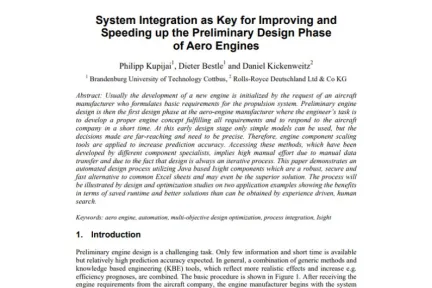
System Integration as Key for Improving and Speeding up the Preliminary Design Phase of Aero Engines

Usually the development of a new engine is initialized by the request of an aircraft manufacturer who formulates basic requirements for the propulsion system. Preliminary engine design is then the first design phase at the aero-engine manufacturer where the engineer’s task is to develop a proper engine concept fulfilling all requirements and to respond to the aircraft company in a short time. At this early design stage only simple models can be used, but the decisions made are far-reaching and need to be precise. Therefore, engine component scaling tools are applied to increase prediction accuracy.

Customer Papers

System Integration as Key for Improving and Speeding up the Preliminary Design Phase of Aero Engines
Multiphysics Simulations of Representative Hypersonic Vehicle Structures

This paper extends a previously developed computational framework for coupled aerothermoelastic simulations for hypersonic vehicle structures in extreme environments. An aeroheating verification and validation case is first conducted on a Mach 6.5+ spherical dome protuberance that was tested in a NASA wind tunnel. ATA’s simulation includes aerothermoelasticity in the physics and captures the heating of the compliant dome structure during the first five seconds of exposure to hypersonic flow. This case is followed by a coupled quasi-static aerothermoelastic analysis of an acreage panel-level structural component for a sustained, reusable, air-breathing Mach 5–7 cruise horizontal-takeoff platform.

Customer Papers

Multiphysics Simulations of Representative Hypersonic Vehicle Structures
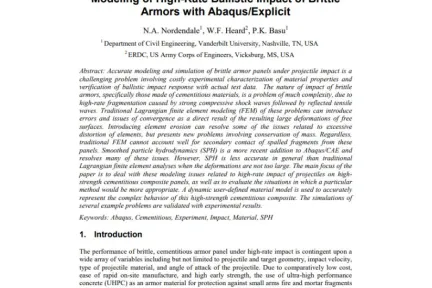
Modeling of High-Rate Ballistic Impact of Brittle Armors with Abaqus/Explicit

Accurate modeling and simulation of brittle armor panels under projectile impact is a challenging problem involving costly experimental characterization of material properties and verification of ballistic impact response with actual test data. The nature of impact of brittle armors, specifically those made of cementitious materials, is a problem of much complexity, due to high-rate fragmentation caused by strong compressive shock waves followed by reflected tensile waves. Traditional Lagrangian FEM of these problems can introduce errors and issues of convergence as a direct result of the resulting large deformations of free surfaces. Introducing element erosion can resolve some of the issues related to excessive distortion of elements, but presents new problems involving conservation of mass.

Customer Papers

Modeling of High-Rate Ballistic Impact of Brittle Armors with Abaqus/Explicit
Finite Element Analysis of Head Impact in Contact Sports

Traumatic brain injury (TBI) is one of the world’s major causes of death and disability. To aid companies in designing safer and improved protective gear and to aid the medical community in producing improved quantitative TBI diagnosis and assessment tools, a multiscale finite element model of the human brain, head and neck is being developed. Recorded impact data from football and hockey helmets instrumented with accelerometers are compared to simulated impact data in the laboratory. Using data from these carefully constructed laboratory experiments, we can quantify impact location, magnitude, and linear and angular accelerations of the head. The resultant forces and accelerations are applied to a fully meshed head-form created from MRI data by Simpleware.

Customer Papers

Finite Element Analysis of Head Impact in Contact Sports
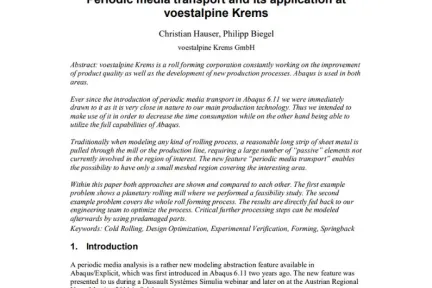
Periodic media transport and its application at voestalpine Krems

voestalpine Krems is a roll forming corporation constantly working on the improvement of product quality as well as the development of new production processes. Abaqus is used in both areas. Within this paper both approaches are shown and compared to each other. The first example problem shows a planetary rolling mill where we performed a feasibility study. The second example problem covers the whole roll forming process. The results are directly fed back to our engineering team to optimize the process. Critical further processing steps can be modeled afterwards by using predamaged parts.

Customer Papers

Periodic media transport and its application at voestalpine Krems
Modeling and Analysis of Salt Creep Deformations in Drilling Applications

Drilling through salt has created increasing challenges for the oil and gas industry. In many cases, deepwater exploration around the world requires drilling through salt layers above oil and/or gas reservoirs. Borehole closure and instability due to salt creep are two major concerns in designing completions for production wells drilled through salt layers. Similar issues also occur where gas storage caverns are built in salt formations. Pressure changes that occur in the salt cavern during operation can cause cavern closure and instability.

Customer Papers

Modeling and Analysis of Salt Creep Deformations in Drilling Applications
Hay 247 resultados

Testimonios de clientes

Hay 132 resultados
Hay 3 resultados

Autoaprendizaje de SIMULIA

Ofrecemos cientos de módulos de autoaprendizaje para que pueda seguir aprendiendo a su ritmo

Blogs

Lea el blog de SIMULIA sobre las últimas noticias e innovaciones de nuestros expertos.

Hay 696 resultados

Descubra lo que SIMULIA puede hacer por usted

Hable con un experto de SIMULIA para descubrir cómo nuestras soluciones permiten colaborar sin problemas e innovar de manera sostenible en organizaciones de todos los tamaños.

Póngase en marcha

Los cursos y las clases están disponibles para estudiantes, instituciones académicas, profesionales y empresas. Encuentre la formación de SIMULIA adecuada para usted. 

Obtener ayuda

Encuentre información sobre certificación de software y hardware, descargas de software, documentación del usuario, contacto con soporte y oferta de servicios