Hay 1497 resultados
Numerical Simulation of Severe Plastic Deformation during High Pressure Torsion Processing

The principle of achieving high strength and superior properties in metal alloys through the application of severe plastic deformation has been exploited in the metal processing industry for many decades. The High Pressure Torsion (HPT) process is one of the most promising techniques for imposing very high strains to a bulk solid without introducing a significant change in sample dimensions. The HPT process involves large shear and compressive plastic deformations, and offers the possibility to deform the material under very high hydrostatic pressures (up to several GPa), with continuous control of the degree of deformation.

Customer Papers
Numerical Simulation of Severe Plastic Deformation during High Pressure Torsion Processing
Structural optimization of a transversal rolling mill component to improve flexional stiffness

The structural component investigated is a roll mill bar which sustain a plug for a transversal rolling of steel pipes. The improvement of the stiffness of this component is the target of the simulation to achieve the desired flexional displacement. An optimization tool is used to achieve the target in a proper and fast way. A 3D FEM model is developed to perform several different static analyses as basis of optimization process. The bending response of the structure is studied on the basis of the real working condition introducing the loads measured in the plant. Explicit model is then used to simulate the new stiffness in the expanding roll process. The main purpose of the improved stiffness is to stabilize the rolling process to maintain the bar and the plug aligned with roll axis, keeping the setup of the machine.

Customer Papers

Structural optimization of a transversal rolling mill component to improve flexional stiffness
Thermal Expansion & Helical Buckling of Pipe-in-Pipe Flowline Systems

Helical buckling analyses are performed primarily to determine the critical effective axial load at which the inner pipe of a pipe-in-pipe (PiP) system snaps into a sinusoidal or helical buckling deformation mode. The expected behavior, when a flowline is compressed within a larger diameter tubular, is that it will first develop a sinusoidal buckle pattern as it lies along the bottom of the larger diameter pipe. Further compression of the inner pipeline will ultimately cause it to snap into a helical deformation pattern, which will lift the inner flowline off of the bottom of the outer pipe. The axial force that triggers the sinusoidal buckling is denoted as Fcs and the larger force needed for helical buckling is denoted as Fc.

Customer Papers

Thermal Expansion & Helical Buckling of Pipe-in-Pipe Flowline Systems
Advanced Finite Element Analysis to Tackle Challenging Problems in Pipeline Geotechnics

Offshore pipeline design is a multidisciplinary field of engineering that covers route optimization, mechanical wall thickness design, fracture mechanics, flow assurance, stress analysis, geotechnics.For decades, pipelines have been designed pursuing a stress based approach, based on analytical methods and semi-empirical rules of thumb. However, the challenging conditions in oil and gas exploration and production dictate the use of sophisticated numerical tools to assist the pipeline design engineer. In particular, pipe-soil interaction is a complicated phenomenon that governs the response of the offshore pipeline to operational load patterns.

Customer Papers

Advanced Finite Element Analysis to Tackle Challenging Problems in Pipeline Geotechnics
Failure Modeling of Thermoplastic Butt-Joint Stiffened Panels by Quasi-Static Loading

In this work the quasi-static response of thermoplastic butt-joint stiffened beam in bending conditions is modeled. In these panels, the stiffener is connected to the skin by a shortfiber reinforced filler. Although this type of connection performs very well in a pull-off loading (fracture loading is 10 times higher than welded connection), optimization is required regarding its impact performance. The main issue concerning this loading type is the extreme resistance to impact until a certain threshold, upon which the stiffener-skin connection fails in an instable manner, however leaving only barely visible damage on the skin side.

Customer Papers

Failure Modeling of Thermoplastic Butt-Joint Stiffened Panels by Quasi-Static Loading
Concrete Constitutive Model, Calibration and Applications

A methodology has been developed for characterising the mechanical behaviour of concrete, based on the damaged plasticity model, enriched with a user subroutine (V)USDFLD in order to capture better the ductility of the material under moderate confining pressures. The model has been applied in the context of the international benchmark IRIS_2012, organised by the OECD/NEA/CSNI Nuclear Energy Agency, dealing with impacts of rigid and deformable missiles against reinforced concrete targets. A slightly modified version of the concrete damaged plasticity model was used to represent the concrete. The simulation results matched very well the observations made during the actual tests.

Customer Papers

Concrete Constitutive Model, Calibration and Applications
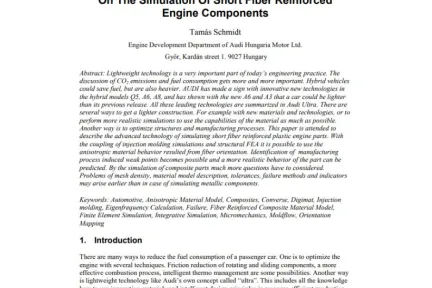
On The Simulation Of Short Fiber Reinforced Engine Components

Lightweight technology is a very important part of today’s engineering practice. The discussion of CO2 emissions and fuel consumption gets more and more important. Hybrid vehicles could save fuel, but are also heavier. AUDI has made a sign with innovative new technologies in the hybrid models Q5, A6, A8, and has shown with the new A6 and A3 that a car could be lighter than its previous release. All these leading technologies are summarized in Audi Ultra. There are several ways to get a lighter construction. This paper is attended to describe the advanced technology of simulating short fiber reinforced plastic engine parts.

Customer Papers

On The Simulation Of Short Fiber Reinforced Engine Components
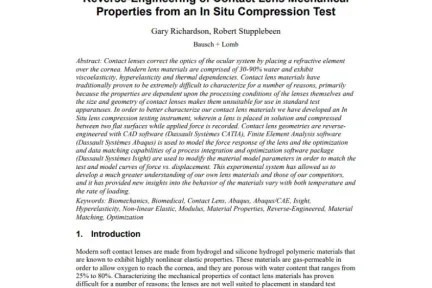
Reverse-Engineering of Contact Lens Mechanical Properties from an In Situ Compression Test

Contact lenses correct the optics of the ocular system by placing a refractive element over the cornea. Modern lens materials are comprised of 30-90% water and exhibit viscoelasticity, hyperelasticity and thermal dependencies. Contact lens materials have traditionally proven to be extremely difficult to characterize for a number of reasons, primarily because the properties are dependent upon the processing conditions of the lenses themselves and the size and geometry of contact lenses makes them unsuitable for use in standard test apparatuses. In order to better characterize our contact lens materials we have developed an In Situ lens compression testing instrument, wherein a lens is placed in solution and compressed between two flat surfaces while applied force is recorded.

Customer Papers

Reverse-Engineering of Contact Lens Mechanical Properties from an In Situ Compression Test
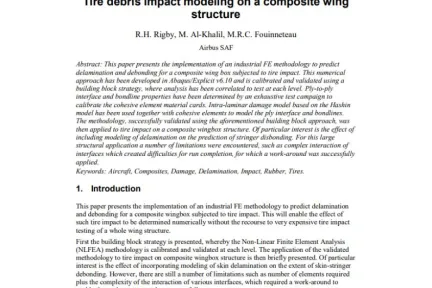
Tire debris impact modeling on a composite wing structure

This paper presents the implementation of an industrial FE methodology to predict delamination and debonding for a composite wing box subjected to tire impact. This numerical approach has been developed in Abaqus/Explicit v6.10 and is calibrated and validated using a building block strategy, where analysis has been correlated to test at each level. Ply-to-ply interface and bondline properties have been determined by an exhaustive test campaign to calibrate the cohesive element material cards. Intra-laminar damage model based on the Hashin model has been used together with cohesive elements to model the ply interface and bondlines. The methodology, successfully validated using the aforementioned building block approach, was then applied to tire impact on a composite wingbox structure.

Customer Papers

Tire debris impact modeling on a composite wing structure
Design and Analysis of a Foldable Wing Mechanism

Rocket and missile systems are often kept in launch tubes until they are fired. Dimensions of the tubes are determined by the munitions inside them. In some cases, due to space and weight limitations, launch tubes must match certain dimensions other than imposed by the system. Inner diameter of the launch tube is mainly determined by control surface span. Thus folding the control surfaces decreases space occupied in the tube. In foldable wing mechanisms, wings are held in folded position in the tube. After munitions leave the tube, wings erect and are locked secure in unfolded position. These mechanisms contain a spring like element that stores necessary energy to unfold the wing and a locking pin that secures the wing in desired position.

Customer Papers

Design and Analysis of a Foldable Wing Mechanism
Analysis and Optimization of a Passenger Bus Frame Through Finite Element Software

The objective of this work is analyze and optimize a passenger bus frame using finite element software, in different static and dynamic conditions. Through a static analysis, torsion and bending constants were extracted using boundary conditions different sets for each one of them. With a linear perturbation step, free and forced vibration modes of the system were obtained and a frequency response analysis was developed. For dynamic analysis, boundary conditions were defined from dynamic automotive equations. Evaluated conditions were suspended weight, acceleration, braking, cornering, and cornering and braking together.

Customer Papers

Analysis and Optimization of a Passenger Bus Frame Through Finite Element Software
Hay 247 resultados

Testimonios de clientes

Hay 132 resultados
Hay 3 resultados

Autoaprendizaje de SIMULIA

Ofrecemos cientos de módulos de autoaprendizaje para que pueda seguir aprendiendo a su ritmo

Blogs

Lea el blog de SIMULIA sobre las últimas noticias e innovaciones de nuestros expertos.

Hay 696 resultados

Descubra lo que SIMULIA puede hacer por usted

Hable con un experto de SIMULIA para descubrir cómo nuestras soluciones permiten colaborar sin problemas e innovar de manera sostenible en organizaciones de todos los tamaños.

Póngase en marcha

Los cursos y las clases están disponibles para estudiantes, instituciones académicas, profesionales y empresas. Encuentre la formación de SIMULIA adecuada para usted. 

Obtener ayuda

Encuentre información sobre certificación de software y hardware, descargas de software, documentación del usuario, contacto con soporte y oferta de servicios