
Improving Part Reuse to Cut Carbon Emissions
Discover how a global equipment manufacturer achieved a 40% reduction in component scrap rate and avoided 2,903 tCO₂e through part reuse powered by NETVIBES on the 3DEXPERIENCE platform.
From Waste to Value: How One Industry Leader Optimizes Part Reuse
When a major equipment manufacturer wanted to enhance its reuse of parts and components, Dassault Systèmes developed a blueprint to make it happen.
In equipment manufacturing, the stakes are high. Massive energy consumption and extensive carbon footprint define its landscape. The problem intensifies when components or parts produced are used only once, leading to significant waste.
As a global leader in manufacturing equipment for electrical, aerospace and automotive companies, this customer faced a big challenge. With operations in over 175 countries, its carbon impact was exponential.
How can it leave a positive handprint?
Recognizing that today’s decisions shape tomorrow’s outcomes, this customer committed itself to enhancing the reuse of its parts and components.
By embracing sustainable manufacturing practices under the circular economy initiative of reducing, reusing and recycling at the lifecycle end, it mitigated risks, decarbonized processes and successfully reduced scrap and waste.
Discover its journey toward a more sustainable and efficient manufacturing future empowered by Dassault Systèmes’ innovative solutions.
About the Customer
Use case: Deployment of NETVIBES on the 3DEXPERIENCE® platform for engineering and design-enabled product part sourcing and standardization.
Industry
Equipment manufacturer
Company size
92,000 employees
Location
Strong presence in more than 175 countries worldwide
The Challenge
The customer’s key challenges stemmed directly from its
Business needs
- Complex product data quality and quantity across five divisions and 70 brands
- Complicated data management due to its fast-paced integration, mergers and acquisitions
Operational requirements
Must ensure the highest quality output, improve product traceability, and achieve cost-effectiveness in its four core processes:
Machining, electroplating, forming, and assembly—connecting more than 100 machines simultaneously.

The Solution
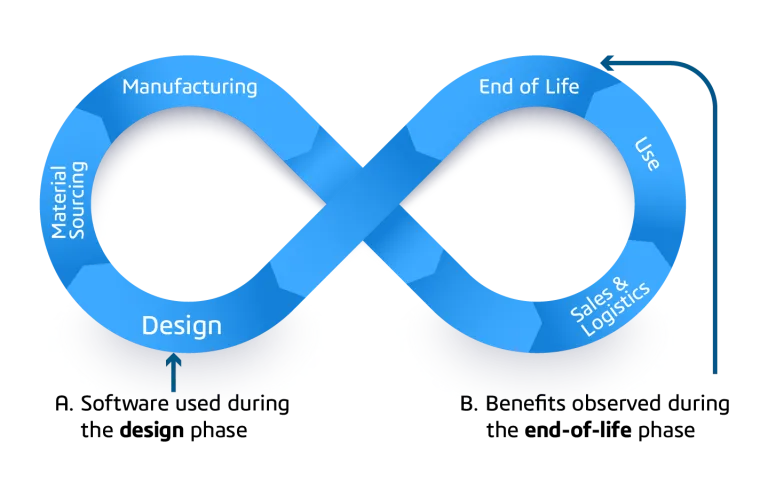
Dassault Systèmes’ approach addressed two crucial parts to achieve this reuse objective:
- Software used during the design phase
- Benefits observed during the end-of-life phase
The Outcome
Through advanced, integrated platform-driven solutions, the complete control of component inventory and reusing or repurposing existing capacitors and printed circuit boards were efficiently established from the start.
This enabled the decarbonization of product development by repurposing materials, components, and products while reducing scraps and waste.
The usage monitoring enabled by NETVIBES on the 3DEXPERIENCE platform uncovered any issues from a designer’s new part introduction and ensured that a single part or component was used in more than one product.
Improved visibility provided real-time insights throughout production to make informed decisions on part or component reuse.
The End Result
One of the most powerful features we adopted was the search module. The immediate impact we had using it, as early as a week after deployment, was that we were able to find and reuse parts that we would have never been able to find previously. We only wished that we had this capability ten years ago
Methods
The avoided emission estimation was estimated following the:
- EU Taxonomy (Regulation Guideline), ISO 14067, 11044, and Guidance of WBCSD Net Zero Initiative Guidelines.
- Methodology based on the comparison of two scenarios for one given functional unit (ISO 14067:2018 and ISO14064-2:2019) 14067:2018, ISO 14064-2:2019).
- Each of these case studies are past or current projects for which emissions avoided or reduced have been estimated following EU Taxonomy (Regulation Guideline), ISO 14067, 11044 and Guidance of WBCSD Net Zero Initiative Guidelines. The 3DS approach and these calculations, along with the allocated contribution of the software, have been certified by an independent third party. External View URD 2023, Chapter 2.
Measuring the Sustainability Benefits of Our Solutions
Discover how we accurately quantify the sustainability benefits of our solutions for customers, using a certified methodology. Through real-world use cases, see how we support organizations in their sustainability transition, delivering tangible, measurable results.
Frequently Asked Questions
Sources
1Scrap reduction achieved were mainly due to solutions fitting the 334418 - Printed Circuit Boards — with mounted semiconductor components North American Industry Classification System (NAICS) description (where proportion components designated as capacitor, resistor, coil, transformer, and other inductor manufacturing).
Related Content
Regulatory Compliance
Drive profitability and meet consumer demands while ensuring regulatory compliance with the 3DEXPERIENCE® platform.
Optimize Sustainable Product Design for Climate Neutrality
Approach product design with sustainability in mind to effectively decarbonize products and value chains for a low-carbon future.
Circular Economy
How circular economy practices can help your business dare to be bold through new business models that preserve the environment for future generations.
Circularity in Action
It’s time for concerted action. Here’s how to make the circular economy achievable, scalable and profitable.