
Publish and review models on the web

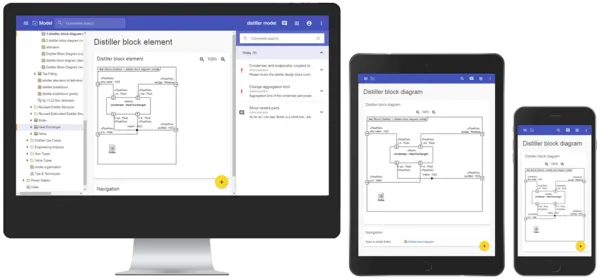
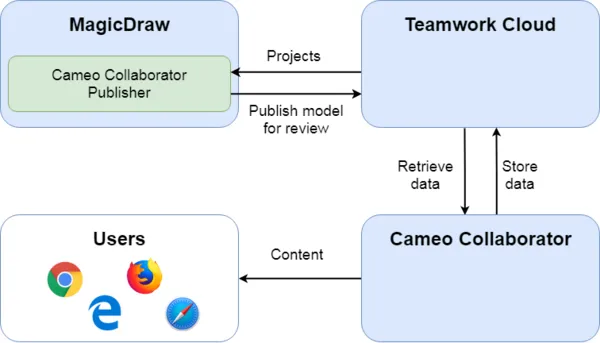
Cameo Collaborator for Teamwork Cloud is a web-based product designed to present models in a simplified form for stakeholders, sponsors, customers, and engineering teams. It allows editing and reviewing models. The product is built with scalability in mind, making it possible to deploy it both in a single node and a cluster setting. It works in all form factors (desktop, tablet, and smartphones), making model sharing and reviewing easy.

Use Cameo Collaborator for Teamwork Cloud to:

  • Present models to stakeholders, sponsors, or customers
  • Present models to engineering teams (modelers and non-modelers) within your organization
  • Keep stakeholders and engineering teams up-to-date with the precise, consistent information from the single source of truth - model repository
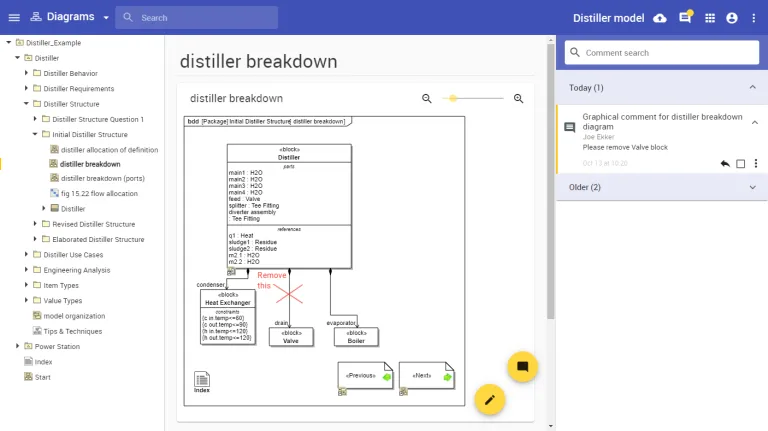
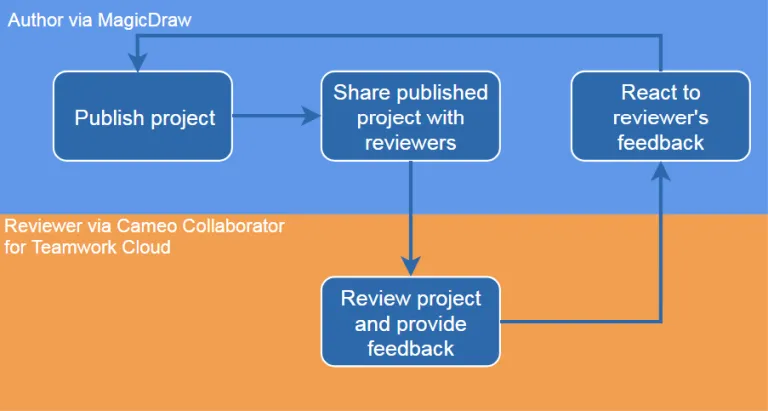
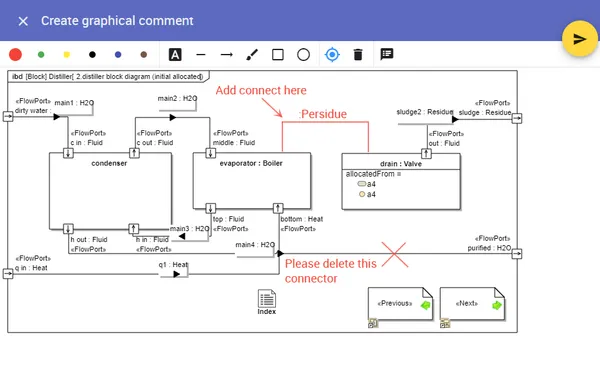
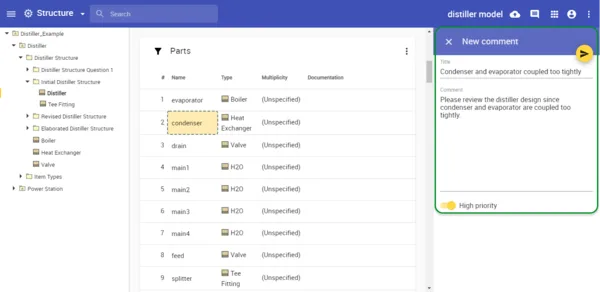
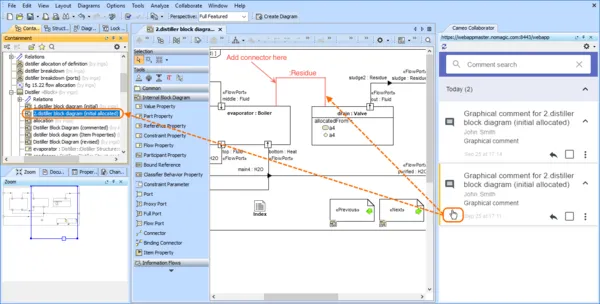
  • Review models and write comments to provide feedback to model authors
  • Address comments by making changes to models without using a modeling tool
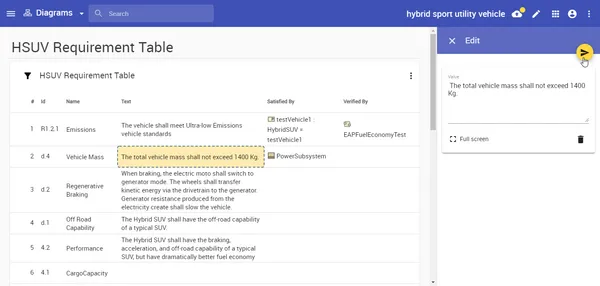
  • Edit models on the web without having to use MagicDraw, e.g. for specification of interface libraries or editing requirements

Collaborator is designed for the following types of users:

  • Non-modelers – users who were not trained in MagicDraw nor are equipped with it nor have good command in modeling languages like UML, SysML, UPDM, UAF, BMPN or others
  • Modelers – typically members of engineering teams working on process engineering, requirements, or system designs

Cameo Collaborator for Teamwork Cloud comes with the following portal types:

  • Model-Based System Engineering (SysML)
  • Defense Enterprise Architecture (UPDM)
  • Business Architecture (BPMN)
  • Software Engineering (UML)
  • Requirements (SysML Requirements)
  • Requirements Document
  • Diagrams
  • Entire model

Track progress of your reviews

The following review processes are supported out of the box:

  • Technical peer reviews – share and review models within the team
  • as a means of getting feedback in the form of comments
  • to address comments by modifying models without having to use MagicDraw
  • Formal reviews – share models for review to other teams
  • Public community interaction, social modeling, crowdsourcing - share models publicly to the entire organization so that users can consume information available in the models as well as to contribute to the models via comments
  • for end users of models to contribute to the model via comments, especially when your users are non-modelers who want to provide feedback on the contents in the model
  • to train users – users can consume information available in the models, ask questions on the content and get answers
  • to share best modeling practices – when separate modeler groups agree on the best practices, they can be shared for the whole organization and input from the community can be provided to the content creators

Features

Presenting Models Like Documents

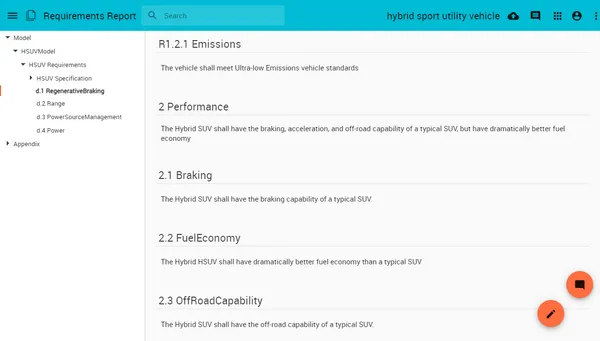
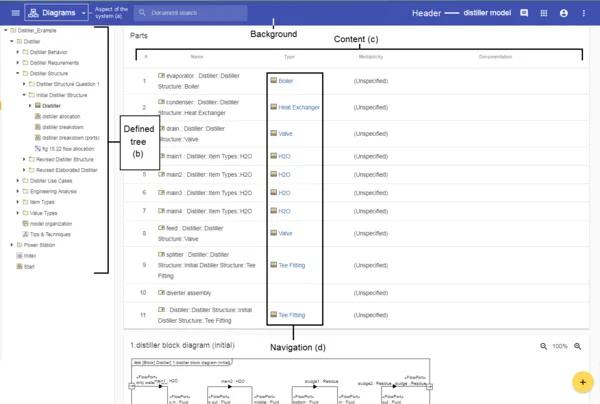
Cameo Collaborator for Teamwork Cloud allows you to present models in a simplified form for sponsors, customers and engineering teams. The product has two viewing modes: Model View and Document View. Model View presents models in a similar way to MagicDraw. Document View provides a Wiki-style view to users who do not have a good knowledge of modeling languages like SysML, UPDM, UAF, BPMN, etc. A Cameo Collaborator for TWC document viewed in a Document view mode.

and other Features

Mobile and Tablet Friendly

Cameo Collaborator for Teamwork Cloud is built considering Google Material Design guidelines. Whether you are using a desktop PC or a mobile device – you can reach and comment models from anywhere.

Join the conversation in the CATIA MBSE Cyber System User Community!

[SAMPLE MODEL] EE&S Artifact Positioning on the Automotive SPICE Grid

What this isA practice model showing where EE&S plugin artifact types naturally land on the ASPICE process grid, using a Collision Avoidance System (ADAS) as the reference system. The point isn't the system — it's demonstrating that the tool's native constructs map directly to ASPICE work products, and that the chain doesn't stop at architecture.ASPICE Process → EE&S Artifact MappingSYS.1 — Requir

CATIA MBSE CYBER SYSTEMS

FlexNet Plugin Licenses in Batch Mode

My team is trying to run Cameo in “batch mode”, and I have a question regarding the FlexNet license server configuration that is not answered in any of the documentation that I was able to find. In the Cameo documentation, I see Java arguments for specifying a FlexNet server and port (FL_SERVER_ADDRESS / FL_SERVER_PORT), and I also see that I can specify a tool edition (FL_EDITION). However, in th

CATIA MBSE CYBER SYSTEMS

Derivation Tables in SysML V2

Requirement derivation tables are easily one of the top requested topics from users across the industry. In my latest video, I walk through how to define a reusable view def and map it directly to your requirement structures.Watch the Video here: [Link to YouTube Video] Download / Copy the Source CodeGrab the SysML v2 code used in the video below to test and adapt for your own models:How are you

CATIA MBSE CYBER SYSTEMS

2026x Server side simulation

Hello,I was able to create a server side simulation using an instance table. There is one part of the simulation that is not working. I have a script that executes as part of a rollup pattern that performs a simple table lookup that fails.The rollup pattern uses a constraint block that has a Groovy script that performs the lookup. The simulation works just fine when executed within Cameo.Here is a

CATIA MBSE CYBER SYSTEMS

NOTE: Existing users of No Magic products can access to the user portal at https://magicdraw.com/main.php, as well as Cameo Collaborator for Teamwork Cloud samples at https://ccexamples.nomagic.com.

Learn What CATIA Can Do for You

Speak with a CATIA expert to learn how our solutions enable seamless collaboration and sustainable innovation at organizations of every size.

Get Started

Courses and classes are available for students, academia, professionals and companies. Find the right CATIA training for you. 

Get Help

Find information on software & hardware certification, software downloads, user documentation, support contact and services offering