What is End-to-End MBSE ?

Classic MBSE often focuses on the use of SysML where requirements are captured as plain text. Therefore they are not part of the verification nor of the simulation. As they are in plain text, nothing can be generated out of them so each and every test case must be created manually from each and every functional requirement. 

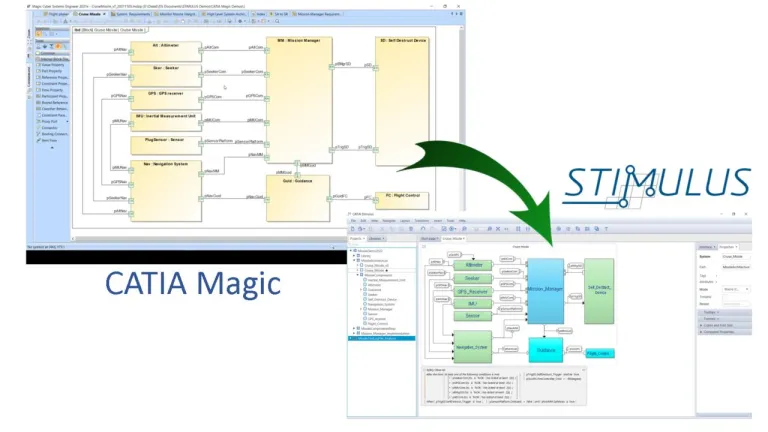
STIMULUS brings a new paradigm as it extends the modeling capabilities to also include the functional requirements. 100% of the system behavior can be captured which also means that new test automation possibilities appear: test scenarios can be captured and the STIMULUS constraints solver will use them to generate as many combinations of input as you like. These test vectors are used to stimulate the specification, but also to stimulate the code later on. STIMULUS will observe the code response and will compare with the behavior defined in the requirements, making the functional test completely automatic. At integration time, Stimulus will analyze the log file generated by the HIL test environment and will compare the integrated system behavior to the requirements enabling tester to detect automatically any violation of any requirement.

Functional Test Automation

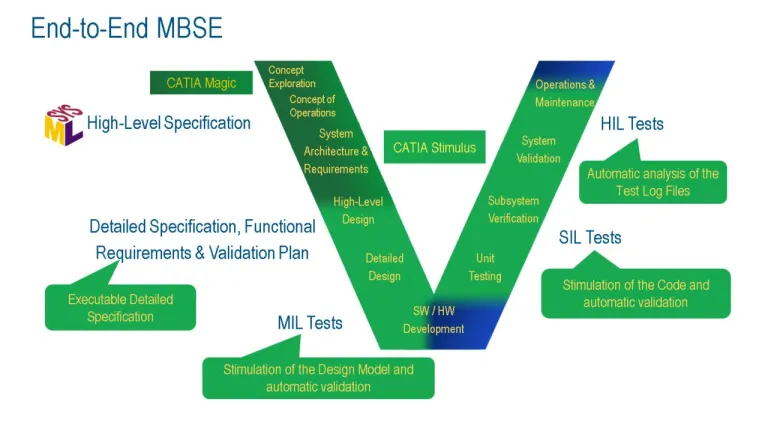
The code is stimulated by test vectors that are automatically generated by STIMULUS, the outputs are observed by Stimulus which compares with the expected relationships between inputs and outputs as per the requirements. A huge number of tests can be generated and executed automatically whilst the requirement coverage is tracked by STIMULUS.

Simulate and Validate your Functional Requirements

STIMULUS enables system architects to extend the use of SysML models to also include the functional requirements that can, for the first time, be simulated and validated. Many errors such as missing, conflicting and erroneous requirements can be detected and corrected early. Development teams work is made much more effective as they receive clear, complete and validated requirements. 

Validation teams do not need to manually derive each functional test case from a functional requirement, With STIMULUS, testing the code or the system against its requirements is 100% automatic, bringing a huge ROI: much more tests are generated and performed with very little efforts. 

.

Hardware-In-the-Loop Tests

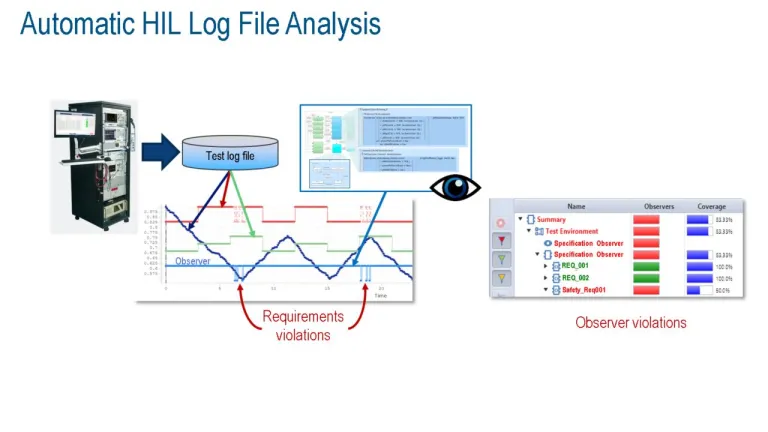
STIMULUS supports the test of the integrated system by analyzing automatically the log file test environments produce. The file contains the I/Os that occurred during the tests, STIMULUS will compare with the requirements and will detect automatically any violation of any requirement.
STIMULUS & CATIA Magic

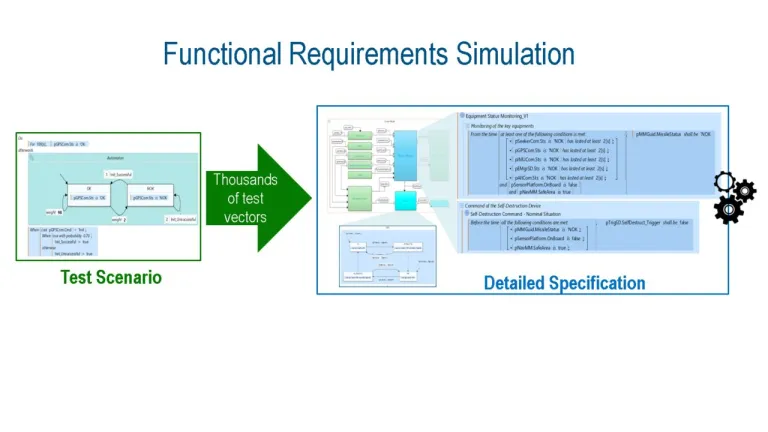
STIMULUS extends the use of models to the detailed behavior which is difficult to capture in SysML. The digital continuity between CATIA Magic and Stimulus is ensured as the SysML architecture (and related signals) can be imported into STIMULUS where the detailed behavior is captured, simulated and validated.

Join the conversation in the CATIA MBSE Cyber System User Community!

How to Customize the Element Creation Dialog in SysML v2 & CATIA Magic

Tired of digging through menus because your most-used SysML v2 elements aren't in the creation dialog? I just dropped a new video showing how to easily patch your CATIA Magic UI to add elements like Views and Viewpoint Definitions right into your palette. We're keeping it strictly focused on native, out-of-the-box configurations rather than writing complex code.Grab the downloadable source file

CATIA MBSE CYBER SYSTEMS

Updating Requirements with excel via reqtify

Hello,I tried to update the requirements on enovia with excel document like verification matrix that has columns ID, Requirement Text and attributes. But the requirements on the enovia is not imported with reqtify so there is not intermediate file. When tried to update requirement set on the enovia with reqtify, it deletes all existed requirements and create new ones. I am using labels as ID (as

CATIA MBSE CYBER SYSTEMS

[Webinar] Digital Engineering Strategy with a Model-Based Approach, September 30

Dear all, we invite you to the upcoming webinar "Digital Engineering Strategy with a Model-Based Approach"Digital Engineering aims to integrate models, simulations, surrogate models, systems and components across engineering disciplines and throughout the full lifecycle.The webinar will explore an integrated digital approach using authoritative system data and models as a connected continuum, supp

CATIA MBSE CYBER SYSTEMS

Importing a spreadsheet and having the fields correspond to block names and value properties.

Hello, I have a basic question.I've been tasked with building out a series of BDDs for a computer network. I have an excel file that specifies the properties of each device on the network, e.g. host name, ip address, operating system, and make/model.For the blocks in the diagram, I would like to create a value property that corresponds to each of the properties specified in the spreadsheet, and po

CATIA MBSE CYBER SYSTEMS

Also Discover

Learn What CATIA Can Do for You

Speak with a CATIA expert to learn how our solutions enable seamless collaboration and sustainable innovation at organizations of every size.

Get Started

Courses and classes are available for students, academia, professionals and companies. Find the right CATIA training for you. 

Get Help

Find information on software & hardware certification, software downloads, user documentation, support contact and services offering