SIMULIA リソース・センター

SIMULIA に関する必要な情報すべてが見つかります 

検索条件に一致する項目が1509件あります
A Study of Durability Improvement of Balance Shaft Module

The balance shaft clamping bolts in the recent engines tend to have the loosening problem by increased engine power. In this paper, a CAE procedure is introduced to predict loosening angle of bolts, wear, durability of the drive shaft. The procedure is performed through two analysis steps. In the first step, the multi-body dynamic simulation is used to obtain more accurate loading boundary conditions applied to the finite element model for the following step. Next, the finite element analysis is performed to predict the durability of the drive shaft through the calculation of the safety factor. Through this CAE procedure, design guidelines leading up to good BSM reliability has been obtained as a result of this activity.

Customer Papers
A Study of Durability Improvement of Balance Shaft Module
Influence of Surrounding Powder Bed and Build Platform on Thermal Cooling Characteristics in 3D Printed Parts via Selective Laser Melting

Selective laser melting (SLM) leads to high cooling rates and correspondingly high residual stresses, which can distort the printed part on the printing platform and even lead to part cracking and consequent print failure. The temperature profile and cooling rates during the SLM process are influenced by the surrounding powder bed and building platform, which can act as a significant heat sink depending on part design and platform arrangement. The new functionality of the Abaqus additive manufacturing simulation framework allows for separate modelling of solid (laser exposed) material, powder bed (not exposed) and platform (not exposed), as well as evolving heat transfer surfaces for the AM part. In this paper we highlight the influence of the surrounding powder bed and platform on the thermal characteristics of the printed part.

Customer Papers

Influence of Surrounding Powder Bed and Build Platform on Thermal Cooling Characteristics in 3D Printed Parts via Selective Laser Melting
BIOMECHANICS OF CRANIOFACIAL FRACTURES: A SIMULATION STUDY

In this study a 3D finite element model of the skull is created using CT scan data. All complexities of the skull geometry are simulated using ABAQUS. This numerical model is then subjected to frontal, lateral. vertical, occlusal and angulated impact conditions. Impact analysis is done and weak areas susceptible to fracture and hence failure are identified. Further fracture fixations of various designs and materials used in craniofacial fracture fixations are placed in different fracture situations in the virtual model and subjected to different impact conditions. This will enable the study of fracture and stability of the fracture of the skull under cranio facial fracture conditions.

Customer Papers

BIOMECHANICS OF CRANIOFACIAL FRACTURES: A SIMULATION STUDY
Development of the Subroutine Library 'UMMDp' for Anisotropic Yield Functions

The working group of JANCAE was launched from the idea of providing a multidisciplinary forum for steel researchers, design engineers, and software engineers through the medium of advanced finite element codes. The subroutine library is called the Unified Material Model Driver for Plasticity (UMMDp). This paper introduces the development of UMMDp and discusses a simulation of a drawing and redrawing process using some yield functions for its applications with Abaqus.

Customer Papers

Development of the Subroutine Library 'UMMDp' for Anisotropic Yield Functions
Stress Analysis Under Random Loading

To assess the durability of a structure under random loading, the frequency based random response analysis is performed to obtain the stresses. Since random response analysis ignore the element damping, the results of the random response analysis can be unrealistically twisted if significant local element damping exists. This paper present an Abaqus FEA procedure to more realistically calculate the stress of the structure subject to random loading by submodeling and including element damping, which is a complementary method to Abaqus random response analysis procedure.

Customer Papers

Stress Analysis Under Random Loading
Predicting the Properties of Additively Manufactured Parts

In this paper, thermo-mechanical-metallurgical simulations of Ti-6Al-4V parts produced by SLM are validated against experimental measurements. The work involves the simulation of the SLM process and the prediction of location-specific microstructural features (such as grain size, morphology characteristics and phase fractions). A framework for more generally predicting the mechanical properties of printed parts is then presented. This involves the implementation of a novel mapping between microstructural quantities and tensile properties at each material point. The results demonstrate the potential that the powerful new features of Abaqus2017 have for simulating AM processes.

Customer Papers

Predicting the Properties of Additively Manufactured Parts
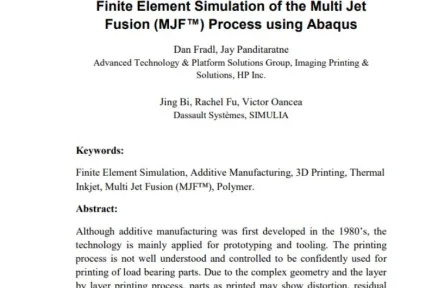
Finite Element Simulation of the Multi Jet Fusion Process using Abaqus

Although additive manufacturing was first developed in the 1980’s, the technology is mainly applied for prototyping and tooling. The printing process is not well understood and controlled to be confidently used for printing of load bearing parts. Due to the complex geometry and the layer by layer printing process, parts as printed may show distortion, residual stress, delamination and failure that render the part unusable at the moment that it comes out of the machine. Finite element simulations of additive manufacturing can be very effective in understanding the cause of these defects and predicting the in-service performance of the printed parts. However, most finite element codes are not designed for simulating additive manufacturing processes.

Customer Papers

Finite Element Simulation of the Multi Jet Fusion Process using Abaqus
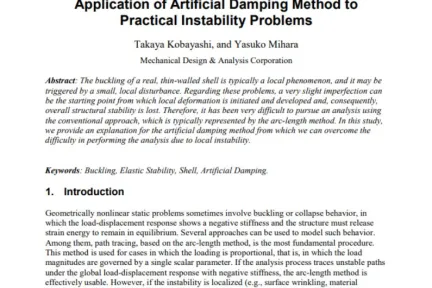
Application of Artificial Damping Method to Practical Instability Problems

The buckling of a real, thin-walled shell is typically a local phenomenon, and it may be triggered by a small, local disturbance. Regarding these problems, a very slight imperfection can be the starting point from which local deformation is initiated and developed and, consequently, overall structural stability is lost. Therefore, it has been very difficult to pursue an analysis using the conventional approach, which is typically represented by the arc-length method. In this study, we provide an explanation for the artificial damping method from which we can overcome the difficulty in performing the analysis due to local instability.

Customer Papers
Application of Artificial Damping Method to Practical Instability Problems
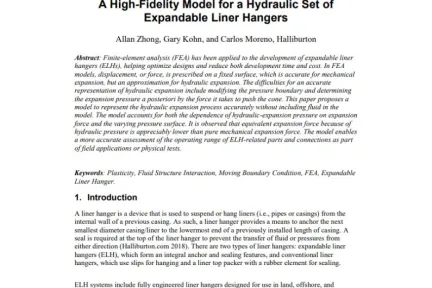
A High-Fidelity Model for a Hydraulic Set of Expandable Liner Hangers

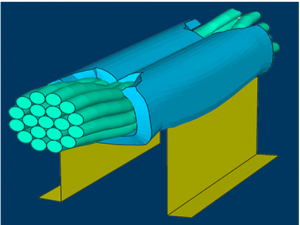
Finite-element analysis (FEA) has been applied to the development of expandable liner hangers (ELHs), helping optimize designs and reduce both development time and cost. In FEA models, displacement, or force, is prescribed on a fixed surface, which is accurate for mechanical expansion, but an approximation for hydraulic expansion. The difficulties for an accurate representation of hydraulic expansion include modifying the pressure boundary and determining the expansion pressure a posteriori by the force it takes to push the cone. This paper proposes a model to represent the hydraulic expansion process accurately without including fluid in the model. The model accounts for both the dependence of hydraulic-expansion pressure on expansion force and the varying pressure surface.

Customer Papers

A High-Fidelity Model for a Hydraulic Set of Expandable Liner Hangers
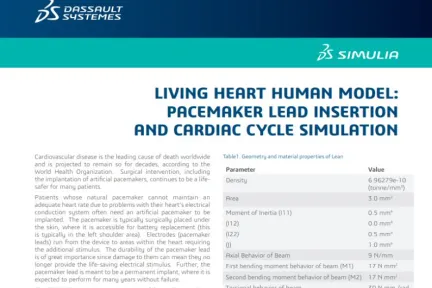
LIVING HEART HUMAN MODEL: PACEMAKER LEAD INSERTION AND CARDIAC CYCLE SIMULATION

The SIMULIA Living Heart Human Model provides a unique testing environment where a pacemaker lead can be virtually inserted and mechanically deformed during the cardiac cycle. Once the mechanical deformation results are obtained, the long-term durability of the implant can be assessed. The virtual nature of the test provides a physiologically accurate methodology to test new and existing devices without exposing patients to un-necessary risk.

Solution Briefs

LIVING HEART HUMAN MODEL: PACEMAKER LEAD INSERTION AND CARDIAC CYCLE SIMULATION
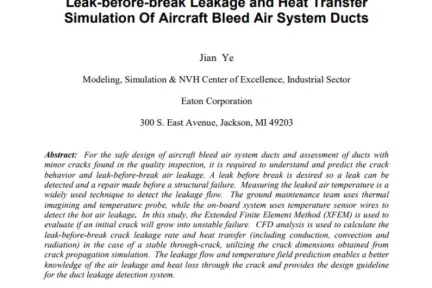
Leak-before-break Leakage and Heat Transfer Simulation Of Aircraft Bleed Air System Ducts

For the safe design of aircraft bleed air system ducts and assessment of ducts with minor cracks found in the quality inspection, it is required to understand and predict the crack behavior and leak-before-break air leakage. A leak before break is desired so a leak can be detected and a repair made before a structural failure. Measuring the leaked air temperature is a widely used technique to detect the leakage flow. The ground maintenance team uses thermal imagining and temperature probe, while the on-board system uses temperature sensor wires to detect the hot air leakage. In this study, the Extended Finite Element Method (XFEM) is used to evaluate if an initial crack will grow into unstable failure.

Customer Papers
Leak-before-break Leakage and Heat Transfer Simulation Of Aircraft Bleed Air System Ducts
検索条件に一致する項目が278件あります

お客様活用事例

検索条件に一致する項目が153件あります
検索条件に一致する項目が3件あります

SIMULIA 自己学習

ダッソー・システムズでは、それぞれのご都合に合わせて継続的に学習できるよう、さまざまな自己学習モジュールをご用意しています

ブログ

ダッソー・システムズの技術者が最新ニュースやイノベーションについて書いている SIMULIA ブログをご覧ください。

検索条件に一致する項目が764件あります

SIMULIA のソリューションの詳細

組織の規模の大小を問わず、シームレスなコラボレーションと持続可能なイノベーションに、当社のソリューションがどう役立つかについて、SIMULIA のエンジニアがご説明します。

始める

学生、教育機関、専門家、企業向けに、さまざまなトレーニング・コースをご提供しています。お客様に最適な SIMULIA トレーニングを受講してください。 

サポートを利用する

ソフトウェアおよびハードウェアの認証情報、ソフトウェアのダウンロード、ユーザー・ドキュメント、サポート窓口、ならびに提供サービスに関する情報はこちらから。