1503 résultats
Subsea Flowline-PLET-Jumper Integrated Abaqus Model

Oil and gas field development is moving into ever deeper waters to meet the world’s growing demand for energy. Subsea flowlines, jumpers and pipeline end terminals (PLETs) are the key components for a reliable and cost-effective subsea field development. Usually, the subsea flowline, jumper and PLET are designed and analyzed separately by different engineering groups using simplified end boundary conditions, and the interface loads from the flowline / jumper to PLET are obtained from de-coupled finite element (FE) models.This paper presents a comprehensive Abaqus model to more accurately analyze the subsea system collectively.

Customer Papers
Subsea Flowline-PLET-Jumper Integrated Abaqus Model
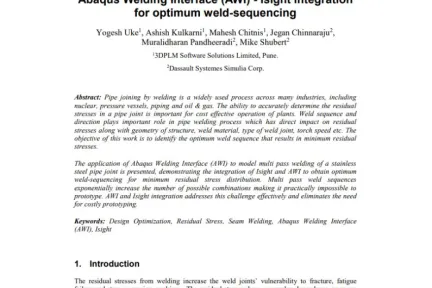
Abaqus Welding Interface - Isight integration for optimum weld-sequencing

Pipe joining by welding is a widely used process across many industries, including nuclear, pressure vessels, piping and oil & gas. The ability to accurately determine the residual stresses in a pipe joint is important for cost effective operation of plants. Weld sequence and direction plays important role in pipe welding process which has direct impact on residual stresses along with geometry of structure, weld material, type of weld joint, torch speed etc. The objective of this work is to identify the optimum weld sequence that results in minimum residual stresses. The application of Abaqus Welding Interface (AWI) to model multi pass welding of a stainless steel pipe joint is presented, demonstrating the integration of Isight and AWI to obtain optimum weld-sequencing for minimum residual stress distribution.

Customer Papers

Abaqus Welding Interface - Isight integration for optimum weld-sequencing
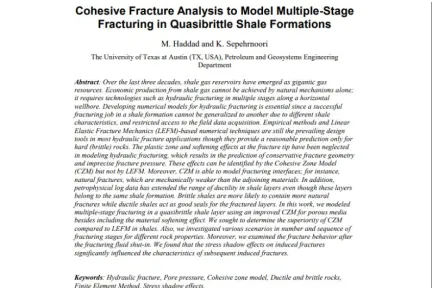
Cohesive Fracture Analysis to Model Multiple-Stage Fracturing in Quasibrittle Shale Formations

Over the last three decades, shale gas reservoirs have emerged as gigantic gas resources. Economic production from shale gas cannot be achieved by natural mechanisms alone; it requires technologies such as hydraulic fracturing in multiple stages along a horizontal wellbore. Developing numerical models for hydraulic fracturing is essential since a successful fracturing job in a shale formation cannot be generalized to another due to different shale characteristics, and restricted access to the field data acquisition. Empirical methods and Linear Elastic Fracture Mechanics (LEFM)-based numerical techniques are still the prevailing design tools in most hydraulic fracture applications though they provide a reasonable prediction only for hard (brittle) rocks.

Customer Papers

Cohesive Fracture Analysis to Model Multiple-Stage Fracturing in Quasibrittle Shale Formations
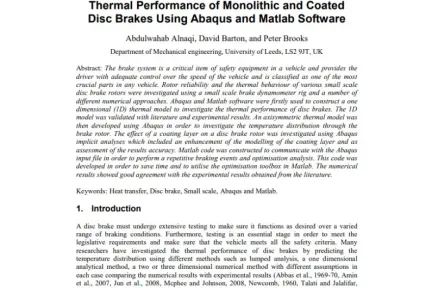
Thermal Performance of Monolithic and Coated Disc Brakes Using Abaqus and Matlab Software

The brake system is a critical item of safety equipment in a vehicle and provides the driver with adequate control over the speed of the vehicle and is classified as one of the most crucial parts in any vehicle. Rotor reliability and the thermal behaviour of various small scale disc brake rotors were investigated using a small scale brake dynamometer rig and a number of different numerical approaches. Abaqus and Matlab software were firstly used to construct a one dimensional (1D) thermal model to investigate the thermal performance of disc brakes. The 1D model was validated with literature and experimental results.

Customer Papers

Thermal Performance of Monolithic and Coated Disc Brakes Using Abaqus and Matlab Software
Analysis of Pressure Transients and Cavitation in a Distributor

During pressure testing of a large distributor the weld securing the bulkhead failed, which triggered large pressure transients and cavitation phenomena. The problem has been studied by explicit integration, using shell elements for the structural parts and acoustic elements for the water. Although the calculations had to be carried out in the absence of any information about the outcome of the accident, very good consistency was achieved between the predictions and the actual observations.

Customer Papers

Analysis of Pressure Transients and Cavitation in a Distributor
Cogging Torque Analysis of Permanent Magnet Machines using Abaqus/Standard

Reduction of cogging torque is one of the fundamental goals in designing permanent magnet machines. Finite element analyses are indispensible in analyzing the various design choices for reducing cogging torque and for faster prototyping of the final product. In this Technology Brief, we show how Abaqus/Standard can be used to compute cogging torque in a permanent magnet generator. To reduce numerical noise, meshing techniques involving a sliding mesh and repeated meshes are realized using the advanced meshing functionality available in Abaqus/CAE.

Tech Notes

Cogging Torque Analysis of Permanent Magnet Machines using Abaqus/Standard
3D Thermal Analysis of Li-ion Battery Cells with Various Geometries and Cooling Conditions Using Abaqus

Modeling thermal behavior of Li-ion cells for vehicle electrification applications is a challenging task. AVL has developed 3D-FEA models to simulate the electro-thermal behavior of Li-ion battery cells with various geometries using Abaqus. In these models, the Li-ion battery system is simplified and modeled as heterogeneous solid medium consisting of a single or multiple equivalent battery layers with composite electrical and thermal conductivities for the equivalent anode, cathode and separator. Thermal behaviors of cylindrical, prismatic and pouch Li-ion battery cells and modules were analyzed under different electrical loads and cooling conditions.

Customer Papers

3D Thermal Analysis of Li-ion Battery Cells with Various Geometries and Cooling Conditions Using Abaqus
257 résultats

Témoignages clients

150 résultats
4 résultats

Auto-apprentissage SIMULIA

Nous proposons plusieurs centaines de modules d'auto-apprentissage pour que vous puissiez continuer à apprendre à votre rythme.

Blogs

Lisez le blog SIMULIA pour connaître les dernières actualités et innovations de nos experts.

703 résultats

Découvrir comment SIMULIA peut vous aider

Contactez un expert SIMULIA pour découvrir comment nos solutions permettent une collaboration transparente et une innovation durable dans des entreprises de toutes tailles.

Commencer

Des formations et des cours sont disponibles pour les étudiants, le monde académique, les professionnels et les sociétés. Trouvez la formation SIMULIA qui vous convient. 

Obtenir de l'aide

Obtenez des informations sur la certification des logiciels et du matériel, les téléchargements de logiciels, la documentation utilisateur, les coordonnées du support et l'offre de services.