CATIA SysML v2
The most powerful, standard-compliant solution for systems modeling with real-time text–diagram synchronization and a FREE Community Edition.
The Most Powerful SysML v2 Solution
With the Object Management Group (OMG) officially releasing SysML v2, systems modeling is entering a new era. SysML v2 delivers a modern, precise, and semantically rich language built for today's complex, multidisciplinary systems.
Meeting this pivotal moment, Dassault Systèmes offers with CATIA SysML v2 the most comprehensive, interoperable, and future-proof implementation on the market. Fully conformant with the OMG standard, it is currently the only solution supporting 100% of the SysML v2 standard with true two-way synchronization between textual and graphical representations ensuring consistency and fluidity throughout the entire modeling lifecycle.
Enhanced with generative AI, native requirements management, open APIs, and seamless integration with the 3DEXPERIENCE ecosystem, CATIA SysML v2 provides your teams with a unified environment to design, analyze, and validate the systems of tomorrow.
100% OMG Standard Conformance

Built on Principle
Standard compliance is a core value, not a checkbox. Every member of our development team is committed to it, from architecture decisions to the finest implementation details.
Interoperability by Design
Models exchange seamlessly with any other tool adhering to the standard, breaking down silos and enabling true cross-tool

Ecosystem-Ready
Full conformance simplifies integration across the partner and supplier ecosystem, reducing friction at every boundary of your engineering environment.

Future-Proof
As the SysML v2 standard continues to evolve, customers face no risk of vendor lock-in or compatibility gaps. Your models remain yours, portable, open, and standard.

Trust and Transparency
Engineers can rely on the fact that their models are pure SysML v2, not tool-specific variants or proprietary extensions in disguise.
What Makes CATIA SysML v2 Unique
Most Cameo/SysML v2 tools force a choice: textual syntax or graphical diagrams, manual views or automated analysis. CATIA SysML v2 removes that trade-off. Text, diagrams, views and evaluation all operate on the same underlying model.
- Text and Diagrams in Perfect Sync
- Dynamic Views
- Model Evaluation
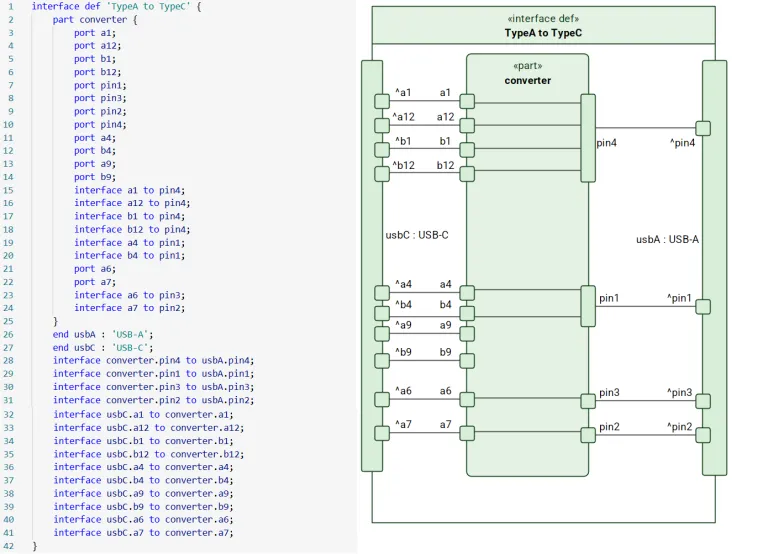
CATIA SysML v2 delivers seamless two-way synchronization between textual and graphical SysML v2 model representations, a capability unique to our solution.
- Instant consistency - Changes in text or diagrams are immediately reflected in both views.
- Dual approach - Textual syntax appeals to software developers, while diagrams provide clarity for complex system architectures.
- Unique capability - Currently the only solution supporting 100% of the SysML v2 standard with true two-way synchronization.
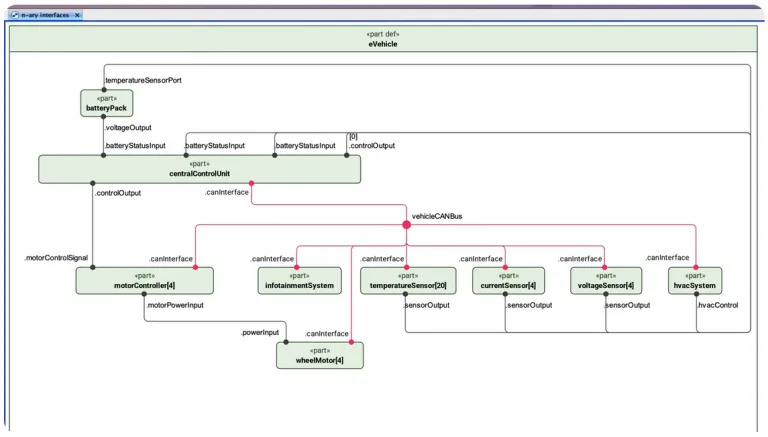
SysML v2 supports three model visualization options: Graphical, Tabular, and Textual. In CATIA Magic/Cameo, users can dynamically generate graphical and tabular views by specifying model queries. Dynamic views are one of the most powerful capabilities in CATIA Magic/Cameo.
- Automatic updates - Views can be rebuilt automatically when the model changes, saving systems engineers significant time and effort.
- Reusable definitions - View definitions can be stored in libraries and reused across projects and teams.
- Efficient modeling - Eliminates manual diagram layout maintenance entirely.
SysML v2 introduces a powerful expression language for model querying, navigation and analysis. CATIA Magic/Cameo enhances this with features that make analysis seamless:
- Requirements verification - Requirement violations are immediately flagged with full traceability to violated constraints.
- Roll-ups & trade studies - Apply roll-up patterns, perform "what-if" analyses, and conduct trade-off studies directly on the model.
- Evaluation in Model or Console – Run expressions directly within the model or use the Evaluation Console to execute custom expressions without modifying the model.
- Advanced evaluation - Supports analysis at both model and meta-model levels.
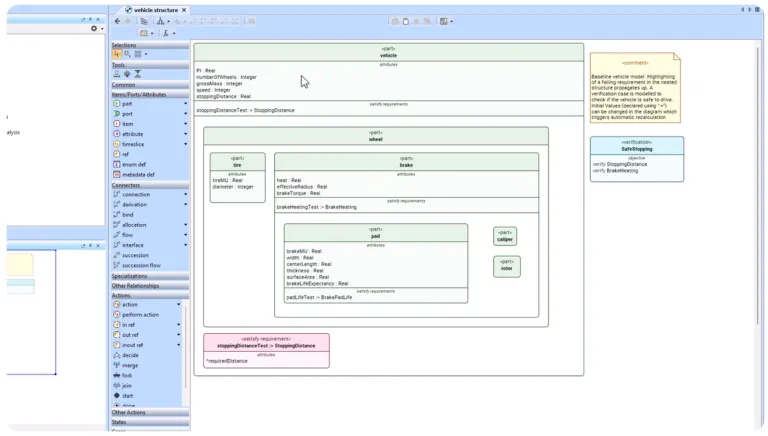
- Interactive diagrams - Adjust initial values to test system behavior without modifying the model.
Adopt CATIA SysML v2 at Your Own Pace
CATIA SysML v2 provides the full infrastructure stack to deploy SysML v2 at scale: a standards-compliant REST API open to any backend, lock-free collaborative modeling for distributed teams, and a browser-based viewer that requires no local installation.
- Standard SysML v2 REST API
- Collaborative Modeling via Teamwork Cloud
- MagicLab – Web-Based SysML v2 Model Reader
Teamwork Cloud fully conforms to the SysML v2 API and Services specification, enabling interoperability with external tools and automated MBSE workflows.
- Programmatic access - Create, edit, query, retrieve, and evaluate models directly from scripts or applications.
- Seamless integration - Connect with data analytics platforms, DevOps CI/CD pipelines, and custom engineering workflows.
- Custom API extensions - Query SysML v2 model efficiently with CATIA Magic's home-grown Model Evaluation services. Export diagrams and textual representations via REST APIs for any 3rd party integrations.
Teamwork Cloud (TWC) enables secure, lock-free collaborative modeling for SysML v2, which brings the following benefits:
- Simultaneous collaboration - Multiple users work on the same model concurrently.
- Automatic merging - Non-conflicting changes merge automatically; intuitive resolution for overlaps.
- Versioned & modular models - Decomposition into manageable units, supporting efficient collaboration across teams, organizations, and geographies. Supports collaborative development in branches for experimentation, with reintegration through a model patch mechanism.
- Role-Based Access Control - Fine-grained permissions at project or branch level.
- Standards-based SAML authentication integrations – supports single sign-on including built-in, LDAP, PKI/CAC, and SAML-based authentication
- Auditing - Provides access to audit reports to track user access and permissions granted for server projects, ensuring compliance and traceability
- Cross-cluster synchronization - Share model updates securely across server clusters, facilitating distributed collaboration.
Teamwork Cloud support for U.S. Department of Defense (DoD) requirements includes:
- DoD Data Markings/Classification - Provides support for Data Markings/Classification based on the DoD Manual 5200.01 Volume 2 specification, allowing to mark security-sensitive data such as users and projects with custom-defined data markings
- Data spillage handling - Dedicated tools for physical removal of model data affected by data spillage incidents
- On-premise deployment for isolated classified programs
Teamwork Cloud integration with the 3DEXPERIENCE platform enables large-scale projects. It also supports multi-discipline integration (electrical, fluidics, thermal, etc.).
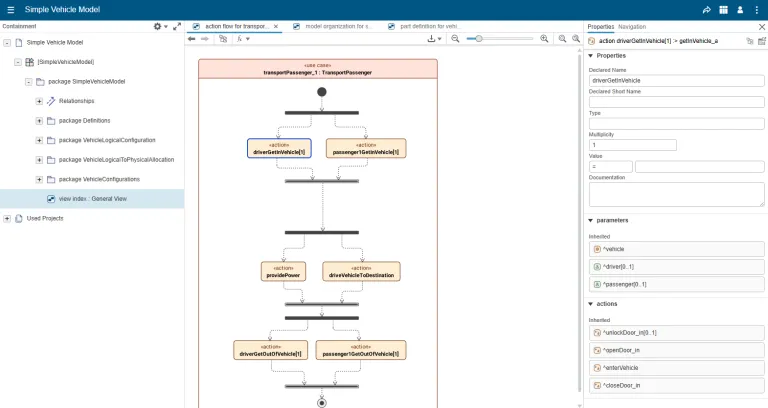
A browser-based, environment for viewing SysML v2 models stored in Teamwork Cloud.
- Instant browser access - Open diagrams, tables, and model elements directly without publishing or exporting models or diagrams.
- Live updates - Changes appear instantly when the model is updated in CATIA Magic/Cameo or via the REST API.
- SysML v2 textual syntax - Includes a read-only textual representation of the SysML v2 model.
- Lightweight sharing - Share model views across teams without requiring local tooling installation.
CATIA Magic/Cameo SysML v2 Community Edition
Designed for educators, students, and engineers discovering SysML v2, the Community Edition provides a fully standard-compliant modeling environment at no cost.
Go Further with CATIA SysML v2
CATIA SysML v2 FAQs
Also Discover
Global Model-Based Systems Engineering Solutions

Provides Standard-based Modeling Solutions for Analyzing, Designing, Simulating Systems of Systems.

End-to-End Model-Based Solutions for Mechatronics & Software-Driven Experiences
Learn What CATIA Can Do for You
Speak with a CATIA expert to learn how our solutions enable seamless collaboration and sustainable innovation at organizations of every size.
Get Started
Courses and classes are available for students, academia, professionals and companies. Find the right CATIA training for you.
Get Help
Find information on software & hardware certification, software downloads, user documentation, support contact and services offering