1495개의 결과가 있습니다.
Using Co-Simulation to Extend the Usage of XFEM

XFEM, Extended Finite Element Method, can accurately predict fracture failure. The Army would like to use XFEM in many areas to prevent fracture failures as part of the design process. Problems of interest include drop tests, concrete penetration, gun launch, recoil, and interaction of gun supports with ground. These problems have loads that are dynamic and multi-directional. The geometry often requires millions of degrees of freedom for accuracy. Explicit codes are generally used to capture the complicated system response as a function of time.

Customer Papers
Using Co-Simulation to Extend the Usage of XFEM
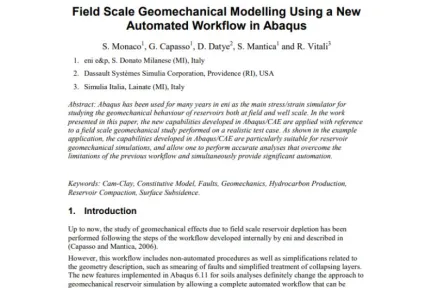
Field Scale Geomechanical Modelling Using a New Automated Workflow in Abaqus

Abaqus has been used for many years in eni as the main stress/strain simulator for studying the geomechanical behaviour of reservoirs both at field and well scale. In the work presented in this paper, the new capabilities developed in Abaqus/CAE are applied with reference to a field scale geomechanical study performed on a realistic test case. As shown in the example application, the capabilities developed in Abaqus/CAE are particularly suitable for reservoir geomechanical simulations, and allow one to perform accurate analyses that overcome the limitations of the previous workflow and simultaneously provide significant automation.

Customer Papers

Field Scale Geomechanical Modelling Using a New Automated Workflow in Abaqus
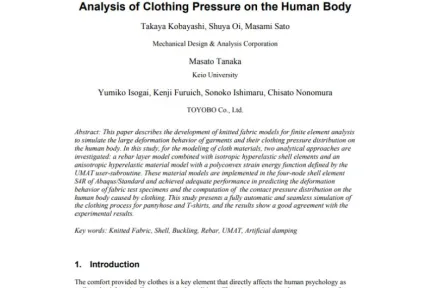
Analysis of Clothing Pressure on the Human Body

This paper describes the development of knitted fabric models for finite element analysis to simulate the large deformation behavior of garments and their clothing pressure distribution on the human body. In this study, for the modeling of cloth materials, two analytical approaches are investigated: a rebar layer model combined with isotropic hyperelastic shell elements and an anisotropic hyperelastic material model with a polyconvex strain energy function defined by the UMAT user-subroutine.

Customer Papers

Analysis of Clothing Pressure on the Human Body
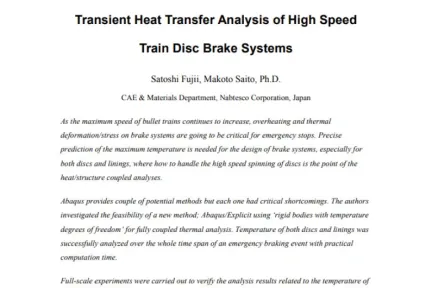
Transient Heat Transfer Analysis of High Speed Train Disc Brake Systems

As the maximum speed of bullet trains continues to increase, overheating and thermal deformation/stress on brake systems are going to be critical for emergency stops. Precise prediction of the maximum temperature is needed for the design of brake systems, especially for both discs and linings, where how to handle the high speed spinning of discs is the point of the heat/structure coupled analyses. Abaqus provides couple of potential methods but each one had critical shortcomings. The authors investigated the feasibility of a new method; Abaqus/Explicit using ‘rigid bodies with temperature degrees of freedom’ for fully coupled thermal analysis. Temperature of both discs and linings was successfully analyzed over the whole time span of an emergency braking event with practical computation time.

Customer Papers

Transient Heat Transfer Analysis of High Speed Train Disc Brake Systems
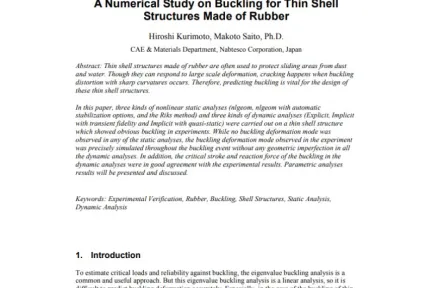
A Numerical Study on Buckling for Thin Shell Structures Made of Rubber

In this paper, three kinds of nonlinear static analyses and three kinds of dynamic analyses were carried out on a thin shell structure which showed obvious buckling in experiments. While no buckling deformation mode was observed in any of the static analyses, the buckling deformation mode observed in the experiment was precisely simulated throughout the buckling event without any geometric imperfection in all the dynamic analyses. In addition, the critical stroke and reaction force of the buckling in the dynamic analyses were in good agreement with the experimental results. Parametric analyses results will be presented and discussed.

Customer Papers

A Numerical Study on Buckling for Thin Shell Structures Made of Rubber
The use of FEA in sand screen design cuts costs and accelerates development

Expandable sand screens are a sand control system which is used to control the ingress of solids, in oil and gas reservoirs in weak and unconsolidated formations. The filtration media is typically sized to the largest 10% of the formation grain size distribution. As a consequence of this some fine solids are often produced. This has a beneficial effect in that it cleans the near wellbore of fine solids which have a tendency to plug the formations. However, in high rate gas wells there may be the possibility of erosion on the inside of the filter media part of the ESS in the transition area between expanded and non-expanded sections of the screen. To reduce the chances of this happening, the addition of thin sacrificial plates were installed over the critical area.

Customer Papers

The use of FEA in sand screen design cuts costs and accelerates development
Abaqus & OpenFOAM Interface for Thermal-Stress Analysis

In this paper the interface between Abaqus and OpenFOAM is described in the context of a case study of a thermal stress analysis of a coolant tank. The generated interface extracts the pressure, wall temperature and convection coefficient distribution from the OpenFOAM analysis and maps the mechanical and thermal loads over the structural ABAQUS FE-model. This interface allows the engineering team to carry out the thermal stress structural development with an accurate thermal and mechanical load prediction based on CFD analysis without compromising the development cost.

Customer Papers

Abaqus & OpenFOAM Interface for Thermal-Stress Analysis
Closed-Loop Geometry Optimization of a Coronary Stent Using Three-Dimensional Structural Analysis

A numerical procedure for optimization of a coronary stent geometry using three dimensional analysis techniques is presented. The objective of the optimization analyses is to maximize the long term durability (fatigue-safety), while keeping acute structural safety (plastic strains) below a given threshold. The expanded and crimped radial stiffness, as well as diametrical expansion recoil output quantities of each optimization simulation are also monitored. The software used during the optimization process consists of HEEDS, an optimization software package developed by Red Cedar Technology, coupled to Abaqus/Explicit.

Customer Papers

Closed-Loop Geometry Optimization of a Coronary Stent Using Three-Dimensional Structural Analysis
Achieving a more Accurate Prediction of a Polymer Snap Deformation Pattern

From simple geometry loading to virtual prototyping, this paper exemplifies the stepwise progress towards a successful match between load case, measurement setup and numerical model validation. It also deals with the gaps at the current numerical model availability and proposes optional enhancements.

Customer Papers

Achieving a more Accurate Prediction of a Polymer Snap Deformation Pattern
Abaqus Thermal Analysis of the Fusion Welding of a P92 Steel Pipe

In this paper, the FE thermal analysis of the arc welding of a typical P92 pipe is presented. The two parts of the P92 steel pipe are joined together using a dissimilar material, made of Inconel weld consumables, producing a multi-pass butt weld from 36 circumferential weld beads. Following the generation of the FE model, the FE mesh is controlled using Model Change in Abaqus to activate the weld elements for each bead at a time corresponding to weld deposition. The thermal analysis is simulated by applying a distributed heat flux to the model, the accuracy of which is judged by considering the fusion zones in both the parent pipe as well as the deposited weld metal. For realistic fusion zones, the heat flux must be prescribed in the deposited weld pass and also the adjacent pipe elements. The FE thermal results are validated by comparing experimental temperatures measured by five thermocouples on the pipe outside surface with the FE temperature history at corresponding nodal points.

Customer Papers

Abaqus Thermal Analysis of the Fusion Welding of a P92 Steel Pipe
Simulation of Multi-Pass Welds Using ABAQUS 2D Weld GUI and Comparison with Experimental Results

This paper describes the application of the newly developed Abaqus 2D Weld Modeller to simulate the residual stress field in ferritic weld test specimens. The specimens were manufactured for an ongoing research programme in conjunction with The University of Manchester and Serco Assurance. The specimens modelled were autogenously welded plates, an eight-pass groove welded plate and a seven-pass ring weld disk.

Customer Papers

Simulation of Multi-Pass Welds Using ABAQUS 2D Weld GUI and Comparison with Experimental Results
Concrete Swelling in Existing Dams

Several chemical reactions are able to produce swelling of concrete for decades after its initial curing, a problem that affects a considerable number of concrete dams around the world. Principia has had several contracts to study this problem in recent years, which have required reviewing the state-of-the-art, adopting appropriate mathematical descriptions, programming them into user routines in Abaqus, determining model parameters on the basis of some parts of the dams’ monitored histories, ensuring reliability using some other parts, and finally predicting the future evolution of the dams and their safety margins.

Customer Papers

Concrete Swelling in Existing Dams
260개의 결과가 있습니다.

고객 사례

150개의 결과가 있습니다.
3개의 결과가 있습니다.

SIMULIA 자기 주도 학습

학습자가 편리하게 학습을 꾸준히 이어갈 수 있도록 수백 개의 자기 주도 학습 모듈을 제공합니다.

블로그

SIMULIA 블로그에서 당사 전문가들이 전하는 최신 뉴스와 혁신에 대해 알아보세요.

775개의 결과가 있습니다.

SIMULIA의 지원 서비스 알아보기

SIMULIA 전문가와 상담하여 당사의 솔루션이 모든 규모의 조직에서 원활한 협업과 지속 가능한 혁신을 실현하는 방법에 대해 알아보세요.

시작하기

학생, 교육, 전문가 및 회사를 위한 교육 과정과 강의가 제공됩니다. 당신에게 맞는 SIMULIA 교육을 찾아보세요. 

도움받기

소프트웨어 및 하드웨어 인증, 소프트웨어 다운로드, 사용자 설명서, 지원 연락처 및 서비스 제공에 대한 정보를 확인하세요.