Silesian Phoenix
Silesian Phoenix streamlines Mars rover development using the 3DEXPERIENCE platform on the cloud, integrating design, simulation and project management to improve collaboration and accelerate development.
A Student Engineering Project That Built a Competition-Level Mars Rover
Few engineering challenges are as demanding as Mars rover design. Operating without direct human control, these systems must navigate unpredictable terrain, complete complex manipulation tasks and integrate mechanical, electrical and software systems into a single platform – all under strict weight and power constraints.
This combination of complexity and extreme operating conditions makes rover development a uniquely powerful training ground for the next generation of engineers. That’s why, in 2018, a team of students at the Silesian University of Technology – one of Poland’s largest and most highly regarded research universities – came together to establish Silesian Phoenix: a fast-growing students’ scientific association focused on designing, manufacturing and programming mobile robotic exploration platforms.
“We wanted to build something that can exist in the real world, not just in lectures or simulations – a real robot that performs real missions,” said Jakub Gurgul, Silesian Phoenix’s team leader.
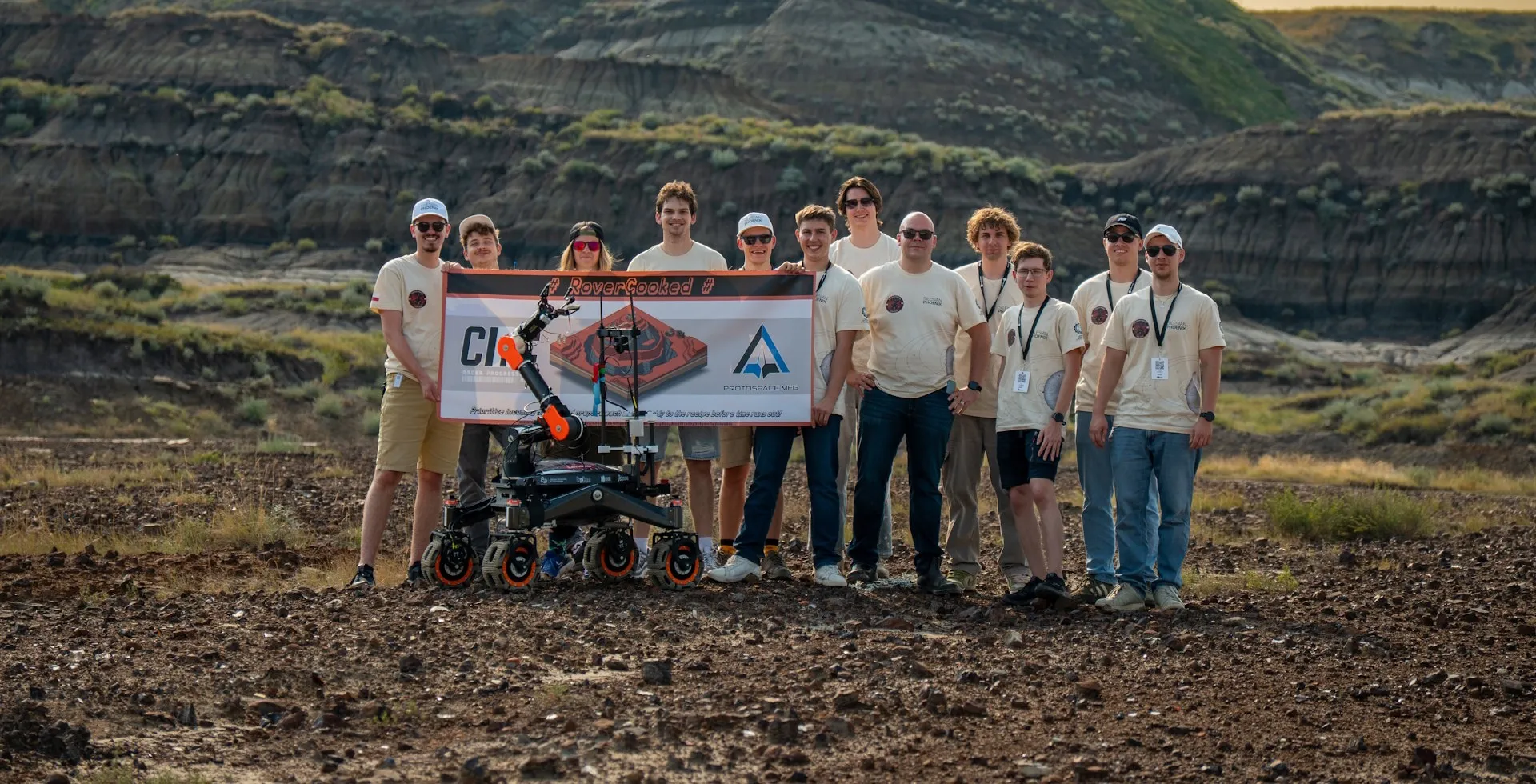
Under the supervision of Andrzej Jałowiecki, assistant professor at the university, Silesian Phoenix has now developed three successive rover platforms: Phoenix I, Phoenix II and Phoenix III, each outperforming the last in terms of autonomy, weight optimization, work time, cruising speed and other key features.
This progress hasn’t happened by chance. It’s the result of a fundamental shift in how the team works. While Phoenix I and II were developed using fragmented tools and disconnected workflows, Phoenix III was rebuilt as a structured program within a unified digital engineering environment: Dassault Systèmes’ 3DEXPERIENCE platform on the cloud.
“Without the 3DEXPERIENCE platform, our rover wouldn’t exist as it does today,” Jałowiecki said.
Establishing a Unified Engineering Environment
Phoenix I and Phoenix II had been built with a patchwork of tools and no shared design history, creating a high level of fragility that was exposed during the COVID-19 pandemic, when remote working became essential. To support students working across multiple faculties, locations and schedules, a cloud-based solution was required. Jałowiecki, a certified SOLIDWORKS and CATIA expert, considered various options, but it was Dassault Systèmes’ solutions that stood out.
“I have previous experience with SOLIDWORKS, so I knew it was easy to learn and had a strong community,” Jałowiecki said. “It also had the capability to integrate with the 3DEXPERIENCE platform on the cloud, which we already use in our degree courses within our mechanical engineering faculty. That meant we could have one environment where we can design, simulate and collaborate without sharing files to other systems.”
The approach to implementation was deliberately incremental. SOLIDWORKS was introduced in April 2022, providing industry-standard CAD for students. The 3DEXPERIENCE platform followed in July 2022, initially as a cloud repository. CATIA became the main design environment in November 2023, and ENOVIA was adopted for project management in June 2024.
“I was aware that if we started with CATIA, SIMULIA and ENOVIA all at once, it would be too overwhelming for students who just joined the Phoenix team and had only just begun working on the project,” Jałowiecki said. “So, we took baby steps and began with SOLIDWORKS, before adopting the cloud-based CAD platform and the solutions available within it.”
Local Dassault Systèmes business partner IBS Poland played a crucial role in the transition to the 3DEXPERIENCE platform on the cloud, providing hands-on support, tailored training sessions conducted on the team’s own files, and direct access to expertise that would otherwise have required hours of searching online.
“Having this kind of partner is very useful,” Jałowiecki said. “We don’t need to look on forums for answers. We have direct contact with a team of experts, and if they can’t help us directly, they will find someone who can.”
Without the 3DEXPERIENCE platform, our rover wouldn’t exist as it does today.

Teaching Real Skills for Real Careers
Working on a live, internationally competitive engineering project gave Silesian Phoenix students hands-on experience with the same processes used by leading engineering organizations worldwide. But with high turnover of team members – a natural result of new learners joining the university and old ones graduating – Silesian Phoenix had to ensure that hard-won knowledge isn’t easily lost when students graduate. The 3DEXPERIENCE platform on the cloud became its institutional memory.
In the platform, design decisions, workflows and engineering knowledge are preserved from one generation of students to the next. To support new recruits, the team built a wiki on 3DSwym, the 3DEXPERIENCE platform’s social collaboration application, containing guidance on revisions, maturity states and file management, alongside links to relevant Edu Space courses. New members also complete practical onboarding tasks – such as designing a lamp holder – that help them learn established workflows before contributing to active rover development.
“We use peer-to-peer learning,” Jałowiecki said. “New members are thrown into a project so they learn in the fire, but they have people around them who can show them how to use it. It’s much easier that way.”
The engineering education students receive through this project-based learning approach has not only helped them to develop the skills required in industry, but has also supported their engineering career development. “One of our former chief mechanics went on to join one of Europe’s biggest rail manufacturers,” Jałowiecki said. “His first role was as an instructor teaching professional engineers how to use the 3DEXPERIENCE platform. He could only do this because he had the experience from Silesian Phoenix. That says everything about the value of working with professional tools on real projects.”
For the students themselves, the value of the platform is equally clear. “For me, the biggest benefit of the 3DEXPERIENCE platform is that everything is in one place,” said Andrzej Ślusarski, an embedded systems engineer at Silesian Phoenix. “I can design, simulate and assemble in the platform, and I can also cooperate with my teammates to manage our project easier and faster.”
Wojciech Łoziński, robotic arm engineer at Silesian Phoenix, added: “In my day-to-day role, I use the system to design new parts, edit existing parts, and manage the project – checking which tasks are delayed and which can be done on time,” he said.
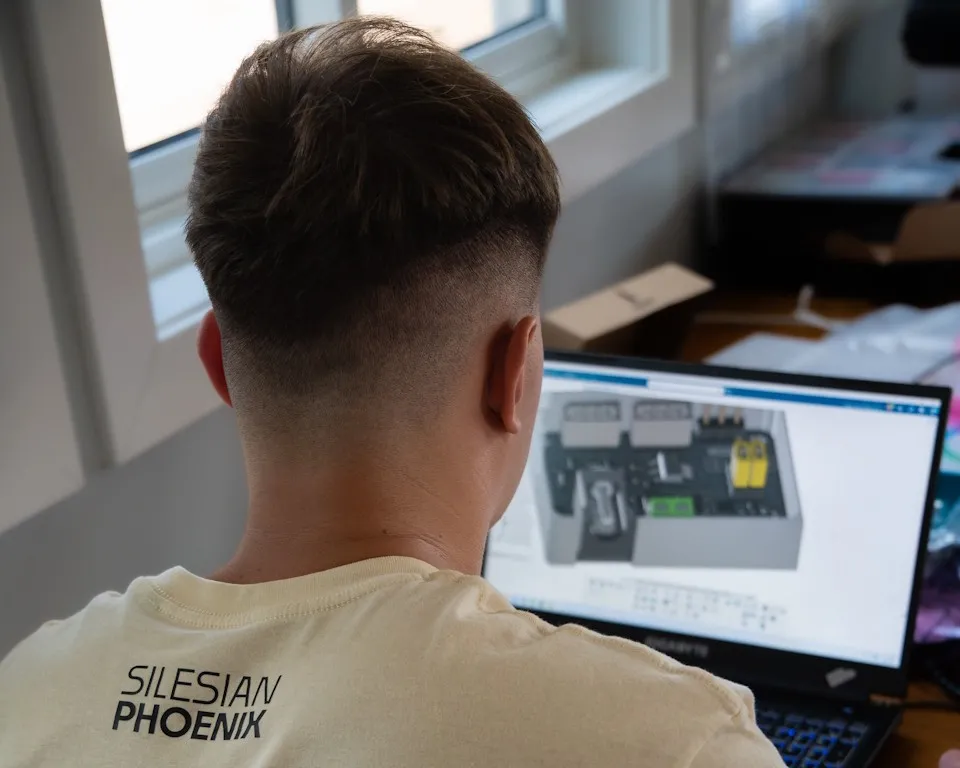
A Silesian Phoenix student uses the 3DEXPERIENCE platform to design and develop components for the team’s Mars rover.
Effective Project Execution at Scale
ENOVIA’s engineering data management capabilities have transformed how the team plans and tracks its work. “The biggest benefit of introducing the 3DEXPERIENCE platform is the collaboration made possible by ENOVIA,” Gurgul said. “I can share knowledge and information with my team, set what must be done, give feedback and make our project work better.”
Gantt charts, teamed with workflows for issue management, change requests and design approvals mean that everyone is informed about the live status of a project and the dependencies between teams.
“When someone completes a redesign, they check the relevant box, the person responsible is notified, and they review and accept or decline the changes,” Jałowiecki said. “We don’t need to waste time informing each other – it’s already automated.”
The impact of ENOVIA on day-to-day coordination across departments is equally significant. Mechanics can now inform the electronics team directly about design changes that affect wiring, and software developers can respond in turn – ensuring every discipline stays aligned as the rover evolves. This avoids a breakdown in communication that has historically been an issue.
“Before, a mechanic might have a two-week delay and think it's not a big deal,” Gurgul said. “But they don't know that the electronics team is waiting for their part, the programmer is waiting on electronics, and suddenly what should have been a two-week job has caused a month's delay. Now, everyone can see the big picture.”
ENOVIA has helped embed more structured engineering practices into the team’s day-to-day work. Over time, students have become familiar with managing revisions and changes within a controlled project environment, mirroring the workflows used in professional engineering organizations. One early example involved a wheel redesign project, where students initially created multiple file versions before fully understanding how revisions should be managed within a controlled product lifecycle.
“We had ‘wheel 1’ and ‘wheel 2’ files, and after working through it with the students, we taught them how to properly manage the lifecycle of a product,” Gurgul said. “Now, all of our mechanics work with revisions and branches, and they understand how this lifecycle works and why it is useful.”
The biggest benefit of introducing the 3DEXPERIENCE platform is the collaboration made possible by ENOVIA. I can share knowledge and information with my team, set what must be done, give feedback and make our project work better.

Design and Simulation in a Unified Digital Environment
Today, the Silesian Phoenix team uses CATIA for far more than basic part design. They use generative design for weight-sensitive components, visual scripting for complex repeatable geometries and user-defined features to standardize processes like heat insert placement. Sheet metal tools, casting mold design and generative shape design for the rover’s distinctive carbon fiber chassis are all part of the workflow.
“We don’t just want to use CAD in the standard way,” Jałowiecki said. “We want to find new ways to design. For example, all our gears and cycloidal discs have visual scripts prepared for them. No one needs to re-enter all those parameters and formulas – we already have this, and we reuse it when necessary.”
Clash analysis has become invaluable. When the electronics team prepared the layout of components that needed to fit inside the rover’s chassis, CATIA’s interference detection immediately identified clashes with the chassis walls that weren’t visible to the naked eye. The same capability was used to define the precise range of motion for the rover’s robotic arm design, identifying the exact joint positions at which the arm would clash with itself.
The parametric design approach has proven equally important during the current phase of Phoenix III’s development. “3D-printed prototype components are being replaced with machined metal parts,” Jałowiecki said. “Rather than redesigning from scratch, engineers simply adjust parameters – wall thickness, for example – and the model updates automatically.”
SIMULIA, meanwhile, has enabled the team to validate designs digitally before committing to physical manufacturing – an important feature for a student association operating on a fixed annual budget. Finite element analysis (FEA) identifies stress concentration points in components before 3D printing begins. Topology optimization has reduced material usage and contributed to weight savings across the rover. Motion simulation enables the assessment of kinematic and dynamic behavior long before manufacturing begins.
“Thanks to our unified modeling and simulation (MODSIM) approach that enables digital prototyping, we don't need to spend a lot of money on physical testing,” Jałowiecki said. “We can spend more time engineering in the digital environment, and, after that, we produce parts that we are far more confident will perform as intended. If we see a weak point in the simulation, we can jump straight back to the design, make changes, and immediately see the impact. Working in this way saves us a lot of time and cost.”
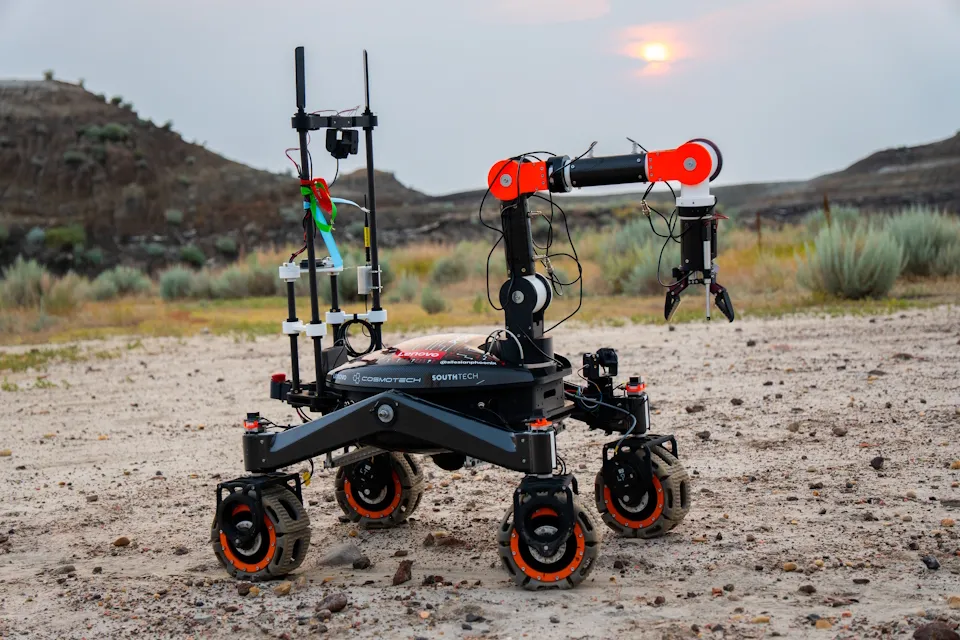
Silesian Phoenix students design and build competition-level Mars rovers to tackle complex engineering challenges and compete in international university rover competitions.
Competing in University Rover Challenges
The platform’s contribution to the team’s competitive trajectory is tangible. At the 2023 Anatolian Rover Challenge, Silesian Phoenix placed ninth. In the 2024 Canadian International Rover Challenge, they placed eighth – and scored nearly three times as many points as in their first attempt. In 2025, they improved again to sixth.
“After our first time in Canada, we came back with a long list of everything that needed to change,” Gurgul said. “And because we had the platform, we could work through those issues systematically. Everyone knew which components corresponded to which issues. They didn’t need to look at everything – they could focus on exactly what needed fixing.”
With Phoenix IV now in the planning stages – to be designed entirely on the 3DEXPERIENCE platform – the team is looking at introducing model-based systems engineering (MBSE).
“Using MBSE, we can connect the models established during the preparation phase with the finished product,” Jałowiecki said. “Take the differential beams, for example. We would first establish what requirements are needed for these components, then design the prototype and put it through extensive testing to make sure the geometry and materials are properly chosen. After this, we will be able to send the documentation to our manufacturers with confidence to prepare the final product.”
Aside from this, the team is also planning to create a virtual twin of the rover. “Right now, we have a digital mock-up of our rover but, in the future, we are planning to prepare a virtual twin to make sure that every move we make in real life can be tracked on the virtual representation,” Jałowiecki said. “This will ensure the decisions we are making are the correct ones.”
Jałowiecki also expects a virtual twin to give the Silesian Phoenix team an advantage during competitions, where their robot can only be controlled via wireless cameras. Telemetry and sensor data rendered in a digital model would allow the team to study mission performance in real time – and avoid costly mechanical failures at the same time.
“We had a situation in Canada where we lost communication with the rover, and we didn’t have full information about the position it was in,” Jałowiecki said. “Because of that, we accidentally broke the arm. A virtual twin would enable us to prevent that kind of problem.”
Ultimately, Jałowiecki is clear that the 3DEXPERIENCE platform is fundamental to the team’s current and future success.
“I now cannot imagine conducting this type of project in the old way,” he said. “Without a clear management structure or a defined way of how the project must be conducted, it would be impossible to achieve something as complex as Phoenix III, and we certainly wouldn’t be able to realize our ambitions for Phoenix IV.”
The aspirations of the Silesian Phoenix team also extend beyond the rover program itself. “We are currently preparing an application for a European defense group initiative that would apply the engineering knowledge developed through Silesian Phoenix in a dual-use context,” Jałowiecki said. “It reflects our broader ambition – that the engineering knowledge students develop here doesn't stay within the university walls.”
FAQ
Focus on Silesian Phoenix
Silesian Phoenix is based at Silesian University of Technology, one of the top ten universities in Poland, with approximately 18,000 students, 13 faculties and around 200 specializations across engineering, science and architecture. The Silesian Phoenix team brings together 37 students from eight faculties and sixteen fields of study – spanning mechanical engineering, electronics, software development and applied science. The Silesian Phoenix Student Research Association was established as an independent association in 2025, having previously operated within the university’s AI-METH interdepartmental research group.
For more information: https://portal.polsl.pl/silesianphoenix/en

Focus on IBS Poland
Founded in 2008, IBS Poland is an accredited Dassault Systèmes PLM solutions supplier and certified training center. The company combines deep experience with a highly skilled team to deliver measurable value through business process integration and optimization. Working across industries including automotive, aerospace, marine and offshore, and consumer goods, IBS Poland acts as a trusted partner focused on helping customers realize innovative product development through PLM implementation.
For more information: https://ibs-poland.pl/

Silesian Phoenix
Discover how student engineering project Silesian Phoenix uses the 3DEXPERIENCE platform to improve collaboration and accelerate Mars rover development.
Customer Story
Standard Bots - Designing AI-Native Robots with SOLIDWORKS
Design intuitive six-axis robot arms that integrate hundreds of mechanical and electrical components in compact assemblies while confirming fit, range of motion, and motor thermal behavior before purchasing or manufacturing parts.
Customer Story
Artworks Florida Classic Fresnel Lenses, llc
Restoring and Reproducing Classic Fresnel Lighthouse Lenses More Efficiently and Cost-Effectively with DraftSight 3D Design Solutions
Customer Story
KIDO Sports
KIDO Sports uses Dassault Systèmes’ solutions to improve consistency and efficiency from design to validation across an expanding helmet portfolio.
Customer Story
Danone
Danone France cuts processing times in half, automates processes, improves collaboration, and secures data with ITEROP.
Customer Story
iHawk Global
iHawk Global redefines container yard visibility with autonomous drones and ground robots which are designed using a simulation-first approach on the 3DEXPERIENCE platform.
Customer Story
Maxxis International by Cheng Shin Tire
Cheng Shin Tire uses MODSIM to innovate tire designs, materials, and compounds for next-gen mobility, driving competitive edge for its global Maxxis brand.
Customer Story
The Antenna Company
The Antenna Company uses SOLIDWORKS and SIMULIA to develop high-performance antenna design for 6G networks using nature-inspired, energy-efficient shapes.
Customer Story

Bulk Automation Delivers Bespoke In-Line Automation Systems
Packaging automation manufacturer uses SOLIDWORKS Design and the 3DEXPERIENCE platform to build and evaluate equipment concepts in 3D before releasing designs for in-house fabrication.
Customer Story