ETRIA
Japanese printing equipment manufacturer ETRIA plans and optimizes its automated assembly lines virtually before implementing them on the factory floor.
Optimized Office Printing Equipment Production Lines
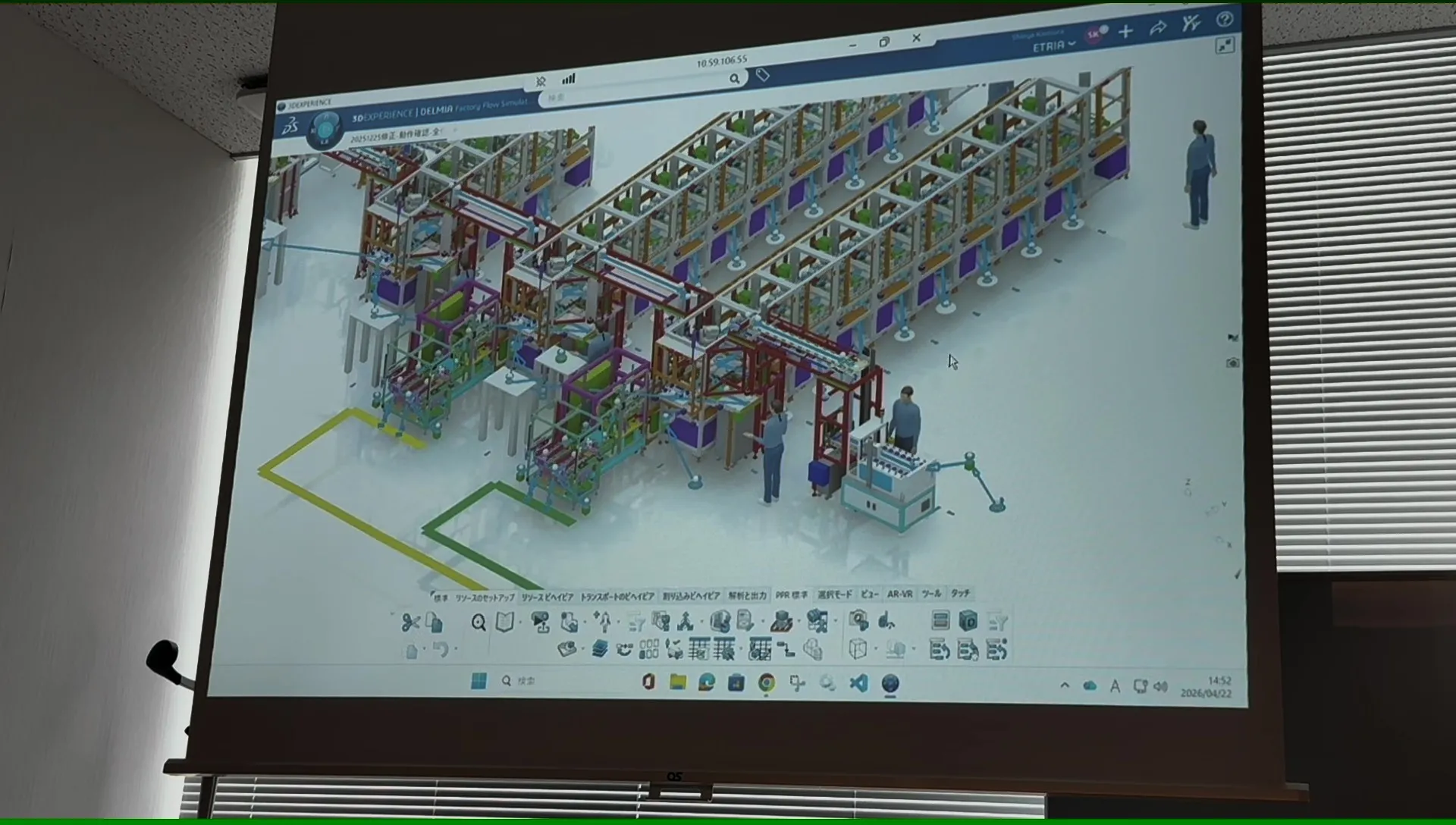
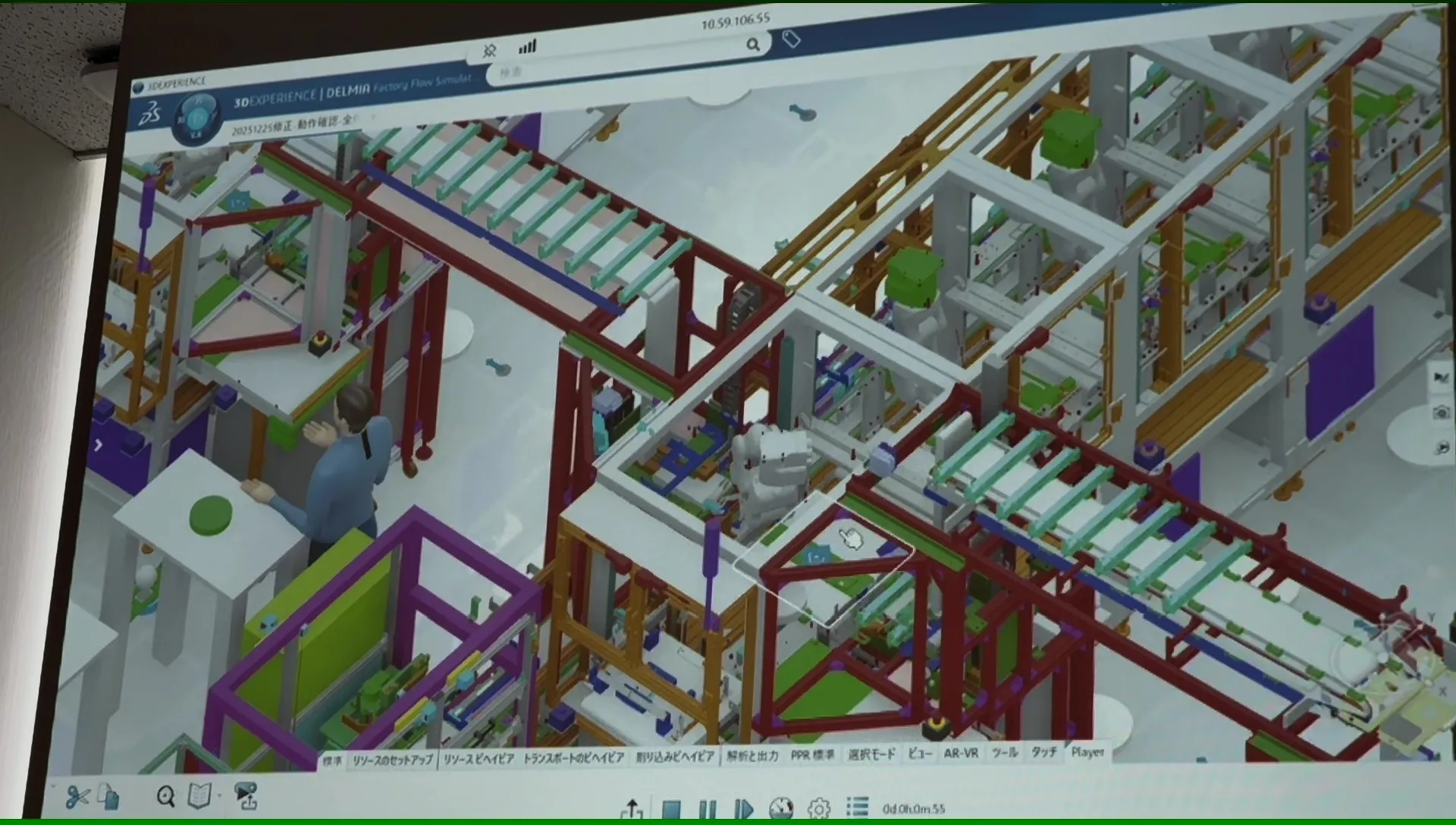
In Japan, a team of engineers remotely redesigns an automated assembly line for one of ETRIA’s plants in China. They start by building a full digital replica of the existing A4 monochrome printing equipment line, then rework it to accommodate A3 color printing machines, virtually testing multiple layouts, configurations and assembly processes to identify the best possible set up.
Within this virtual twin on Dassault Systèmes’ 3DEXPERIENCE platform on the cloud, the engineers simulate how the altered production line will perform under real operating conditions. This helps them understand how to adapt it for production of the larger, more complex A3 printing machine as well as how to run the line even more efficiently.
“We successfully converted the assembly line to accommodate the larger printing machine and improved overall performance in the process,” said Kentaro Yajima, group leader of the core product technology development division at ETRIA. “Compared with the previous line, we achieved a 3.2% increase in performance availability, reduced equipment costs by 42% and halved the line installation area required. This shortens the distance between processes and increases throughput. Over time, that adds up to a significant increase in overall production capacity and makes it easier to replicate and scale these more compact, efficient line setups in factory automation projects.”
A virtual twin (left) simulates how a robot (right) will perform under real operating conditions.
Shared Industrial DNA for Printing Equipment Production
Established in 2024 through a joint venture between Ricoh, Toshiba Tec and Oki Electric Industry, ETRIA brings together decades of expertise in printing machinery and imaging equipment production. Although demand for paper communication is declining in some areas of the market, printed documents still play an important role across many industries, particularly where secure information handling and document workflows remain essential. At the same time, rising sustainability expectations are changing how this equipment is designed, built and maintained, placing greater emphasis on waste reduction, longer product lifecycles and support for circular business models.
ETRIA addresses these challenges through digital transformation. The company uses the 3DEXPERIENCE platform on the cloud and DELMIA to power its manufacturing virtual twin, allowing it to plan its production systems in ways that would have been extremely costly and resource intensive in a purely physical environment. Using DELMIA’s equipment and layout engineering capabilities, the team can model machinery and factory layouts in 3D, simulate assembly operations and verify how parts move through the line before equipment is installed.
“Initially, we focused on virtual production line simulation at our main smart factory in Kanagawa Atsugi, Japan,” Yajima said. “We then expanded the model to our mass-production sites in China, with further plans to extend to factories in other regions, including Thailand.”
Supporting ETRIA throughout this transformation is Dassault Systèmes’ business partner Fasotec, which managed the DELMIA license rollout and guided ETRIA through installation and adoption of the manufacturing simulation and planning software across the organization.
The virtual twin lets us test, refine and improve continuously, so we can move faster, roll out manufacturing automation more effectively and make better use of resources from day one.

Designing and Ramping Up Automated Lines Virtually
Like many manufacturers, ETRIA used to develop and validate production lines directly on the shop floor. Much of the process relied on the experience of skilled workers, testing could only begin once physical equipment was installed, and last-minute fixes were costly and caused delays. ETRIA’s new virtual-first approach is changing this.
“Every new product launch demands a further step up in line productivity,” Yajima said. “Our goal is to improve productivity and flexibility, reduce cost and ramp up our overseas factories efficiently. The virtual twin lets us test, refine and improve continuously, so we can move faster, roll out manufacturing automation more effectively and make better use of resources from day one. We’ve dramatically improved the accuracy of our planning.”
Today, engineers explore multiple line layouts and equipment scenarios side by side in the 3DEXPERIENCE platform, understand tradeoffs early and carry forward what works. Rather than starting from scratch each time, they build on proven models, adapting them for new products and sites. Over time, this creates a shared library of production knowledge that captures final designs and also the thinking behind them, so each new line benefits from what has already been learned.
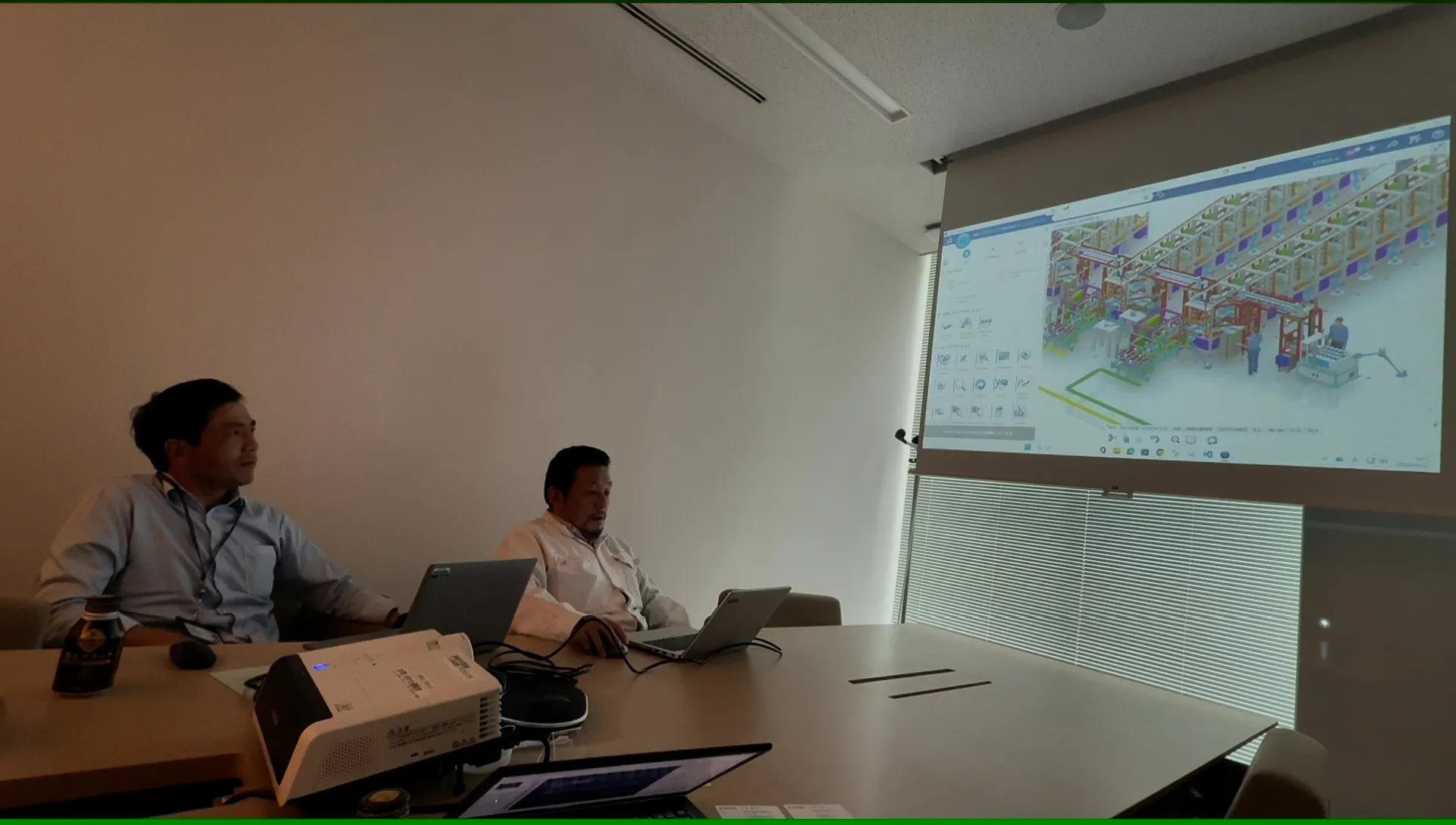
Detailed design reviews can now take place remotely.
Remote Startup and Global Collaboration
Because the entire virtual twin environment is hosted in the cloud, all production models, line designs and data are stored and managed centrally, allowing teams in different locations to work simultaneously from the same up-to-date information. This allows management at ETRIA headquarters to standardize engineering methods and virtual line models across sites, while giving factories the flexibility to produce different products or shift production between locations as demand changes.
Thanks to the cloud, working practices are changing too. In the past, equipment designers traveled to overseas factories to carry out functional adjustments, robot teaching and startup verification directly on physical machines. “Most troubleshooting also depended on local, hands-on intervention, which meant our teams were frequently making costly and time-intensive trips,” said Shinya Kamiura, engineer in the core product technology development division at ETRIA.
Today, virtual twins of production equipment allow detailed design reviews, issue resolution and robot motion validation to take place remotely. Engineers in Japan collaborate with on-site teams through shared digital models, guiding installation and startup without needing to be physically present. This approach has significantly reduced travel demands while freeing engineers to focus on higher-value work.
“By overseeing equipment startups remotely, engineers no longer need to travel overseas and spend weeks away from home for on-site visits,” Kamiura said. “This frees up about 30% of engineers’ time, which can now be redirected to other engineering and planning tasks, supporting a more flexible way of working.”
The virtual twin also makes it easier for us to identify bottlenecks ahead of time and then guide the team on the shop floor with the best ways to improve performance.

From Intuition to Data-Driven Improvement
Once lines move into full production, the virtual twin continues to add value. Real operating conditions, including machine speeds, handover time between stations and defects, are monitored within the virtual twin to reflect what is happening on the shop floor. By comparing the ideal production state defined during planning with actual performance, engineers can pinpoint where time, capacity or labor is being lost and determine how best to allocate workers.
“This also makes it easier for us to identify bottlenecks ahead of time and then guide the team on the shop floor with the best ways to improve performance,” Kamiura said.
In all cases, actions are based on proven outcomes in the virtual twin rather than assumptions, reducing risk, limiting disruptions, avoiding unnecessary adjustments and supporting continuous improvement in quality, cost and delivery performance (QCD).
The virtual twin provides a clear view of how automated guided vehicles (AGV) are coordinated.
Toward Highly Connected and Automated Production
ETRIA’s longer-term plan is to create a fully connected production environment in which data from day-to-day operations feeds back into the virtual twin, providing a clear view of all factories and how they are performing. Next steps will focus on connecting manufacturing equipment more closely to the virtual twin so performance and condition can be monitored in greater detail. Over time, this will support predictive maintenance and AI-guided support.
“Our vision is to use the 3DEXPERIENCE platform to become a truly data-driven organization,” Yajima said. “By turning insights into action, we generate opportunities for creative, knowledge-driven work rather than reactive problem-solving, helping teams make better decisions and continuously enhance how our factories operate.”
Focus on ETRIA
Established in 2024 as a joint venture between Ricoh, Toshiba Tec and Oki Electric Industry, the ETRIA Group develops and manufactures imaging equipment, building on decades of combined expertise in printing and information technologies. ETRIA’s core portfolio includes office printing technologies and auto-ID business machines such as photocopiers, printers and toner products, supplying global markets through its parent organizations while advancing more digital, efficient approaches to manufacturing.
For more information: https://etria.global/

Focus on Fasotec
FASOTEC Co., Ltd. is a leading 3D engineering company in Japan, founded in 1983 by machining engineers with expertise in 3D CAD/CAM/CAE. As a Dassault Systèmes Gold Partner (as of 2026), we have been contributing to solving the challenges of many customers through the provision of solutions centered on the 3DEXPERIENCE platform. We support the entire process from design to production, and strongly support operational efficiency and improvements in quality, cost, and delivery (QCD) through data integration utilizing the 3DEXPERIENCE platform. Furthermore, based on our expertise and extensive experience in PLM (Product Lifecycle Management), we provide engineering services that support the enhancement of corporate competitiveness.
For more information: https://www.fasotec.co.jp
ENERBIOFLEX
Enerbioflex digitalizes its business processes to support its rapid growth and secure energy purchasing for its clients, with 3DEXPERIENCE ITEROP from Dassault Systèmes
Customer Story
Maxxis International by Cheng Shin Tire
Cheng Shin Tire uses MODSIM to innovate tire designs, materials, and compounds for next-gen mobility, driving competitive edge for its global Maxxis brand.
Customer Story
Sonaca España
Airframe supplier Sonaca España is unifying design, engineering and manufacturing on the 3DEXPERIENCE platform to tackle product complexity and gain digital continuity.
Customer Story
GEBERIT
Sanitary product manufacturer Geberit leverages the 3DEXPERIENCE platform for handling mechanical engineering, design management and collaboration.
Customer Story

EVIO
Discover how EVIO improved collaboration with a single connected environment for 3D design, product data management and virtual reality experiences.
Customer Story
UUDS Aero
UUDS Aero cut cabin interior processing from two weeks to two days with the 3DEXPERIENCE platform, improving design and aircraft cabin experience.
Customer Story
Silesian Phoenix
Discover how student engineering project Silesian Phoenix uses the 3DEXPERIENCE platform to improve collaboration and accelerate Mars rover development.
Customer Story
Airbus
Airbus has deployed Dassault Systèmes’ (3DS) applications to drive a global collaborative solution throughout the value chain from engineering to manufacturing...
Customer Story
SABCA
Connecting engineering and manufacturing to efficiently build complex assemblies for the aerospace industry.
Customer Story