




Explore how smart grid technologies powered by virtual twins can help us create a more resilient and sustainable tomorrow.
Podcast

Tune in and learn how digital solutions are propelling product reformulation and accelerating the delivery of eco-friendly goods.
Join us in this episode as we delve into the world of product reformulation and sustainability. Listen to our experts as they discuss the challenges and strategies for creating more sustainable products in various industries. Explore how key industry players adapt to changing customer preferences, the significance of digital transformation and why sustainability is a top priority. Discover more


With a digital solution that predicts successful results, you can go faster and model many more formulas than you can physically create in the lab."
Robyn Mandalakis
Narrator: This is Disruptors Unleashed, the series that highlights the disruptive technologies shaping our world. Previously, we looked at virtual twins and their impact on sustainability with our trailblazers: Arvind Krishnan from Lifecycle Insights and Philippe Bartissol from Dassault Systèmes.
In this episode, we discover — and break through — the limits of product reformulation with our experts: Robyn Mandalakis from Act2 Consulting; Nandakumar Subramaniam from Tech Mahindra; and Rik Pepermans, an independent consultant.
Host: The topic of digital reformulation is very timely, as more and more customers demand more sustainable products from their favorite brands. We start with Rik Pepermans, an independent consultant, formerly at Unilever for 30 years. Rick managed the digital transformation of Unilever Global R&D.
Rik: Well, the C in CPG stands for consumers. Consumers decide to shop for what they want to buy. And that's a fast decision — no detailed rational analysis but intuition. And the outcome that evolves in time. The CPG industry spends a lot of effort to keep their understanding of consumers’ actual behavior. These evolving insights then have to be translated into an evolving product.
Staying tuned to the consumer is a major reason for reformulation. Sure, it's not the only reason, but it's a major one. Reformulation is modifying an existing formulated product to meet changing requirements.
The traditional process of reformulation requires a lot of experience. The number of choices is large – which ingredients, how much of each ingredient, which production process, what packaging – the number of combinations of these choices is far too big to try even a small fraction of them.
And the list of acceptance criteria for the product is also long. Picking the right formulation was half science and half art. Pairing this with the current trends, the frequency of reformulation requests is increasing. And the time to deliver a requested formulation gets shorter. There are simply not enough experienced formulators to keep up with that. And those are needed to create new formulations, which is even harder. I think a digitally augmented formulator might be the solution. But that's another story.
Rik: One might think that the sustainability expectations just add a series of additional acceptance criteria to the long list: Use only ingredients that are sustainably sourced, limit energy consumption, limit waste and so on. All products on the markets, of course, must be re-evaluated against these criteria. Existing products that don't meet expectations must be reformulated. That means even more reformulation requests.
However, adding to sustainability criteria also means creating new kinds of data, evaluating new technology and building new knowledge. But above all, expanding the values of the company. On top of the market shares, revenues and profits, CPG companies are now evaluated on their sustainability ranking. And I can tell you, Unilever takes that very seriously. And so do the competitors. Big companies have a big responsibility to make the world a better place to live.
The impact of sustainability may have been a mere reformulation for each product, but for responsible CPG companies, it is a huge transformation. The digitalization of product development is key to make CPG industries sustainable.
Host: Now we turn to Robyn Mandalakis, the President of Act2 Consulting. Robyn worked for Colgate-Palmolive for over 29 years, implementing lab management systems and formulation systems.
Robyn: Developing more sustainable products is one of the top five objectives for all key players. Many consumers are now requiring sustainable ingredients that support a circular economy, healthy living and protect our planet. In responding to these challenges, using more natural ingredients is probably the easiest and most traditional way to reformulate.
It's much more difficult to find innovative new synthetic chemicals as much more testing is involved to prove they're sustainable. And as we know, competition is all about speed. In order to achieve speed, roughly 90% of CPG product development is reformulation, while only 10% is delivering truly new products. And this is to satisfy customers who always want new products on the shelves.
Companies could develop products even faster if they had the ability to predict formula performance when swapping ingredients without having to do any physical testing. If you've managed to eliminate testing, you've not only gained speed to market but also huge cost savings. Testing is both expensive and time-consuming. Sustainability demands and speed to market are the biggest use cases for reformulation technology today.
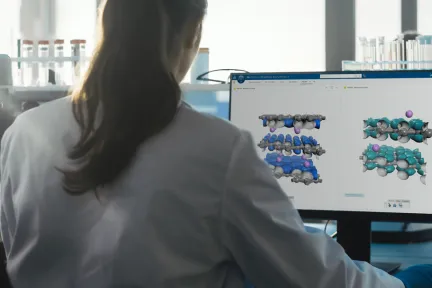
Robyn: Here's a simple example: What if I replace one ingredient in a product with a greater one? This process goes faster with modeling. But in order to model a product and predict performance, you need to have all the formulation data together with all the test data on the ingredients and prior formulations. Then, you can apply machine learning to predict how the new formula will perform.
With a digital solution that predicts successful results, you can go faster and model many more formulas than you can physically create in the lab. You can optimize the ingredients in new and better ways, which is a key selling point for digital transformation and formulation.
BIOVIA is good at tying formulating with testing systems to a point where you can apply machine learning and predictive capabilities so that you can model substitution of materials for cost savings and sustainability impact. But a huge change management effort is still needed to get scientists to fully buy in and engage in comprehensive formulation testing and predictive solutions.
We need more success stories to share. And within CPG companies, there's a need for strong internal advocates who can sell formulation technology solutions to senior leaders with compelling business cases. As more and more digital natives enter the scientific population, I think it'll be an easier change management effort to move companies into digital labs in the future.
Host: Thank you very much, Robyn. Now, we know better what is needed for a successful transformation in the labs.
Robyn: Thank you for having me.
Host: Our next guest in this podcast is Nandakumar Subramanian, Product Lifecycle Management and Lab Automation System Pre-Sales Lead at Tech Mahindra, a Dassault Systèmes Platinum Partner for over 20 years.
Nandakumar: Sustainability is of paramount importance for all three segments of the oil and gas industry. For today's session, I'm going to keep the focus on the downstream side of the business, specifically lubricants and chemicals.
This segment of the industry is facing unprecedented challenges with an ever-increasing number of specifications and tests by OEMs. New and more stringent regulations and customer expectations around high performance are growing. And these are never-ending challenges. It is evident that R&D organizations must continuously innovate and be agile to meet market demands and growing complexity. Digitizing and digitalizing the R&D processes is one of the key strategies that is helping these organizations to be agile.
Nandakumar: Well, that's an interesting question. I see two key levers in controlling cost and improving efficiency. One is leveraging data, and two is improving workflow efficiency.
Companies today are really bogged by data and application silos. Researchers and scientists spend a significant amount of time duplicating information — entering the information from one system to another system, searching for information and curating information. This needs to be broken. Breaking silo is key not only for improving the workflow efficiency but also for improving the data integrity.
We have taken a one-platform approach with one of our key customers. With the Dassault Systèmes platform, we integrated and consolidated 30-plus siloed applications into one single platform, which actually has helped them in improving not only time to market but also data integrity significantly.
Nandakumar: More than half of the product changes that are undertaken by lubricants and chemical businesses are associated with reformulation. Reformulation is a key aspect of R&D. However, both sales and marketing, and also the supply chain play a major role in this overall process. So, integrating this value chain is essential.
For example, IMO 2020 is a recent standard that was introduced for marine lubrication. IMO 2020 allowed lubrication or the marine customers to take multiple options: They can continue to use the existing lubricants, go for a low sulfur lubrication or pick up some other options. So, they had multiple options to move forward to meet the standard. Now, all the chemical companies or the lubricant companies will have to meet all these different options. So, it is essential that the R&D department is aware of what the customer's direction is and where the customer is going.
Host: Well, thank you for all these insights, Nandakumar, and thank you for joining us on this Dassault Systèmes podcast.
Nandakumar: Well, thank you for having me. Glad to be part of it.
Host: I hope you enjoyed listening to our experts. Now, you know more about the challenges of product reformulation for sustainability, and why digital tools should play a major role.
Narrator: Disruptors Unleashed is produced by Dassault Systèmes. For more episodes, follow us on Apple Podcasts, Spotify, Deezer, or your nearest streaming platforms. To learn more about Dassault Systèmes, visit us at 3ds.com.

Launch more sustainable, cost-compliant product formulations with a data-driven strategy, powered by smart technology on the 3DEXPERIENCE® platform.
How digital reformulation helps optimize products to increase sustainability.

Accelerate the launch of innovative, sustainable and quality new therapies through a connected digital backbone.

Secure an advantage to deliver best-in-class batteries with the power of virtual twins.

Discover the digital edge in research, development and manufacture of alternative materials for a circular, sustainable business.

Foster Innovation with In Silico Design
Explore how smart grid technologies powered by virtual twins can help us create a more resilient and sustainable tomorrow.
Podcast

Discover how urban planners can leverage virtual twins to transform our cities for a resilient future.
Podcast

Learn how virtual twins can help manufacturers optimize lifecycle management and unlock cost savings through sustainable sourcing and eco-design.
Podcast

Discover how rethinking R&D in life sciences and healthcare fosters biodiversity preservation and medical innovation.
Podcast

Discover how Education Experiences equip today’s students with industry-ready skills to engineer a more sustainable tomorrow.
Podcast

Explore how modular construction and digital innovation are reshaping the building industry to enable more efficient, sustainable urban development.
Podcast

Learn how cities’ virtual twins can foster climate resilience and empower communities to adapt and thrive in a changing world.
Podcast

Join 9-year-old Infrastructor Bernardo as he explores how virtual twins enable bold energy solutions to decarbonize rail freight.
Podcast

Explore how Dassault Systèmes delivers the missing piece, connecting people, data and processes for end-to-end manufacturing transformation.
Podcast

Learn how the 3DEXPERIENCE platform harnesses collective intelligence, empowering organizations to confront sustainability challenges for a greener future.
Podcast

Discover how the virtual twin fosters end-to-end collaboration across product engineering, manufacturing planning, scheduling and operations.
Podcast

Get the full story on how emerging technologies are transforming the way we teach our engineering students.
Podcast

Discover how virtual twin experiences are shaping the future of industrial equipment manufacturing.
Podcast

Explore the cutting-edge world of virtual twins and their transformative impact on the industrial equipment industry.
Podcast

Discover how seamless collaboration, cloud-enabled apps and effective knowledge re-use accelerate creating innovative high-tech experiences
Podcast

Learn how virtual twin experiences are set to revolutionize medical device design, clinical trials and patient treatments.
Podcast

From the surge in electrification to the advent of software-defined vehicles, these trends compel automotive businesses to innovate faster and more efficiently.
Podcast

Tune in to explore how virtual twin technology enables top aerospace companies to manage conflicting trends, speed up development and reduce costs.
Podcast

Get expert insights on how businesses can empower their engineering teams to achieve greater speed, efficiency and performance through MODSIM.
Podcast

What does a sustainable city of the future look like? Listen to a preview of the Building Tomorrow five-part documentary series.
Podcast

How can the virtual twin help reduce the environmental impact of building a sustainable tower? Bastien Hillen from Dassault Systèmes has the answer.
Podcast

Everything you’ve ever wanted to know about productization — a modular approach to product design — and its impact on the construction industry.
Podcast

We take a peek into Building Tomorrow, a five-part documentary series that examines what a sustainable city of the future will look like.
Podcast

Tune in to learn how In-space Servicing, Assembly and Manufacturing (ISAM) technologies power a more sustainable space environment and economy.
Podcast

Circularity embraces a fundamental economic transformation that redefines product design, the materials used and how businesses operate.
Podcast

Making circular economy achievable, scalable and profitable.
Podcast

Transform how you do business through circular supply chains to achieve profitability and lasting success.
Podcast

Applying Eco-design Principles for the Entire Product Lifecycle
Podcast

Embracing Circularity into Product Development through Sustainable Materials
Podcast

Tune in to discover how digital transformation raises inventory management to new heights, unlocking new horizons for manufacturing success.
Podcast