
Cities & Public Services
Design and Deliver sustainable living environment and public services to citizens.
Industry
By simulating heat, airflow and testing out different urban designs and layouts, Meudon in France is creating cooler, more welcoming public spaces, and involving residents in important decision-making.
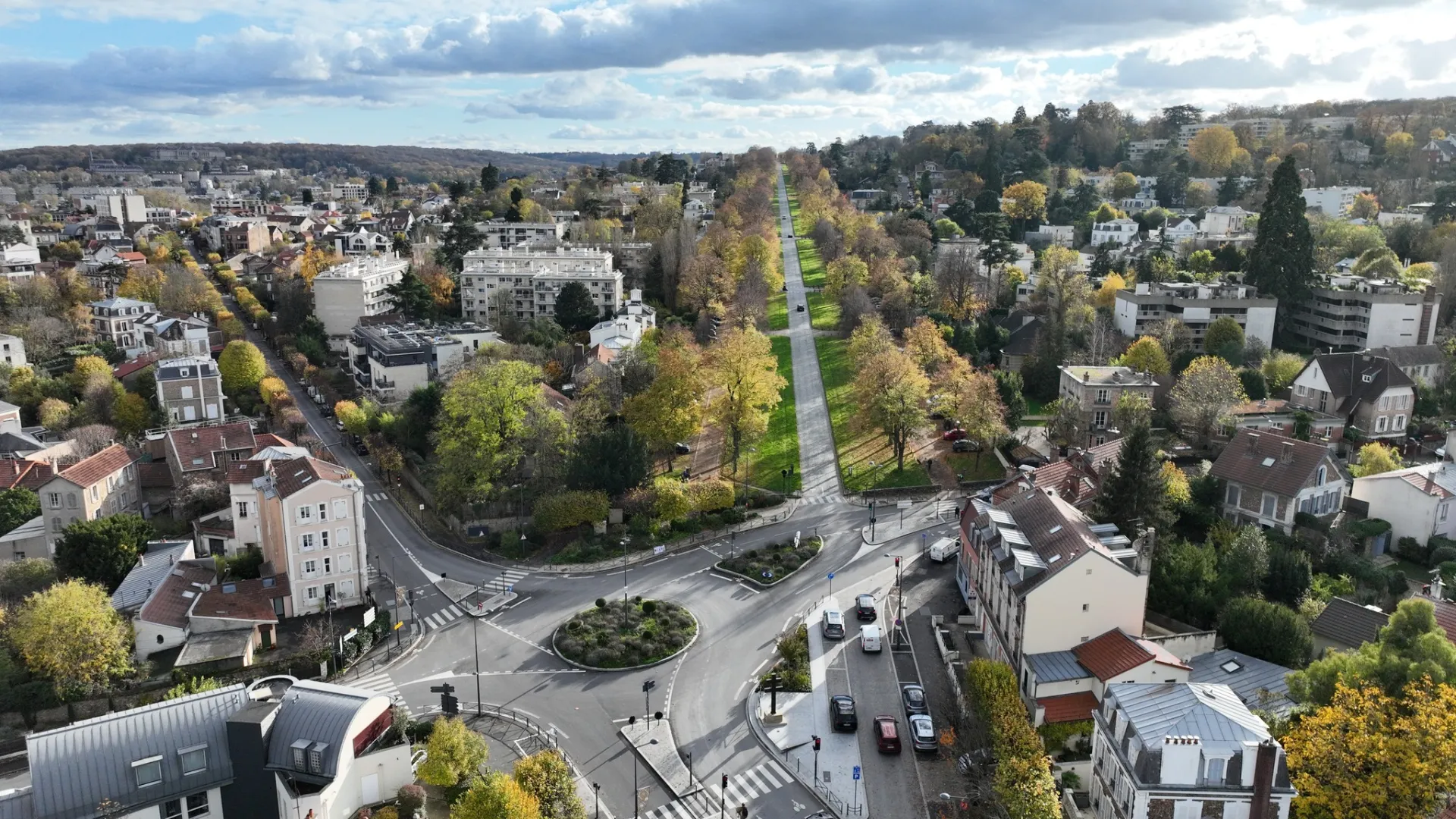
While forest fires, flooding and extreme heat are becoming more frequent across Europe, the French town of Meudon just outside of Paris is not waiting for the next disaster to strike before taking action. Instead, local leaders are tackling climate change in a rather unique way. They invest in innovation and cutting-edge technology like the virtual twin and advanced simulation to lower urban temperatures, safeguard its community and improve daily life.
By partnering with Dassault Systèmes, Meudon is bringing science and technology into urban planning. Through this approach, the town can model public spaces and simulate heat, airflow and design choices to make smarter, data-driven decisions about where to plant trees, modify layouts and create truly sustainable environments.
“Our residents want a town that’s resilient in the face of climate change, something we’re already experiencing locally through heatwaves and heavy rainfall,” said Denis Larghero, mayor of Meudon. “There’s also a strong focus on protecting and adapting our forest.”
Our team has really embraced the project and continues to work closely with Dassault Systèmes on next steps. We share a vision of how this technology can transform decision-making and shape the sustainable and resilient towns and cities of tomorrow. Together, we’re imagining the future.
Meudon’s long-term strategy, Meudon 2040, is focused on making urban life more enjoyable, inclusive and resilient. One of the town’s biggest concerns is the intensification of urban heat islands, places where the layout of streets and buildings, heat-absorbing materials and limited greenery cause temperatures to rise sharply, even after sunset. Some cities can be up 10 to 15 degrees centigrade (°C) hotter than rural areas during summer heatwaves.
Many of Meudon’s public spaces were also designed for cars, not people, so they have wide paved surfaces, minimal shade and little greenery, making them unappealing places to relax and socialize.
“People want public spaces where they can pause, connect with neighbors, and access shops and services all within walking distance,” Larghero said. “They want to live in their town, not just pass through it.”
At a smart city expo, where Meudon was invited to participate as a metropolitan district of innovation, officials had the opportunity to meet with Dassault Systèmes and learn more about how virtual twin technology could support future urban planning decisions.
“We saw the possibility of working together on these urban heat islands,” Larghero said. “Dassault Systèmes’ virtual twin capabilities would allow us to assess situations with incredible precision and model potential interventions in public spaces, which often come with significant costs. We wanted to gain a clear picture of the impact those choices will have, helping us make informed decisions and make sure public funds are spent wisely.”
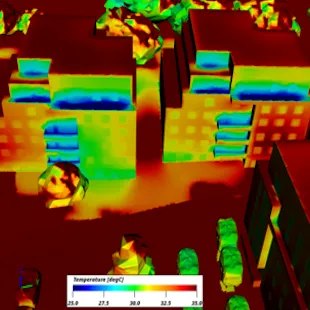
Using Dassault Systèmes’ virtual twin technology, Meudon simulates heat and airflow in public spaces to guide data-driven decisions that lower urban temperatures and improve comfort.
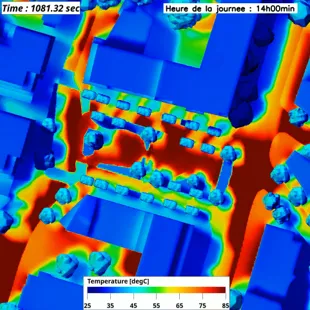
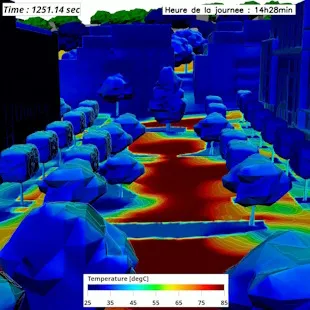
By working with Dassault Systèmes’ SIMULIA team, Meudon gained access to expert modeling, simulation and analysis capabilities without needing to invest in expensive new IT infrastructure. This proved a very practical and scalable solution, especially for a town of its size.
To begin with, the project focused on two public spaces being transformed through new planting: Tony de Graaff Square and Simone Veil Square. The next phase expanded to simulating conditions across the wider residential area in Meudon-la-Forêt. Dassault Systèmes’ team visited the sites and integrated detailed building data in conjunction with city services to assess surface materials, vegetation, greenery and airflow, and created detailed virtual twins of each space.
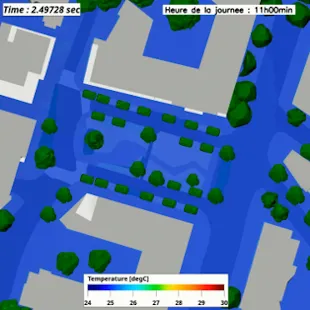
“We captured these spaces on the hottest and coldest days: peak summer and winter conditions, with full sun and varying wind levels throughout the day,” Larghero explained. “The simulations tracked temperature changes across the square at different times and covered ground, child and adult height level, as well as surrounding buildings. We also looked at airflow at the entrances and exits of the square to ensure good ventilation. This helped us plan vegetation, like tree placement, in a way that enhances airflow rather than blocking it.”
Tony de Graaff Square before (left) and after (right) its transformation into a cooler, greener public space.
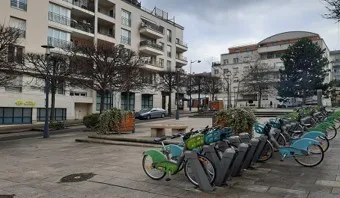
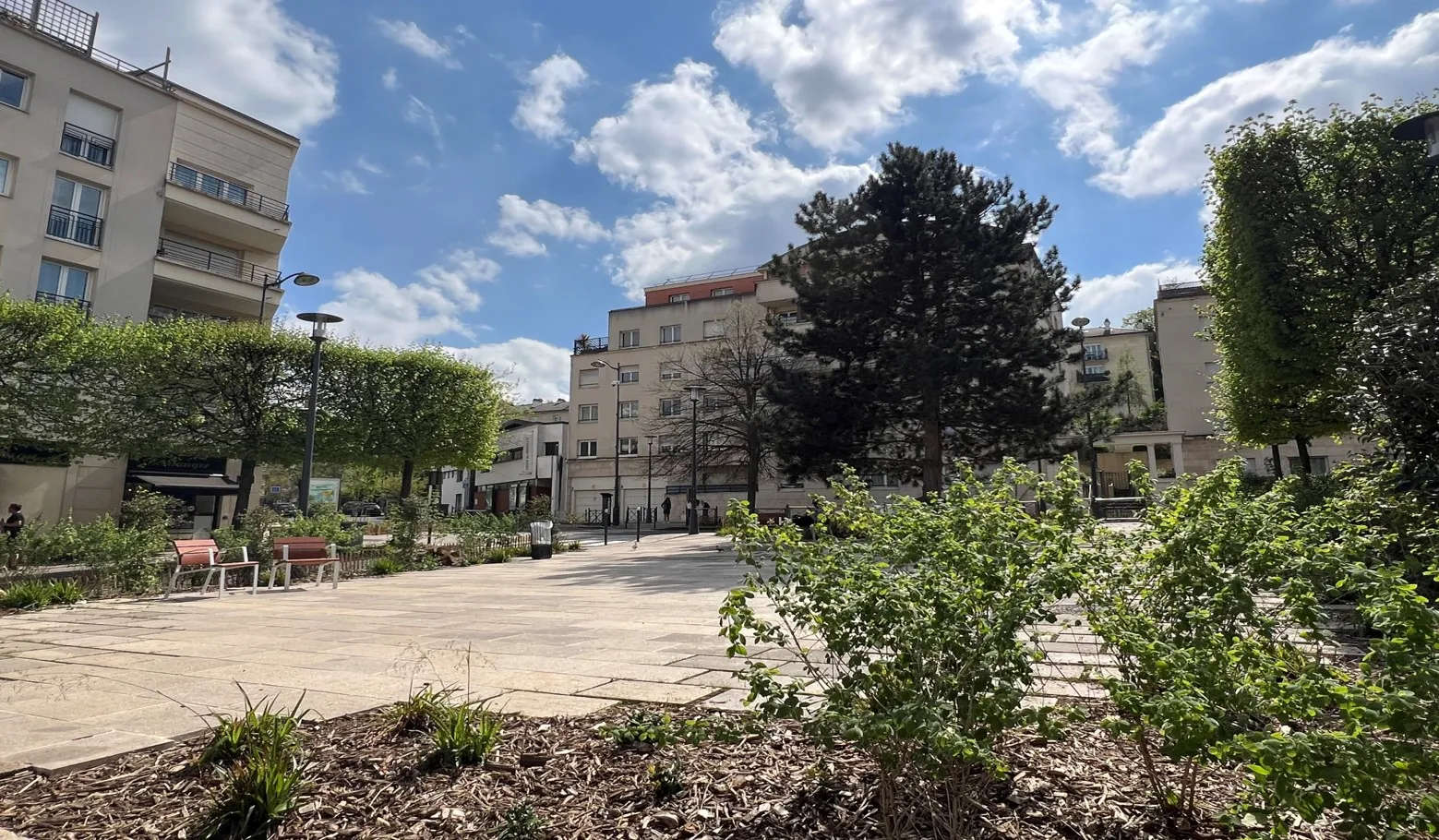
Dassault Systèmes virtually tested a multitude of different scenarios such as replacing concrete with soil and permeable surfaces, adding trees and vegetation, modifying urban furniture and layouts, and evaluating wind flow to regulate temperatures.
“This approach lets us choose the most suitable materials and layouts for each part of the space, depending on whether it’s shaded, used by cars or bikes, already planted or not,” Larghero said. “We even considered the materials used in surrounding buildings to reduce temperatures further and looked at how we could use panels, plants and other features to avoid strong wind flows in places where people may want to rest.”
The simulations provided Meudon with clear, data-driven recommendations for real-world improvements, helping to refine planting strategies, rethink tree placement and adjust pruning methods to optimize shade and airflow.
“For example, we’re now letting trees grow more freely, rather than pruning them, so they can reach upper-floor apartments and provide more shade,” Larghero said.
This commitment to science-based urban planning and design is already delivering impressive, tangible results on the ground. Part of the town’s Nature 2050 program, the Tony de Graaf Square has been transformed. Once mostly paved, it has now been de-paved and planted with vegetation to create a cooler environment for residents. Removing over 870 m² of impermeable surfaces and planting suitable species strengthens the local green network and facilitates the absorption of runoff water on the site. Planting grass between paving joints over 450 m² will further improve stormwater management. Solutions like this bring immediate benefits to local communities and help the town prepare for projections from Météo-France’s ClimaDiag tool, which predicts a 2°C increase in Meudon by 2050 and a tripling of heatwave episodes.
“In some cases, we’ve seen surface temperature drops of up to 40°C during the hottest part of the day, which was far greater than we expected,” he said. “In the parking lot, we saw a drop of 14°C. Even smaller temperature drops like 6°C on the facades of neighboring buildings make a big difference, creating cooler zones where people can take a break and find relief from the heat, while limiting the use of energy-intensive air conditioning.”
Simone Veil Square before (left) and after (right) data-driven design improved shade, airflow and comfort.
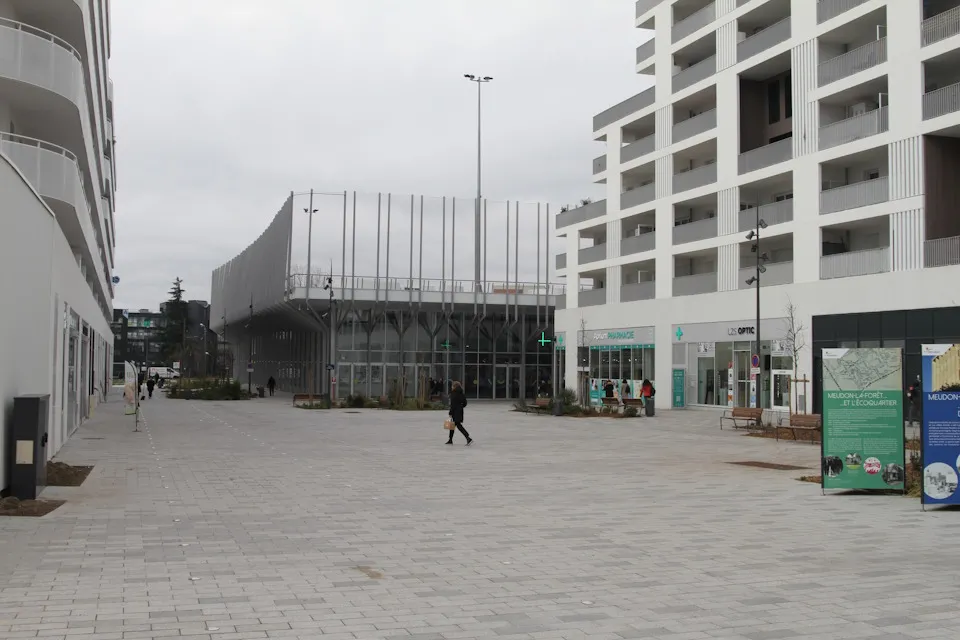
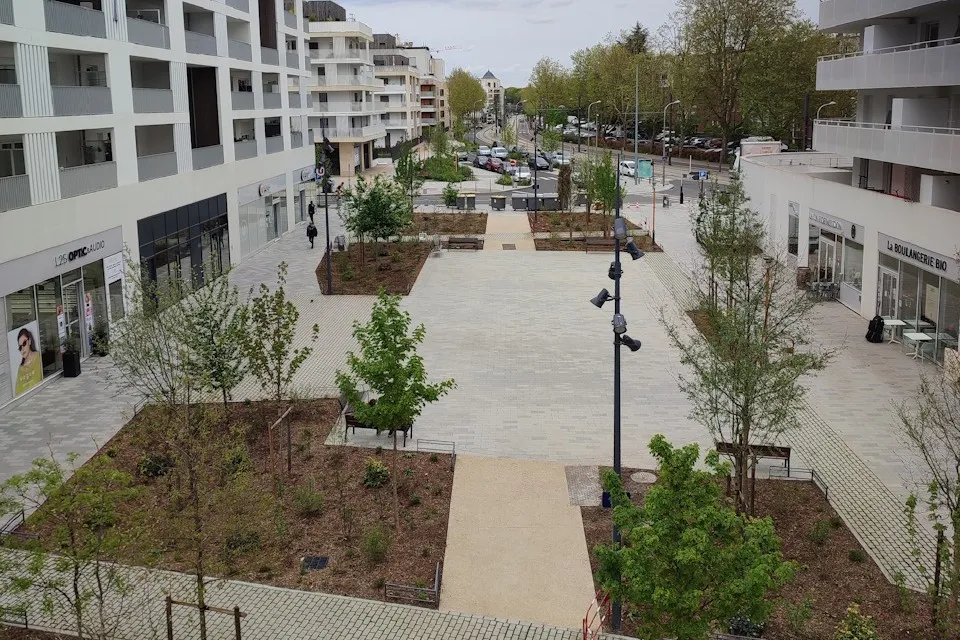
Meudon’s residents have been very receptive to the changes underway, thanks to the transparency and social governance made possible by the virtual twin. This highly intuitive and visual way of sharing information makes complex data easy to understand, justifies investments and helps people see for themselves how different planning and construction decisions affect their environment and improve their well-being.
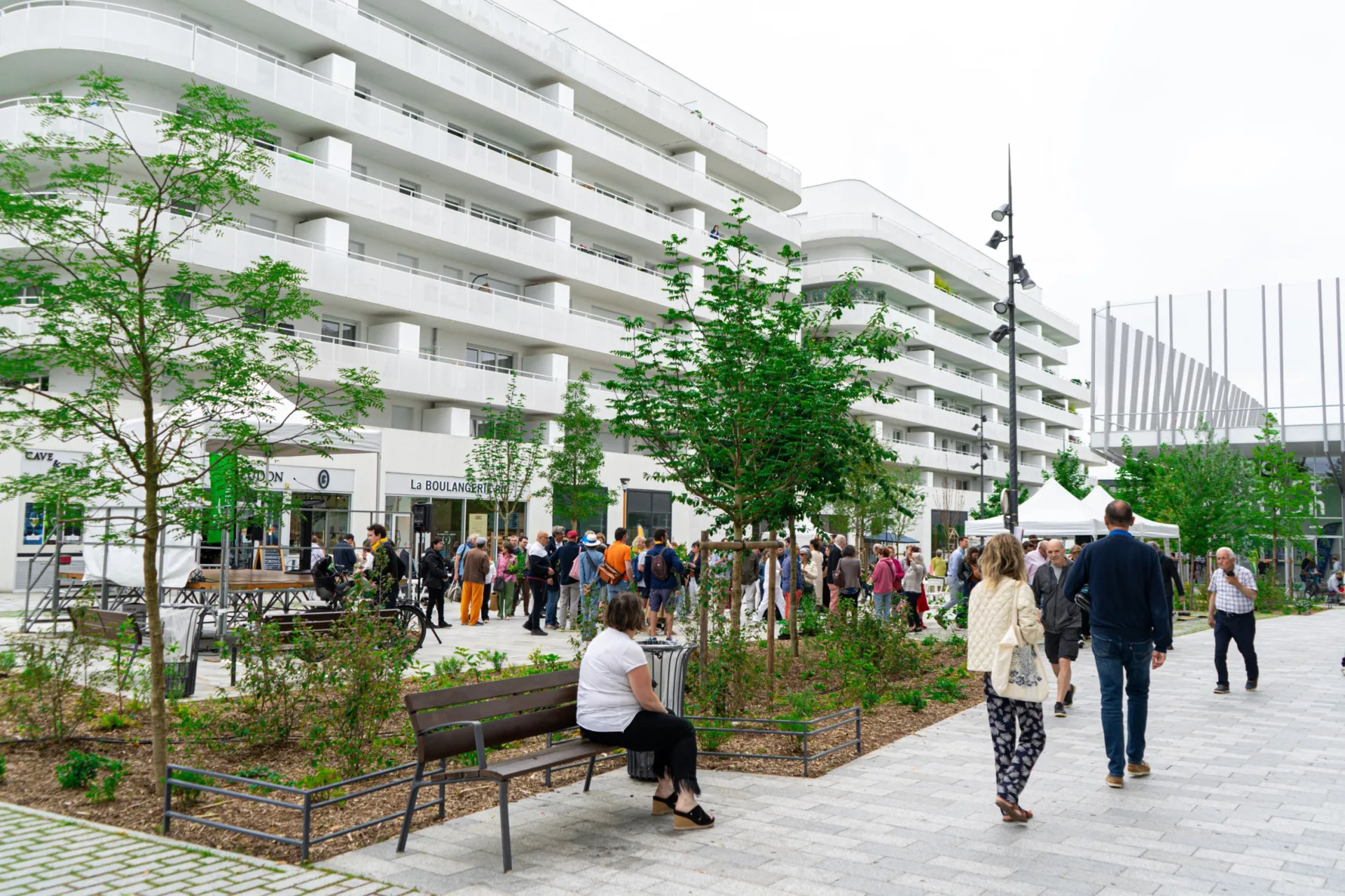
The town organized public meetings to present the simulation results and allow residents to explore the findings firsthand.
“This helped residents and local shopkeepers understand what changes were coming and why,” Larghero said. “We also organized guided tours of the spaces, including an event attended by the French Minister of Ecological Transition and experts from key institutions like the CEO of Météo-France and the director general of the European Critical Raw Materials Board.”
“Meudon’s example shows that, in the face of climate change, we have the means to rethink how we develop our towns and cities,” said Agnès Pannier-Runacher, Minister of Ecological Transition, during the visit. “These decision-making tools help us make better choices.”
The technology is also proving invaluable for preserving and sharing knowledge and planning for future emergencies, including complex crisis scenarios such as evacuating the local RER C tunnel – a major commuter rail line to Paris that runs underneath part of Meudon. Using the virtual twin, local teams will be able to simulate different situations in detail, visualize evacuation routes, and test how people, vehicles and first responders would move through the area under various conditions.
“As our urban spaces evolve with new buildings, traffic changes and flood zones, virtual twins let us simulate and prepare for different scenarios,” Larghero said. “That’s especially important for crisis management. It took nearly three years to prepare a full-scale emergency exercise for the RER C tunnel, involving 300 people and hundreds of vehicles. In future, with a virtual twin, we can replay the exercise, update it virtually and share our insights with all the relevant teams such as firefighters, police and the Red Cross. We’ve also started thinking ahead about how virtual twins could help us model flood risks, especially given our proximity to the Seine.”
Meudon’s experience is a great demonstration of the power of virtual twins and proves the technology isn’t just for large enterprises or major cities; it is also a valuable shared tool for engineers, urban planners and even gardeners, helping everyone make smarter, more sustainable choices for their community.
Looking ahead, Meudon plans to build on its virtual twin by integrating new layers such as biodiversity, energy consumption, water management and mobility flows. Each addition will make the town model even more useful for day-to-day decision-making. The town is also encouraging neighboring municipalities to adopt similar approaches.
“Whether you’re dealing with heat islands, flooding, or noise pollution, virtual twins can help,” Larghero concluded. “All these issues affect entire regions, so it’s important to collaborate at the intercommunal level. In Meudon, we’re already thinking about the next iterations, because issues like air quality and flooding require ongoing adaptation. Our team has really embraced the project and continues to work closely with Dassault Systèmes on next steps. We share a vision of how this technology can transform decision-making and shape the sustainable and resilient towns and cities of tomorrow. Together, we’re imagining the future.”

Meudon is a town of 47,000 residents and a recognized hub for technical and scientific innovation within the Greater Paris metropolitan area. Major institutions such as CNRS (National Center for Scientific Research), the Observatory and ONERA (the French Aerospace Lab) are based in Meudon, alongside global leaders including Esri, Bouygues Telecom, Thales, HP France, Dassault Systèmes and Equinix. Meudon Town Hall employs 850 people in more than 100 professions and is actively engaged in ambitious modernization and transformation initiatives.
For more information: http://meudon.fr
Design and Deliver sustainable living environment and public services to citizens.
Industry
Digitize public organizations to deliver optimized public policy for a sustainable society.
Market Segment
University of Moncton uses Virtual Twins for smart city planning in Moncton and Dieppe, balancing density, housing and biodiversity.
Customer Story
As part of its smart city blueprint, Hong Kong, China government wanted to establish a Common Spatial Data Infrastructure (CSDI). Arup and Dassault Systèmes jointly proposed the 3DEXPERIENCE platform as the foundation of the CSDI to Hong Kong, China’s planning department to optimize smart city operation and management.
Customer Story
Rennes Métropole chooses the 3DEXPERIENCE platform to implement 3DEXPERIENCity Virtual Rennes, a collaborative solution based on the cloud.
Customer Story
The government of Singapore uses Dassault Systèmes’ smart city offer called 3DEXPERIENCity to create a dynamic, 3D digital model of the city and connect all stakeholders in a secure, controlled environment.
Customer Story
Running airflow simulations in the virtual world to prevent virus transmission.
Customer Story