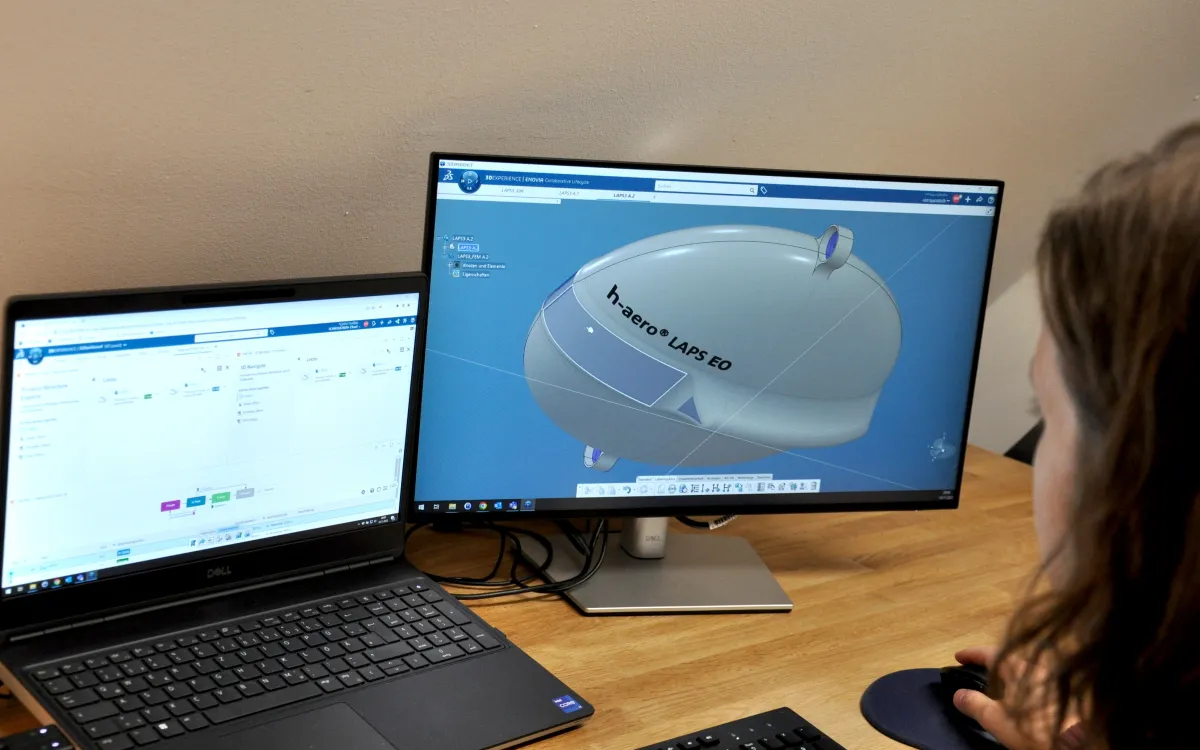
At first glance, h-aero looks like a large, elliptical balloon. In fact, it’s a combination of three separate flight concepts – a balloon, helicopter and airplane – drawing from each of their unique advantages to create a lightweight aircraft that delivers speed, endurance and agility.
“If we want to keep flying, we need to do so with regenerative energies, so we’ve found a way to combine the three flight concepts in a new way, using helium for static lift and buoyancy, yet staying as agile as a helicopter or plane,” Singer explained. “What’s more, h-aero can be equipped with solar panels on the hull for autonomous, non-stop flight. Our aim is to be a better alternative to manned surveillance systems and satellites, bringing down costs by an order of magnitude while only using renewable energy.”
Made from fiber composites, canvas and high-density foils, h-aero is defined by its ultra-lightweight construction. It is recognized as one of the smallest payload-carrying balloons, capable of bearing all manner of equipment, targeting a weight of up to 10 kilograms.
“Imagine being able to remotely monitor any place on Earth from the stratosphere around the clock and carry out drought damage measurement and air quality monitoring or support a new era of lower cost and widely accessible internet and communication without burning fuel or creating space debris,” Singer said. “That’s a future we see with h-aero. The advantages of our solution are numerous, including unlimited hours of flight time, reduced noise, increased safety and global access – all with a vastly reduced environmental footprint.”
As Singer works on bringing his vision to life, he and the Hybrid Airplane Technologies team needed to bring in more sophisticated CAD functionality as well as the ability to work from a common environment for seamless data sharing and collaboration. Singer found the 3DEXPERIENCE Cloud platform a perfect fit.